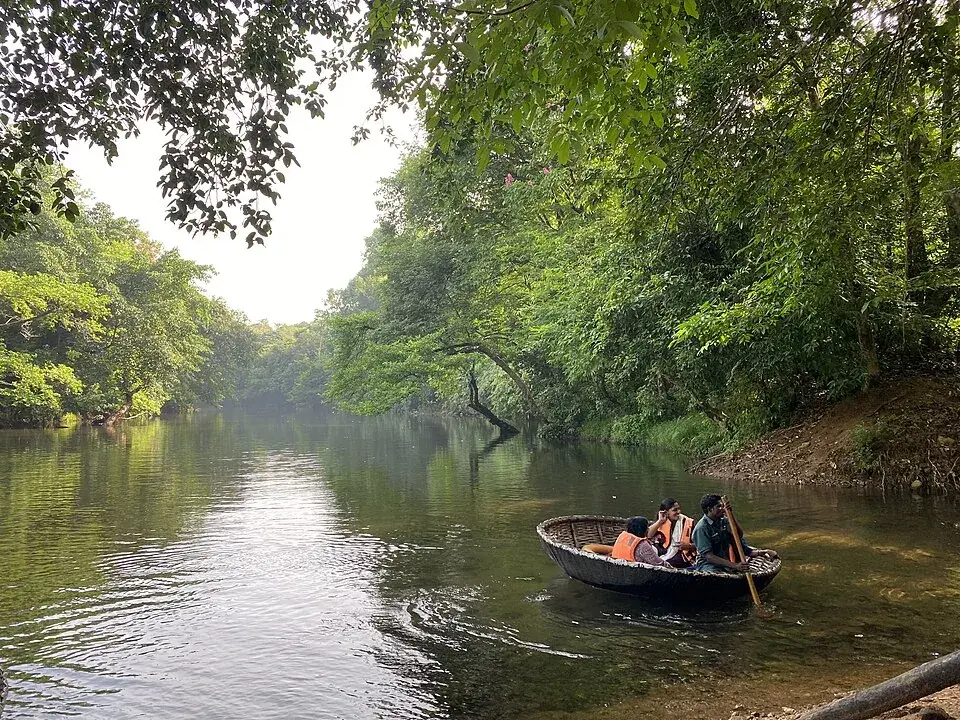
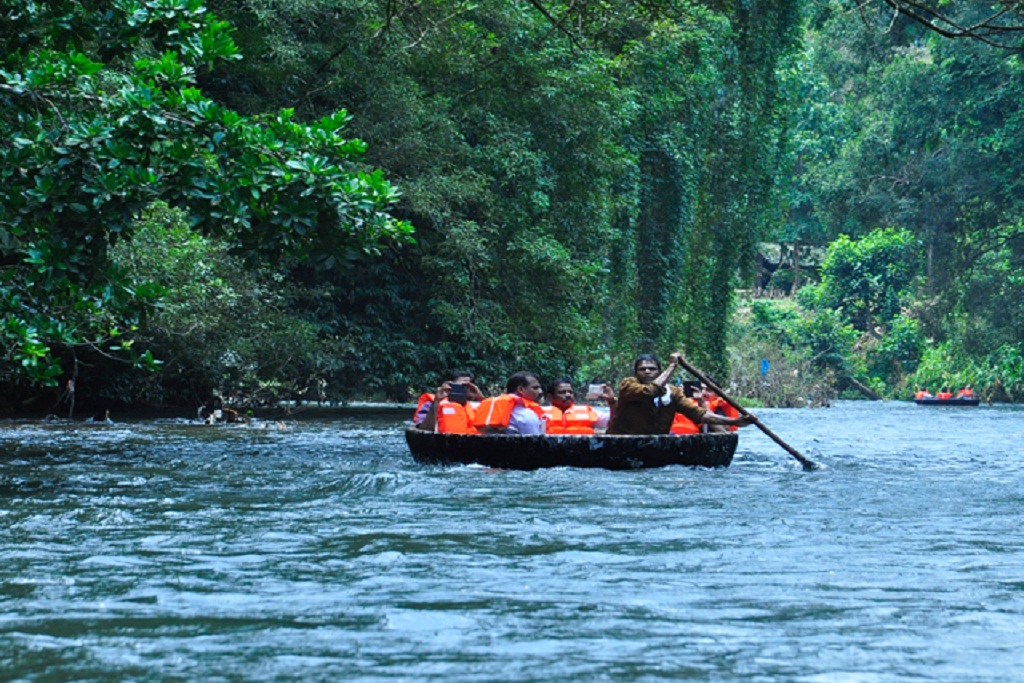
Adavi is a river experience before it is a trek. The official programme puts visitors into round woven coracles on a broadened reach of the Kallar, where the water moves beneath overhanging forest a short drive from Konni.
The story of Konni Adavi trek
The word “trek” in the page title can send a visitor looking for a trailhead that does not exist. Kerala Tourism describes Adavi through bowl-boat or coracle riding on a five-kilometre stretch broadened by the Kallar River. The named map point is the ecotourism base on the Konni–Thannithodu road; it is where a managed visit begins, not a promise that every bank is open for walking.
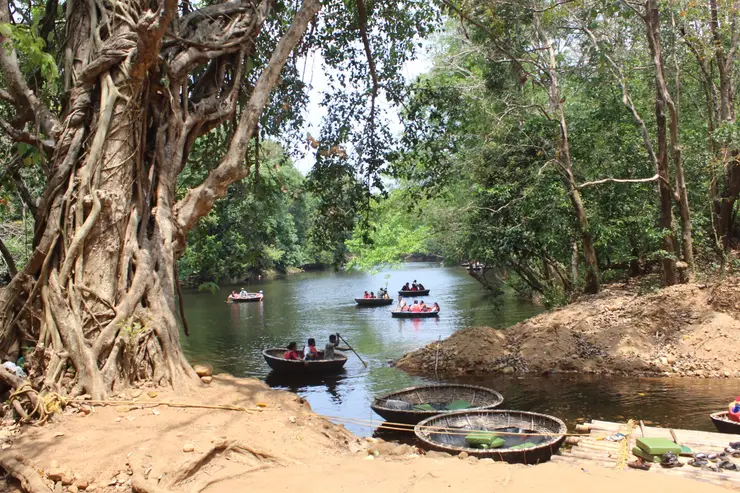
The first thing to notice is the boat itself. A coracle is a shallow circular craft, its woven shell giving no bow or stern to point downriver. The operator supplies direction with a paddle while passengers sit low around the rim. That geometry makes even a calm reach feel different from a conventional ferry: the view turns with the basket, and forest, reflection and bank exchange places.
Adavi’s broad water is held visually between dense banks. Branches lean over the reach, roots show at the landing and the canopy breaks the sun into moving patches. In the strongest photographs the river does not look like a corridor cut through forest; it looks as if the forest has briefly opened enough water to carry a boat.
The landing is practical rather than theatrical. Coracles wait at the earth bank, paddles lie across their woven interiors and riders step down close to exposed roots. This is why footwear and balance matter even though the ride itself is seated. The risky moment is often boarding or leaving the round craft, not travelling across the calm centre of the reach.
Kerala Tourism publishes two coracle products, a short ride and a long ride, with different group capacities and tariffs. Those are operator categories, not distances a visitor should infer from the five-kilometre river description. Ask which ride is running, how many people the craft will carry and what the day’s water level allows before paying.
The official page calls the monsoon the best time because the Kallar is full and the vegetation intensely green. That recommendation needs to be read beside its own disclaimer: every ecotourism package can change with climate and other conditions. Fuller water can make the landscape richer while also making the operator more cautious. “Best” never overrides a suspension.
A dry-season visit tells another story. More bank and root may show, light reaches farther into the trees and boarding ground can be easier. The river may feel less dramatic but more legible. Neither season guarantees the same line or duration; this is a working forest-and-river operation rather than a fixed amusement ride.
The soundscape is unusually important. A coracle has no engine, so paddle strokes, birds, insects and voices travel across the water. Keeping conversation low is not only etiquette. It is the way the ride preserves its character and lets the shaded river feel separate from the road that delivered everyone to the counter.
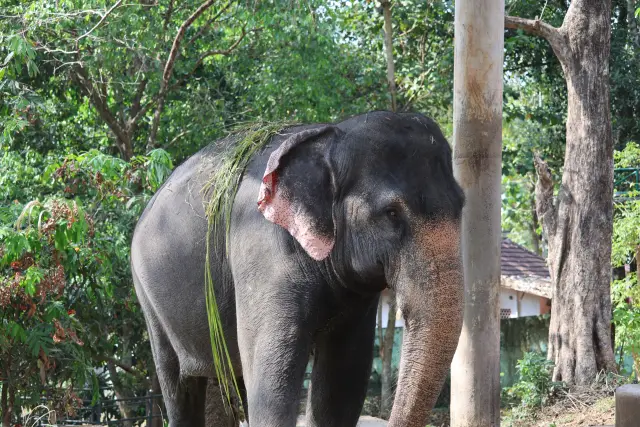
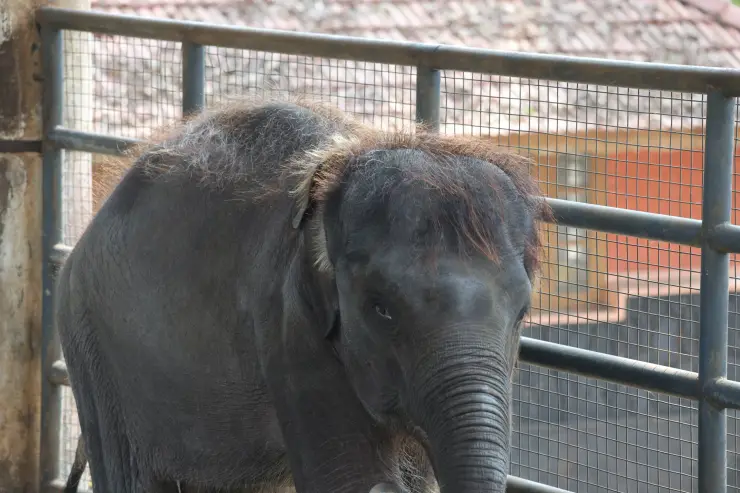
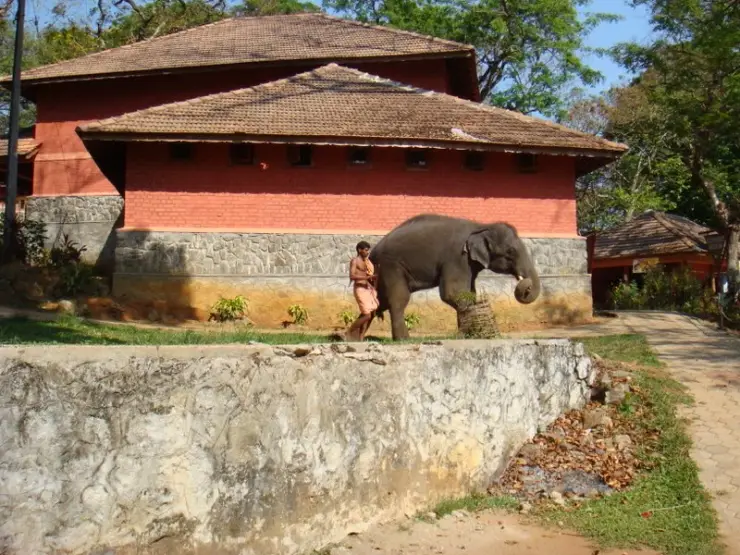
Adavi sits within the larger Konni forest story, but it is not the elephant kraal. The kraal is a separate historical site nearer Konni and its access must be checked independently. Combining the two in a day can make geographical sense; treating one ticket, opening status or safety condition as evidence for the other does not.
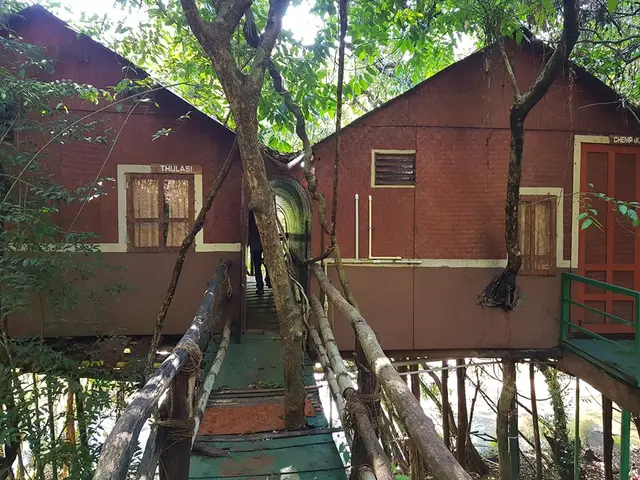
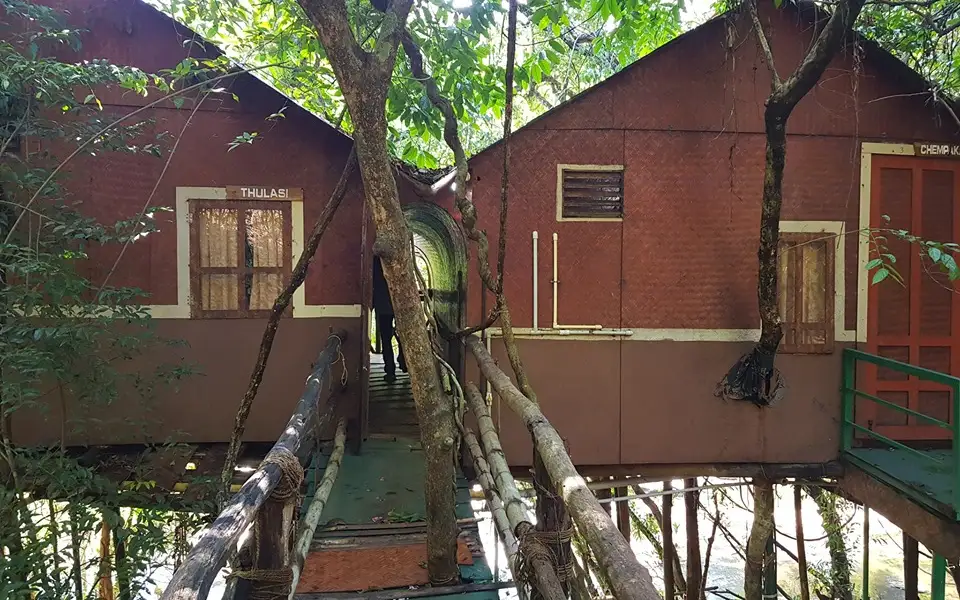
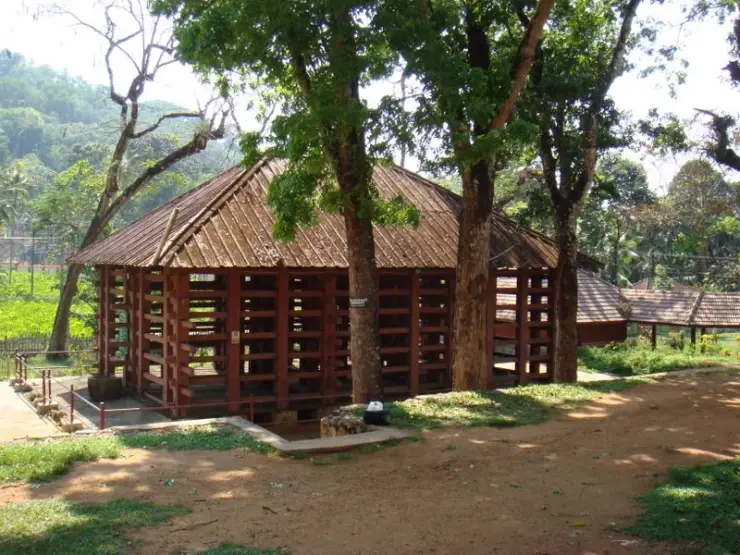
The tree-top bamboo huts are another separate product. Kerala Tourism describes an overnight package with food for a single hut. Their raised rooms and bamboo approaches belong to the same forest base, yet a hut booking is not included in a coracle ticket. Ask about current condition, meals, check-in and night access rather than assuming the photograph describes what is available today.
The longest programme attached to Adavi leaves the river entirely: an official full-day bus tour to Gavi. Its route passes the Moozhiyar, Kakki and Anathodu dam landscapes, reaches Kochu Pamba and returns through plantation towns. That is a road journey with arranged lunch, not an extension of the coracle ride and not a short add-on after arriving late.
These distinct products explain the value of precise language. “Konni–Adavi package” can mean the forest office’s family of activities, while a visitor may mean only the bowl boat. Name the coracle ride, bamboo hut or Gavi bus when contacting the office. Precision prevents a day-trip expectation from being attached to an overnight stay or a thirteen-hour road circuit.
The Divisional Forest Office at Konni is the operating contact published by Kerala Tourism. This matters because river conditions, forest rules and equipment availability can change faster than a static travel article. A confirmation is part of the trip, not administrative decoration. It establishes which programme is running and where staff expect the group.
Once aboard, resist turning the ride into a wildlife chase. The Kallar corridor is habitat, but no official itinerary promises a particular animal. The dependable subjects are the river’s surface, canopy layers, flowering bank vegetation and the human scale of a paddle-powered boat. A quiet passage remains complete without a headline sighting.
Photography works best when it respects the craft. Secure the camera before boarding, remain seated and do not ask the operator to create instability for an angle. The circular rim, paddle and reflections already describe the experience. A dropped phone is a small problem compared with a group shifting suddenly in a shallow woven boat.
Adavi is close enough to Konni for a half-day forest outing, but its controlled format prevents casual wandering. Unsigned banks can be slippery, privately used or ecologically sensitive. The honest boundary is simple: use the authorised landing and operator, follow the ride selected, and do not turn a short managed visit into an unapproved forest walk.
Read the five-kilometre figure carefully. It describes the broadened river setting named by Kerala Tourism, not a guarantee that every booking travels five kilometres or that the public may follow that distance along the bank. The short and long rides are the usable visitor choices. Their actual course belongs to the operator because water depth, current, loading and the condition of the landing all affect what can run safely.
That distinction also changes how the landscape is read. A footpath announces itself through tread, gradient and junctions; a river route can look open while still hiding shallow stones, submerged wood or a stronger line of current. Passengers do not need to interpret those hazards independently. They need to let the trained paddler choose the line and to avoid treating a placid photograph as proof of today’s conditions.
The coracles waiting on shore explain the programme’s capacity better than any promotional adjective. Each is small, and boarding happens one group at a time. On a busy day the visit can include a queue even though the ride itself is brief. Arriving earlier in the operating window leaves more room for staff instructions and weather changes; it does not create a right to a departure when the river has been judged unsuitable.
The round craft also rearranges the social experience. In a conventional boat, passengers tend to face forward and watch a destination approach. Here people sit around a shared centre, see one another as well as the banks, and may turn through the scene as the operator corrects the boat. The ride is less about reaching a landmark than about occupying the river for a controlled interval.
Families should make decisions from the landing, not from the easy difficulty label alone. A seated ride can still be awkward for someone who cannot step down to a low moving rim, remain stable without a backrest or rise from the same position at the end. The access note on this page describes those physical transitions so a group can ask the office a precise question before travelling.
The forest edge has two scales. At water level, roots, leaf litter and low branches dominate the frame; looking upward reveals taller crowns and small gaps of sky. Bird photographs from Konni help describe the wider habitat, but they should not be converted into a checklist for one short ride. The honest pleasure is learning to notice movement and calls without making the operator pursue them.
This restraint is part of the ecotourism bargain. Visitors receive a close, quiet encounter with a forest river, while access remains concentrated at a staffed base and within a small craft. The result is narrower than an open trail network but more specific: one landing, one traditional boat form, one paddler and a reach of Kallar that changes visibly with rain and light.
It also makes the return worth watching. Details that passed quickly on the outward movement—a leaning trunk, a bright crown, a pocket of reflected sky—often read differently from the opposite side of a turning coracle. There is no need to demand a longer route merely to collect more scenery. Attention can make the same short reach feel newly composed on the way back.
The river’s reflections are useful evidence of changing light, not of depth. A dark green surface can be shallow beneath shade, while a bright patch can be deeper and simply holding the sky. Visitors should avoid reading safety from colour or stillness. The operator has the local knowledge and the paddle; passengers have the simpler responsibility to keep their weight settled and follow instructions.
Rain changes more than the amount of water. It darkens the exposed bank, makes roots slick, softens the boundary between river and foliage and can reduce the time in which staff can load a group comfortably. A shower may enrich the scene without ending the programme, or conditions upstream may stop departures even when the landing itself looks quiet. The decision is operational, not photographic.
On clearer days, the strongest contrast is between the open strip of water and the layered wall of vegetation beside it. The coracle keeps riders close enough to see leaves and roots as individual forms, then lets the same bank merge into canopy when the craft moves away. That alternating intimacy and distance is Adavi’s real sequence; it does not require invented waypoints or named viewpoints.
The stored boats tell a second story after the ride. Turned upside down, they reveal broad circular shells rather than the familiar long outline of a canoe. Moored upright, their dark interiors and crossed paddles show how little machinery the experience needs. Seeing both states helps explain why this is a managed craft operation: the boats are handled, checked, launched and returned by people at the base.
A visitor writing about Adavi afterwards should keep those boundaries intact. Say that the coracle travelled on the Kallar at Adavi, not that it explored all five kilometres; say that birds occur in the Konni landscape, not that a short ride guarantees them; say that Gavi is reached by a separate scheduled bus product, not that it is the end of the boat route. Exact language preserves what made the place distinctive.
This precision is especially important online, where “trek”, “rafting”, “safari” and “boating” are often exchanged as search terms. At Adavi the visible object settles the question: a round paddle-driven coracle carrying a small group on a controlled forest reach. Calling it that is not underselling the visit. It gives travellers the experience they can actually arrive and ask for.
A useful itinerary therefore gives Adavi room without inflating it. Do the river programme as its own experience, pause after landing, and only add another Konni activity when its opening status has been confirmed separately. The Gavi bus deserves a whole day; the bamboo huts deserve an overnight plan; the elephant-kraal compound cannot be assumed open merely because Adavi is operating.
The best final image of Adavi is therefore not a summit or endpoint. It is the moment the coracle rounds slowly under trees and the landing disappears behind a bend. The experience measures distance by changing reflections and paddle strokes. That is why the river, not the label “trek”, should organise the visit.