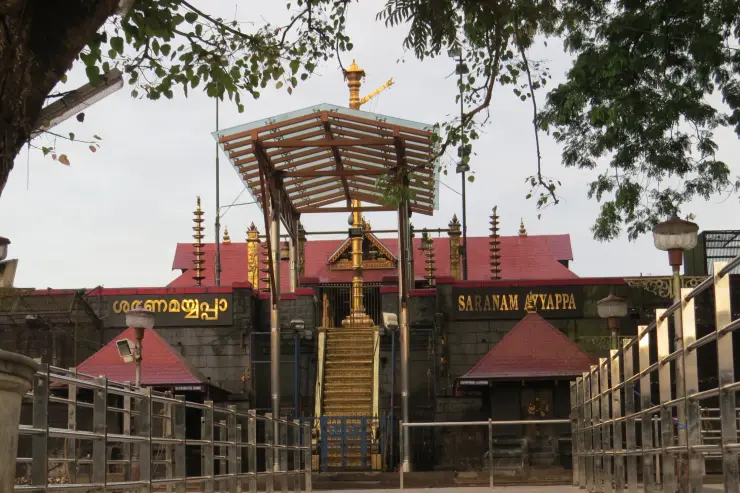
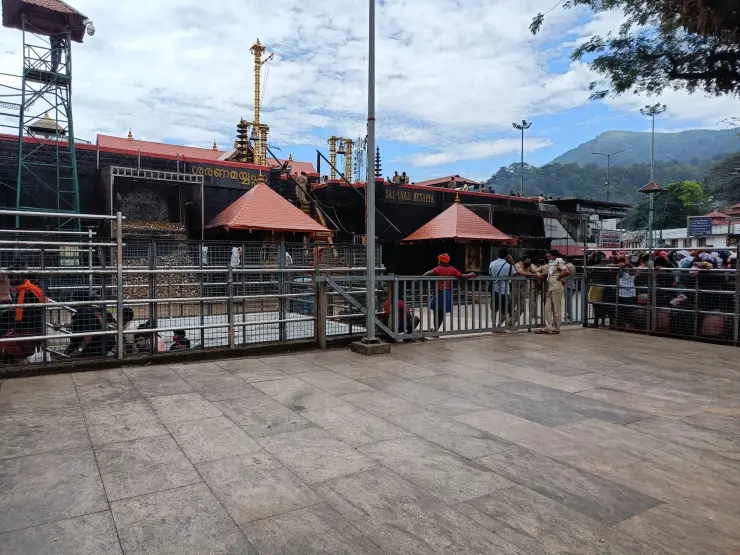
Pathanamthitta is a small hill-edge municipality of 23.5 square kilometres and about 37,500 people that carries an administrative load out of all proportion to its size. It is the headquarters of Kerala’s thirteenth revenue district, created on 1 November 1982 out of villages taken from Quilon, Alleppey and Idukki, and it is the civil base for a pilgrimage season that brings an estimated three to four million people into the district every winter. It is also the capital of the most Christian district in Kerala — 38 per cent of the population, with cathedrals, seminaries and two of the largest religious gatherings in Asia within half an hour’s drive. And it is the capital of a district that is emptying: Pathanamthitta is one of only two Kerala districts whose population fell between 2001 and 2011.
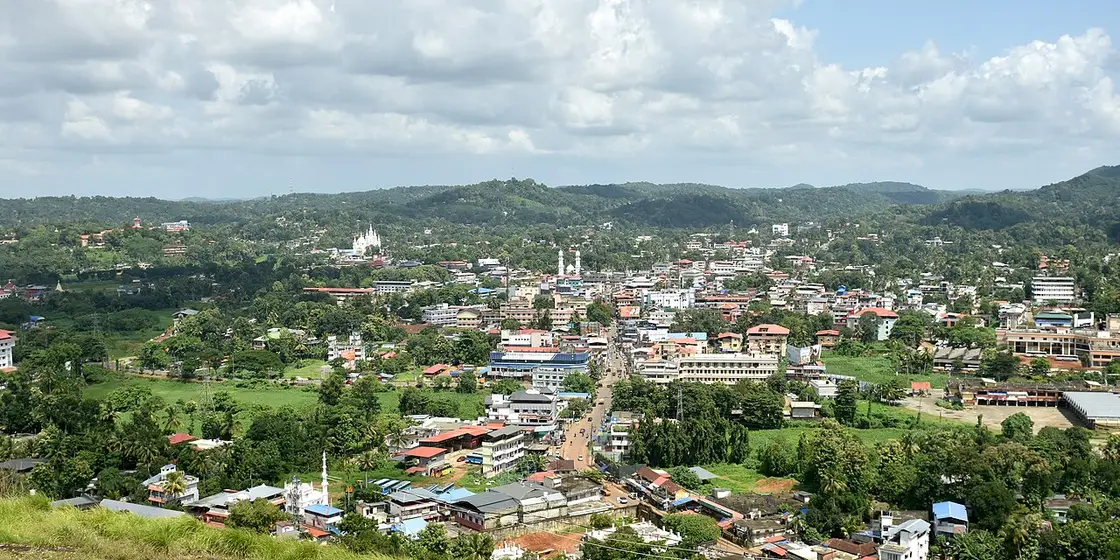
The town sits in the low foothills where the rice country of central Travancore starts folding upward toward the Western Ghats. Its recorded elevation is a modest 31 metres, but that figure flatters the ground: from the ridge above the town you look across a bowl of wooded hillocks with the bazaar strung along the valley floor, and in a single frame you can pick out a white church spire on one slope, the minarets of the town mosque in the middle distance, and a temple roof among the palms. The municipality covers 23.5 square kilometres in 32 wards, sits inside Kozhencherry taluk, and recorded 37,538 people at the 2011 census. It is bounded by the Malayalappuzha panchayat to the north, Mylapra to the east, Pramadom and Omallur to the south and Elanthoor to the west.
Almost everything the town does, it does because it is the district headquarters. The Collectorate, the district courts, the Devaswom and forest offices, the district police chief and the seasonal control rooms are all here, and they are the reason a town of thirty-seven thousand has the bank branches, hospitals, hotels and printing presses of somewhere much larger. Pathanamthitta became a municipality in 1978, four years before it became a district capital, which is a useful thing to know: the town was not built for the job it now does. It was given it.
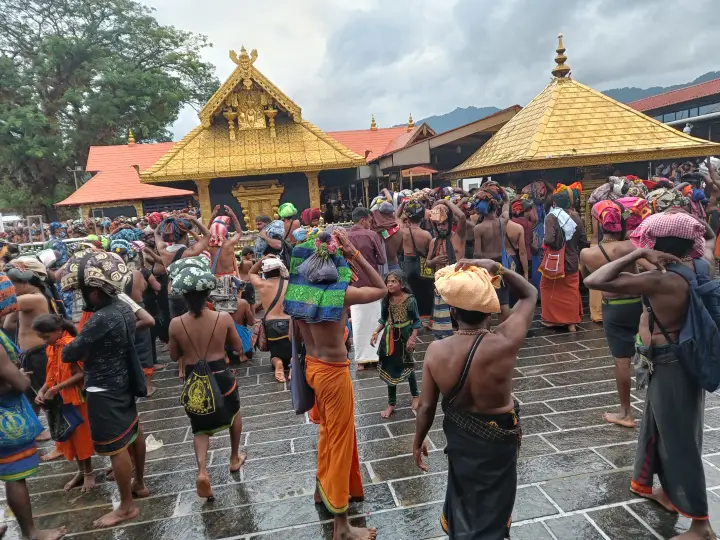
The job, above all, is the Sabarimala season. The English Wikipedia article on the district puts the seasonal inflow at an estimated three to four million pilgrims, and the whole rhythm of the town from mid-November to mid-January is set by that number. Pathanamthitta is the last town on the approach where everything still works normally — where a pilgrim can draw cash, find a chemist, get a vehicle repaired, sleep in a bed rather than a hall. The lodges fill, the eating houses run extended hours, the taxi and jeep operators re-price, and the district administration runs the season from offices in the town rather than from the forest.
The forest apparatus itself is not here, and we do not describe it on this page — the vehicle base at Nilakkal, the road-head and bathing ghats at Pamba, and the walk beyond them belong to our Sabarimala and Pamba record. What belongs to Pathanamthitta is the civil side: the co-ordination, the medical and police deployment planned from the district headquarters, and the fact that management of the shrine sits with the Travancore Devaswom Board, a statutory body constituted under the Travancore–Cochin Hindu Religious Institutions Act XV of 1950. Crowd control is now an active legal matter rather than a matter of custom: as of November 2025 the Board was operating a cap on daily entry following an order of the Kerala High Court, so anyone planning a season visit should check the current position rather than assume it.
The town is a road town and nothing else, which is unusual for a Kerala district capital. It stands where State Highway 7 — the T.K. Road, the old route that carried hill produce down to Alappuzha — crosses the Main Eastern Highway, State Highway 8. There is no railway station: the nearest railheads are Chengannur at about 24 kilometres, Thiruvalla at about 30 and Mavelikara at about 32.5, and only Thiruvalla is inside the district. The nearest airports are Thiruvananthapuram at roughly 113 kilometres and Kochi at roughly 142. A Sabari International Airport at Cheruvally, about 28 kilometres away, has been proposed for years and is not built. So the bus stands do the work that a station would do elsewhere: the KSRTC station and a separate, large private bus stand, both of which run hard through the season.
The second thing Pathanamthitta is the capital of is Christian Kerala. At the 2011 census the district was 56.93 per cent Hindu, 38.12 per cent Christian and 4.60 per cent Muslim — a Christian share matched by very few districts in the state — and the institutional density that goes with it is unusual. St Peter’s in the town is the cathedral of the Syro-Malankara Catholic Eparchy of Pathanamthitta, erected by Pope Benedict XVI on 25 January 2010 and running to about 100 parishes by 2021. The Malankara Orthodox Syrian Church’s Thumpamon diocese, one of its largest, is based in the district. The Mar Thoma Church, the reformed wing of the same ancient Syrian tradition, has its heartland a short drive north. Catholicate College, founded in 1952 and affiliated to Mahatma Gandhi University, and the Catholic High School of 1931 are among the town’s oldest institutions.
Thirty-odd kilometres away, that density produces something genuinely remarkable. Each February, on the dry sand-bed of the Pamba beside the Kozhencherry bridge at Maramon, the Mar Thoma Evangelistic Association pitches a single vast shed on the riverbed for the Maramon Convention, held there since 1895 and widely described as the largest Christian gathering in Asia. The scale is not folklore: the main pandal is documented as seating in excess of 160,000 people on the sand, and the first convention, held from 8 to 17 March 1895, already drew ten to fifteen thousand a day and about twenty-five thousand on its closing day. The Association that runs it was formed by twelve members on 5 September 1888. The 2023 meeting was the 128th. One detail is worth keeping because it is so odd: accounts of the convention record that no police presence is required, order being kept by priests and elders.
What is less well known outside Kerala is that the same riverbed hosts a Hindu counterpart. A few kilometres upstream at Ayiroor–Cherukole, the Cherukolpuzha Hindumatha Parishath — the Cherukolpuzha Hindu Matha Maha Mandalam — has been held on the dry Pamba bed every February since 1912, founded by Swami Theerthapada Paramahamsa, a follower of Chattampi Swamikal, and it runs for roughly a week. Two mass conventions of two different faiths, on the same river sand, in the same month, seventeen years apart in their founding, is the single most characteristic fact about this stretch of Pathanamthitta, and it is not a coincidence: both grew out of the reform-and-revival ferment that ran through Travancore either side of 1900.
The last thing to understand about Pathanamthitta is that it is the capital of a district that is losing people. Between 2001 and 2011 the district’s population fell from 1,234,016 to 1,197,412 — the district administration and the census both publish the decadal rate as −3.12 per cent — and only one other Kerala district, Idukki, recorded a fall at all. The sex ratio, at about 1,130 women per 1,000 men, is among the highest in the state, and literacy at around 96.6 to 96.9 per cent is at or near the top. Those three numbers describe the same thing: sustained emigration, overwhelmingly male and overwhelmingly young, to the Gulf and to the West. At Kumbanad, in the north of the district, bank deposits across the Kumbanad–Thiruvalla belt were put at around ₹5,400 crore as far back as 2009, and the BBC reported from the same town in 2023 on what happens to a place when its young people leave and its remittances stay: a market in nursing homes, hospitals and elder services, and streets of large houses with nobody in them.
For the traveller, that mixture is the interest of the place. Pathanamthitta is not a sight. It is a working headquarters town in river-and-forest country, a base from which the Achankovil valley, the Konni forests, the Pamba temple-and-church towns and the road east toward Gavi are all within an easy morning — and, for a few weeks each winter, one of the busiest logistical towns in south India.
Legend & myth
Pathanamthitta town’s own body of legend is smaller than the district’s, and it is important to say why: the great stories of this district belong to specific places, and each of those places has its own page here. The Manikandan and Pandalam foster-son legend, the eighteen steps and Makaravilakku are Sabarimala’s. The route cycle — Vavar’s mosque at Erumely, the pebble carried up from the Azhutha, Karimala, Neelimala, Sabaripeedam, the arrow planted at Saramkuthi — belongs to the approach, and we tell it on our Sabarimala and Pamba record. The Bhadrakali of Malayalappuzha, her katusarkarayogam idol and the Raktha Pushpanjali sought against curses and the evil eye have their own story page. None of them is retold here. What the town itself owns is its name, and a ring of ritual villages inside about ten kilometres whose festivals are the real folk culture of central Travancore.
Start with the name, because it has three competing explanations and no settled answer, and the disagreement is itself the point. The commonest reading splits it as pathanam and thitta — houses, and the raised bank or ledge of a river — giving an array of houses along a riverside, which fits a town in the Achankovil’s basin exactly. A second reading hears patthu inam thitta, the ledge of ten communities, making the name a description of a mixed settlement rather than a mixed landscape. A third is a piece of local tradition rather than philology: that a Pathan trader was granted land here in the reign of Dharma Raja, that the place was called Pathanithitta after him, and that it wore down into Pathanamthitta. We print all three. The Malayalam Wikipedia gives the first as the commonest, and none of the three is documented in a way that settles it.
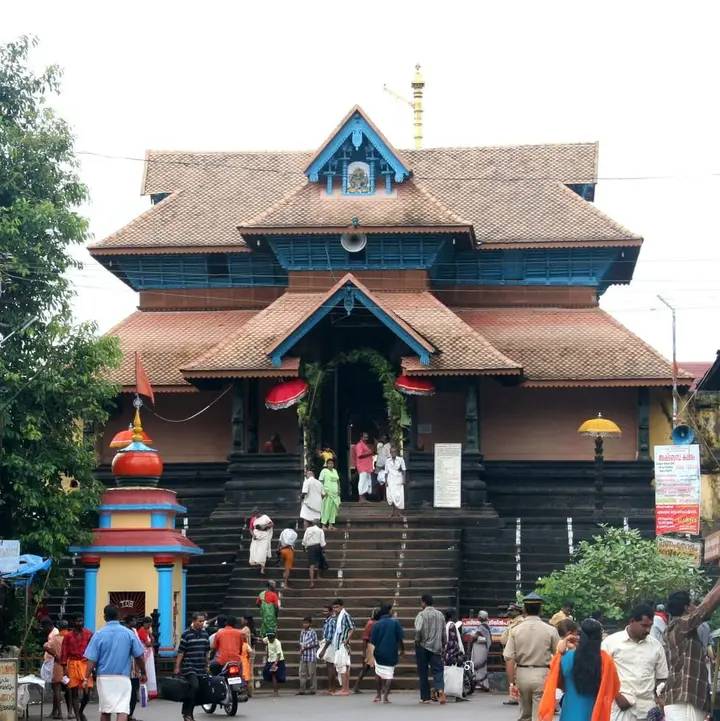
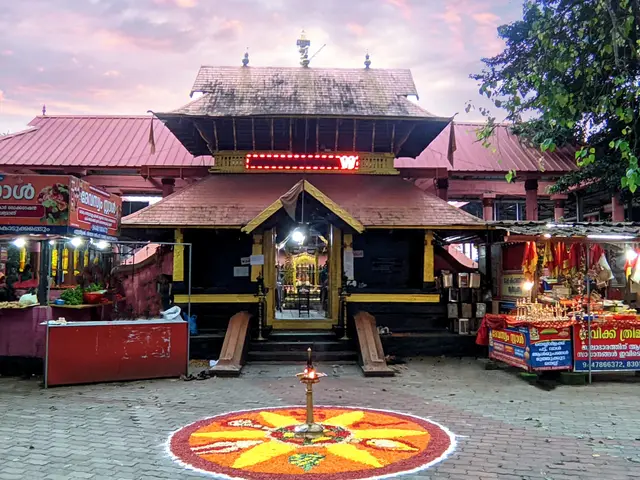
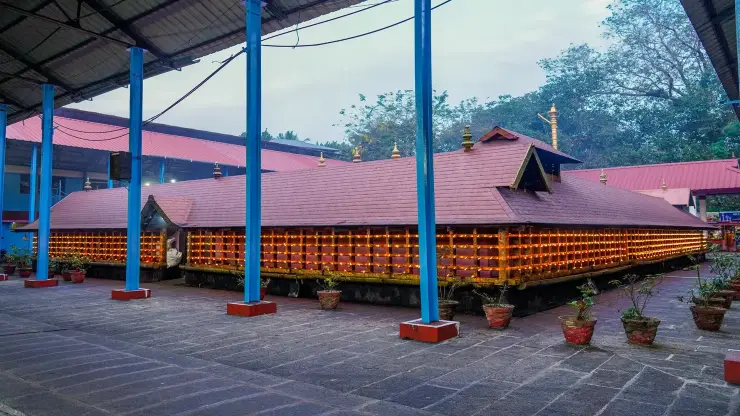
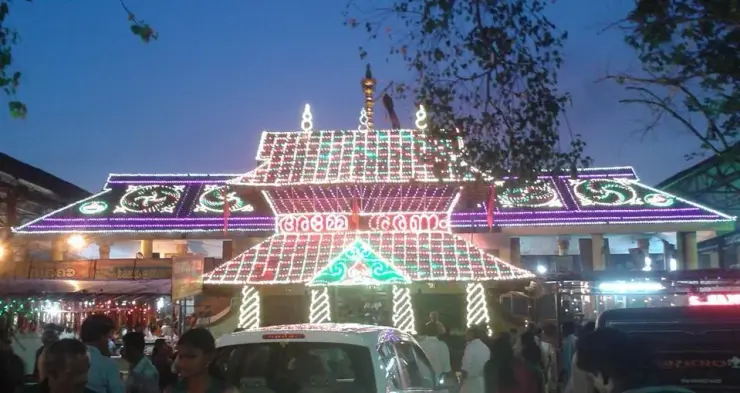
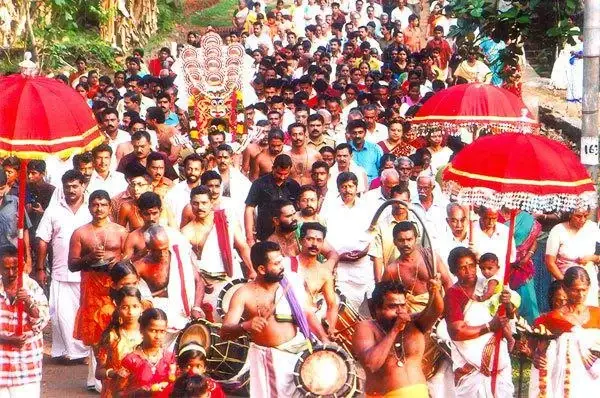
Six kilometres from the town is Kadammanitta, and Kadammanitta is where the district’s folk religion is at its most concentrated. The Bhagavathi temple there holds a ten-day Padayani each year in the Malayalam month of Medam, which falls across April, and it is regarded as the culmination of the Padayani season in central Travancore. The pattern of the ten days is fixed: the deity is invoked on the second day, the processions begin on the third, and the climax comes on the seventh and eighth nights. What arrives on those nights is not a stage performance. It is a vow being discharged, in a temple courtyard, in front of people who have watched their relatives do it.
The origin story behind Padayani is a Kali story, and it is a gentler one than most. After Bhadrakali had killed the demon Darika, the legend runs, her rage did not subside with the victory: her own army of goddesses and spirits, terrified by an anger they had never seen in her, broke and fled the field. To calm her, Subrahmanya — in other tellings Shiva — devised an extravagant dance, with elaborate costume and rhythm, and performed it in front of her until she was amused and appeased. Padayani is that dance, repeated. The word itself comes from pata and ani, military ranks or a marshalling of troops, which is what the procession of masked figures is understood to be.
The craft of it is as remarkable as the story. The kolams — the towering masks-and-frames the performers wear — are cut fresh each year from the sheath of the areca palm, painted with natural pigments and fringed with tender coconut leaf, and a major performance is said to consume 1,001 sheaths. They are burned or discarded afterwards; nothing is kept. The percussion is the padayani thappu, a hand-held drum specific to the form, with chenda, para and kumbham alongside it. The kolams that appear at Kadammanitta include Kalan, the form of death; Marutha; Bhairavi; Kanjiramala; the Yakshi forms including Sundara Yakshi; Kuthira, the horse; Pakshi, the bird; and Kurathi and Paradeshi, which carry the satirical and social commentary that is a real part of the form rather than an ornament on it. The season across the region runs from about mid-December to mid-May, at Bhadrakali temples along the Pamba, and Kadammanitta closes it. A Padayani Village with a museum was established there in 2010. The earliest written trace of the practice is far older: the Talakkad inscription of 1024 CE records a tax collected by a village temple council for a Padayani festival.
Three and a half to four kilometres south of the town is Omallur, whose name is itself argued over — either omana nel oor, the place of good rice fields, or omal oor, the beautiful village — and whose Raktakanda Swamy temple is a working pilgrim stop on the Sabarimala approach. The temple is said locally to date from the eighth century, a claim we report as tradition rather than as documented fact, and it keeps a ten-day annual festival. Omallur’s more distinctive event is the Vayal Vanibham, the field fair: an agricultural market held in the fields themselves, where cattle, produce and farm implements are traded. On its timing our sources disagree and we say so plainly — the Malayalam Wikipedia places it in the Malayalam month of Meenam, which corresponds to March and April, while the English article prints Meenam and then glosses it, wrongly, as October. Meenam is March–April; we go with the Malayalam.
Two further claims deserve to be reported rather than asserted. The Malayalam Wikipedia article on the municipality describes a Juma Masjid in the town as 700 years old, which would make it one of the older mosques in this part of Travancore; we could find no primary source for the age and print it as a local claim. And the district is widely credited with being the first polio-free district in India, and was named in a 2014 WHO study as having the cleanest air in India by concentration of dust particles. Both are repeated everywhere and sourced nowhere we could reach, so both are here as attributions and not as our own statements.
More about Pathanamthitta town
History
Before there was a district there was Pandalam. The country around Pathanamthitta lay under the Pandalam royal house, a lineage that traced itself to the Pandya line, and the immediate neighbourhood had its own petty rulers: Omallur, just south of the present town, is recorded as having been held by the Koyikkal Thampurakkal as feudatories of Pandalam. That arrangement ended with Travancore. Marthanda Varma’s expansion swept through this country around 1740–50, and Pandalam itself was formally absorbed into Travancore in 1820, after which the whole area was administered from Thiruvananthapuram.
Pathanamthitta town’s own civic history begins in 1978, when the municipality was constituted across the Pathanamthitta village. It is worth stating in that order, because it is the reverse of what most people assume: the town became a municipality first and a district capital second, and only by four years.
The district was created by G.O. (M.S) No. 1026/82/RD dated 29 October 1982, with effect from 1 November 1982, as the thirteenth revenue district of Kerala. Its own history page sets out exactly what was taken and from where. From Quilon district came 21 villages of Pathanamthitta taluk and 9 of Kunnathur taluk. From Alleppey came 4 villages of Chengannur taluk, 2 of Mavelikkara and 18 of Thiruvalla. From Idukki came the North Pamba valley area and the Sabarimala Sannidhanam region, out of Peerumade taluk. Fifty-four villages in all. Two revenue divisions were formed, Adoor and Thiruvalla, and five taluks were constituted on 9 June 1983 — Thiruvalla, Mallappally, Ranni, Kozhencherry and Adoor — with Thiruvalla itself cut down from eighteen villages to nine so that Mallappally could be made out of the remainder.
Two footnotes to that. First, the district now has six taluks, Konni having been added, and 70 revenue villages, 57 grama panchayats and 9 block panchayats — but the district’s own demography page still prints the older set of five taluks, 53 panchayats and 8 blocks, so the official figures on the official site disagree with each other and a reader should not be surprised by it. Second, the Malayalam Wikipedia article on the district states that its creation was a political favour granted by Chief Minister K. Karunakaran to the MLA K. K. Nair. We could not trace that to any official source, and we repeat it as a claim made there rather than as history.
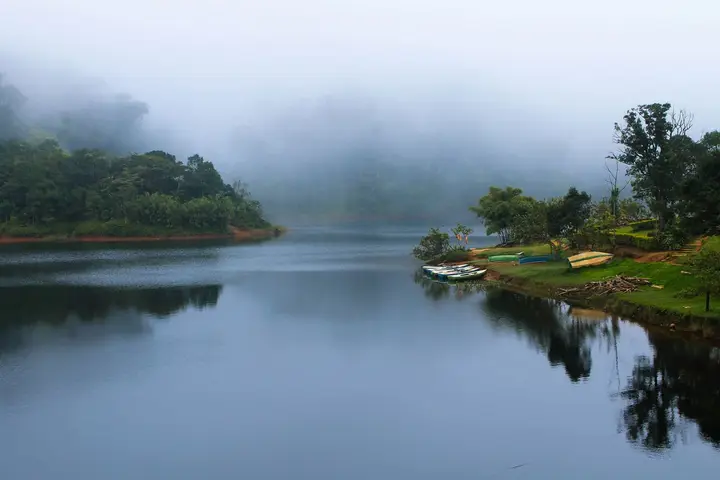
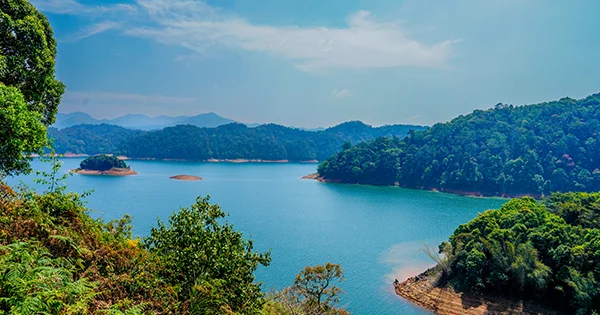
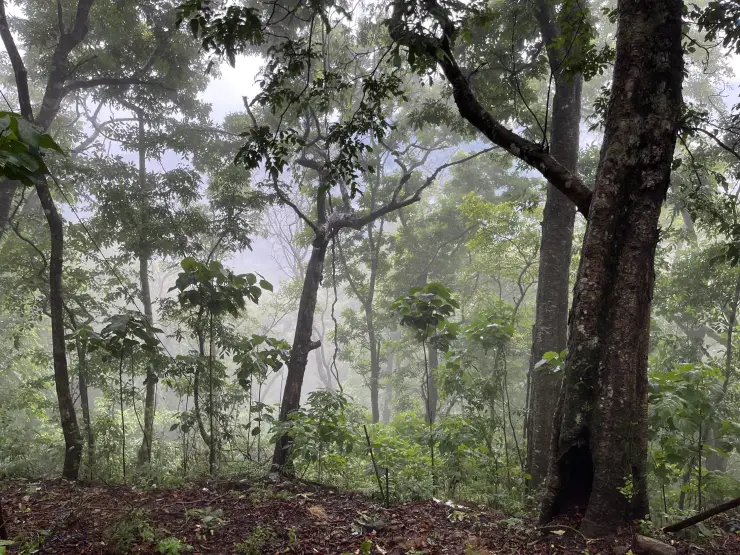
The modern district is defined by water and forest as much as by administration. Three rivers run through it — the Pamba at 176 kilometres, the Achankovil at 128 and the Manimala at 90 — and roughly half the district’s 2,642 square kilometres, some 1,385 square kilometres, is forest. Behind that forest sits the Kakki reservoir, completed in 1966 on a tributary of the Pamba in the Ranni reserve, holding 454.2 million cubic metres at a full reservoir level of 981.45 metres above sea level, with a catchment of 225.33 square kilometres and a water spread of 17.6 square kilometres. It is the district’s water tower and the reason the Pamba below it is a regulated river. We do not repeat the widely circulated claim that the district’s hydro generation supplies a third of Kerala’s power; we could not source it, and the Sabarigiri project it refers to is rated at 340 megawatts.
The district’s institutions grew alongside all this. The Catholic High School dates from 1931 and Catholicate College from 1952; the Syro-Malankara Catholic Eparchy of Pathanamthitta was erected in 2010, giving the town a cathedral to go with its Collectorate. For a district barely forty years old, that is a dense civic inheritance — most of it built before the district existed.
Why visit
It is the most practical base in the district — banks, hospitals, garages, buses and beds, in a place where the countryside around has none of those at scale.
The Christian institutional landscape here has no real parallel in Kerala: a Syro-Malankara cathedral in the town, the Orthodox Thumpamon diocese in the district, and the Mar Thoma heartland half an hour north.
For the Maramon Convention in February, on the Pamba sand-bed at Kozhencherry — a shed on a riverbed seating in excess of 160,000 people, run since 1895.
For the Cherukolpuzha Hindumatha Parishath, the Hindu convention held on the same February riverbed since 1912 — the pairing is the point.
For the Kadammanitta Padayani in April, six kilometres out: ten days of areca-sheath kolams and thappu drumming that close the Padayani season for the whole of central Travancore.
Because it is the civil headquarters of the Sabarimala season, and in December the ordinary business of a small Kerala town is visibly running one of the largest annual pilgrimages on earth.