What to expect
Highlights
- Sea views and sunset at Kollam Beach
- Nearby seafood, cafes or beach walks where available
- Easy pairing with local stays and short day trips
The city’s Mahatma Gandhi beach and park on the Arabian Sea, a popular evening spot near Kollam town.
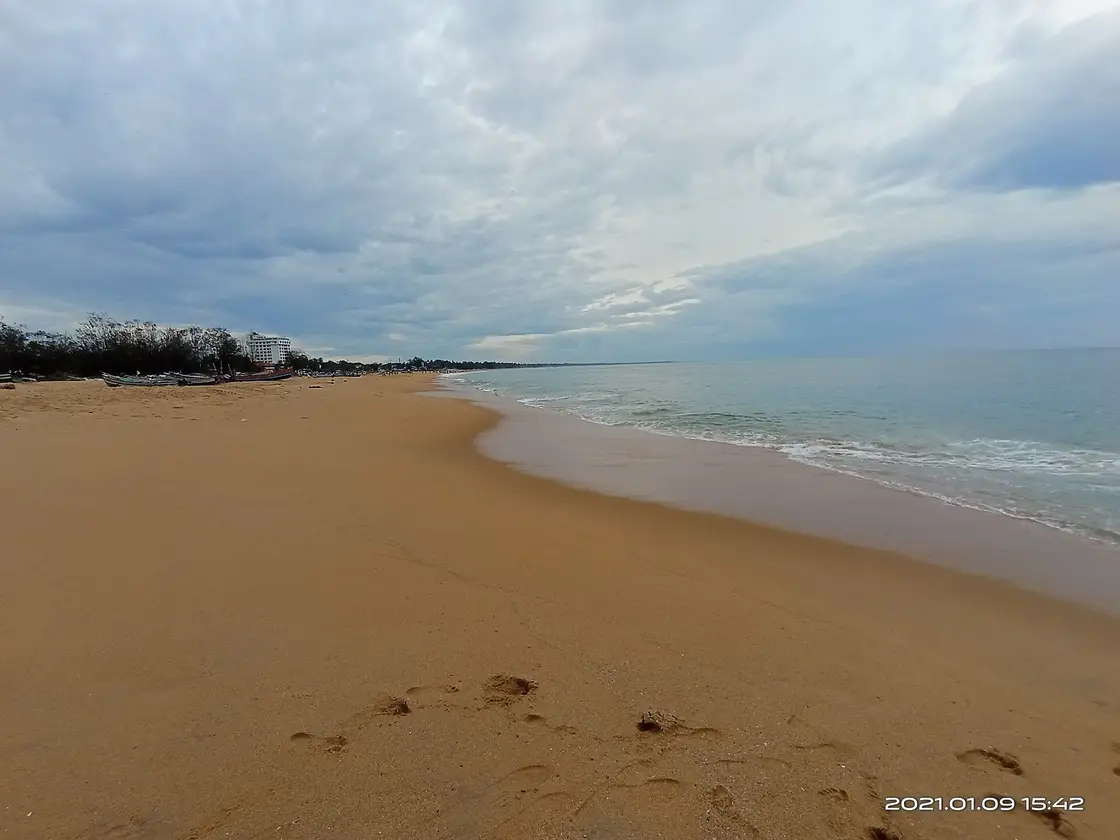
Kollam Beach — widely called Mahatma Gandhi Beach, after the park beside it — is the seafront of the old spice port of Kollam (Quilon), at Kochupilamoodu about two kilometres from Chinnakada. A promenade, a landscaped park, a giant seated mermaid and the sweep of the Arabian Sea meet on the edge of one of Kerala’s most storied trading towns, with a remarkable hinterland of Portuguese and Dutch ruins and an 1902 lighthouse a short walk south at Thangassery. Two things this page will not soften: the sea here is genuinely dangerous, in a way the gentle promenade does not advertise, and the beach itself is disappearing at roughly twenty metres a year.
The first thing you notice at Kollam Beach is the light. In the last hour before dusk the Arabian Sea turns molten, fishing catamarans become dark silhouettes against the glow, and the whole promenade fills with families, courting couples, joggers and knots of friends sharing paper cones of roasted peanuts. This is the town’s living room, an easy walk from the heart of Kollam, and on any given evening it hums with the unhurried sociability that defines Kerala’s coastal towns.
The beach runs about two kilometres, edged by a brick-paved walkway with food carts, ranks of parked two-wheelers and Malayalam hoardings. It used to be about 150 metres wide. It is not any more: reporting from October 2025 describes the shore losing roughly twenty metres of sand a year, with only about six metres of usable beach left in places and the lifeguards’ safety rope pushed back almost to the road. The southern stretch, Vedikkunnu, is going fastest. Nobody agrees on why. The fishermen blame Kollam Port and the Thangassery breakwater for interrupting the sand moving along the coast; oceanographers quoted in the same reporting put it down to monsoon winds and seasonal sea incursion instead. We are not going to settle that here, but you should know the argument is live.
The sea deserves a paragraph of its own, and a blunt one. A warning board at the beach states that fifty-one lives have been lost here in the last ten years; journalists covering the beach think the real figure is above a hundred, and an earlier official framing gave ninety-seven deaths in ten years and fifty-seven in seven. The reason is not surf but depth. This is a steep beach: roughly a metre and a half deep at the very edge, and over three metres just two metres out, with scoured sand leaving hidden pits that swallow people who thought they were paddling. Plan to view the sea from land; do not treat ankle depth or a rope as a guarantee of safe water entry. Lifeguards have worked here since 2005, but as of late 2025 there were seven of them against a stated requirement of twenty, three or four on duty at a time, covering 07:00 to 19:00 — which means the beach is unguarded after seven in the evening, exactly when it is busiest and exactly when most guides tell you to come.
Anchoring the shore is Mahatma Gandhi Park, owned by the Kollam Municipal Corporation and maintained under contract. Inside it are lawns and walking paths, a Gandhi statue, a swimming pool, an observatory, a cafeteria and sweet shops, water fountains and artificial waterfalls. The original complex also had a deer park and an aquarium; both are closed. The park was renovated and reopened on 4 August 2010 by the then Mayor, Prasanna Earnest. Descriptions of it as a park of international standard come from a single unsourced sentence on Wikipedia and mean nothing in particular, so we have not repeated them.
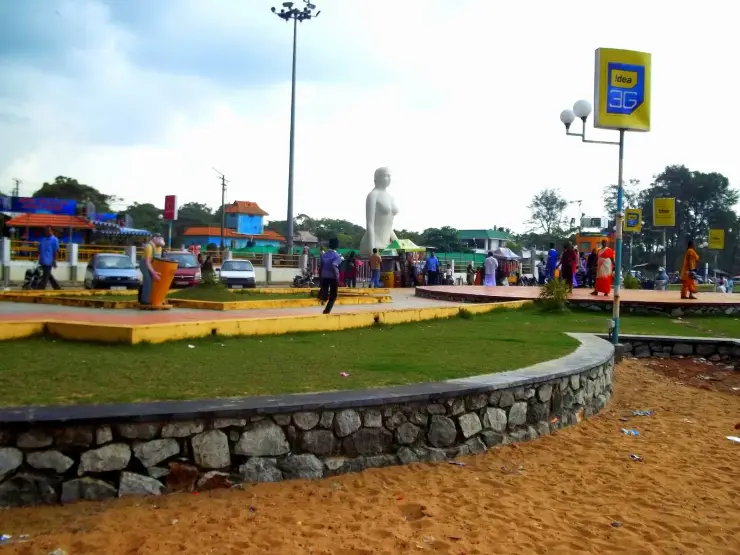
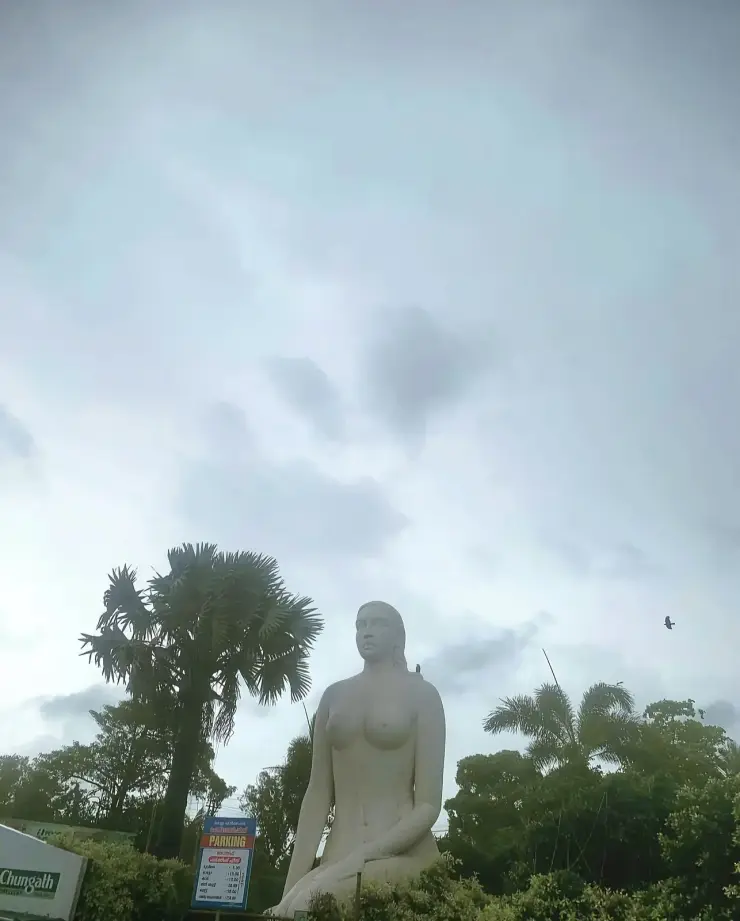
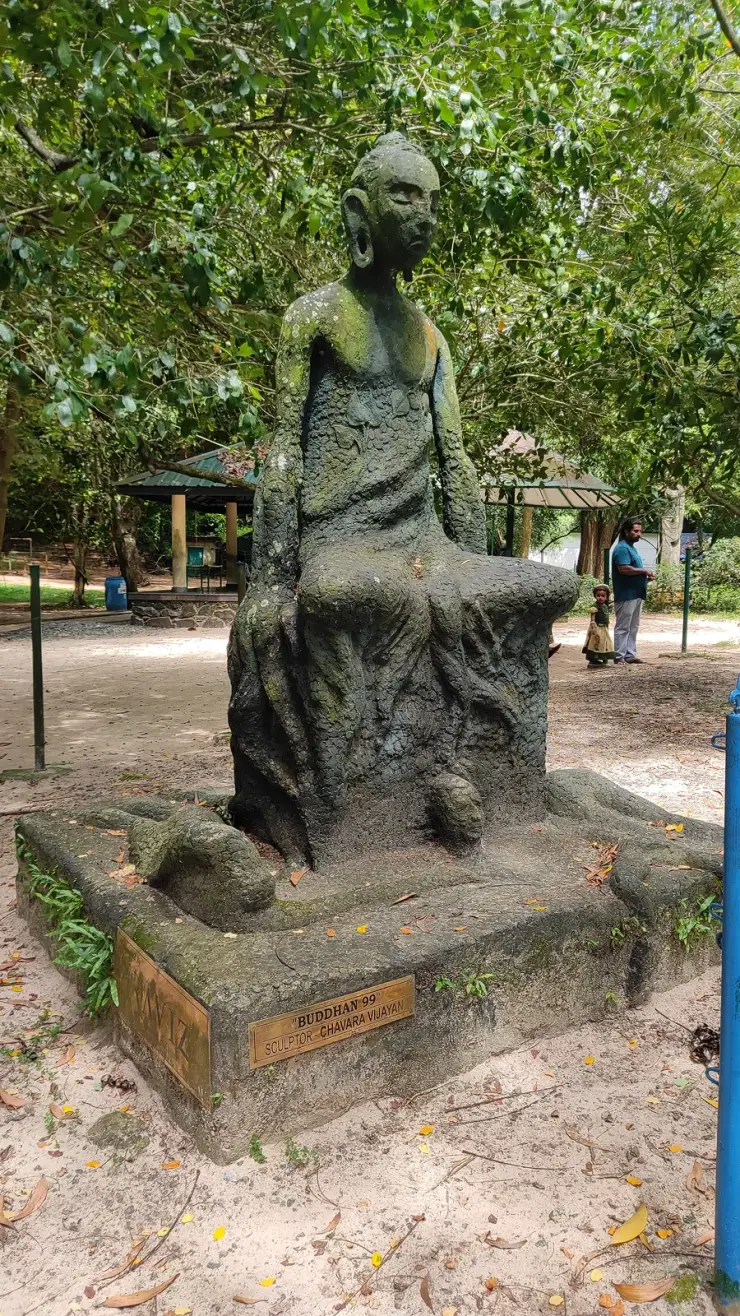
The object everybody photographs is the mermaid — a large concrete Matsyakanyaka in the park, seated upright with her head raised and her hands folded over her tail. That posture is worth registering, because almost everything written about her online actually belongs to a different statue sixty-five kilometres down the coast: Kanayi Kunhiraman’s Sagarakanyaka at Shanghumukham in Thiruvananthapuram, which is 26.5 metres long, reclining, and holds the Guinness record for the largest merperson sculpture in the world. Kollam’s sits up. Kollam’s is a different object by a different sculptor. It is quite possibly the second-largest mermaid sculpture anywhere, and it is almost never described that way because the first one is close enough to swallow it.
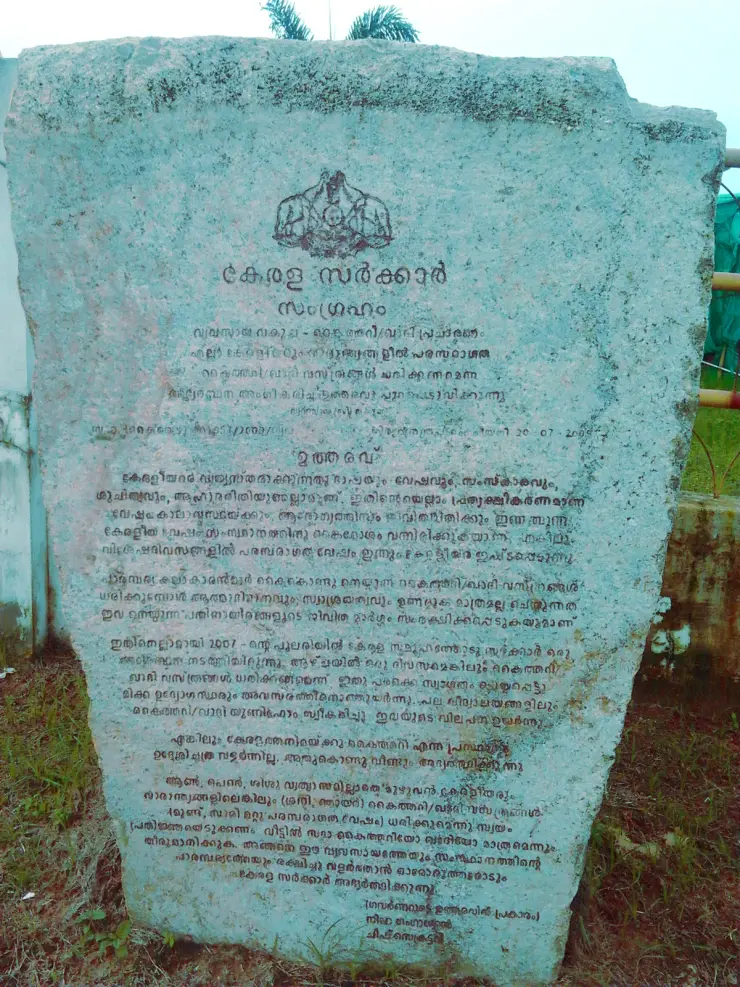
Two other things on the front are worth finding. The Corporation runs a marine aquarium at the eastern end of the beach — twenty-four tanks, a twelve-thousand-litre pool and eighteen marine species including clownfish and Moorish idols — which opened in July 2019 after a build that began in 2014; there is a free-licensed photograph from 2015 showing it as a roofless brick shell in a field of gravel. And somewhere on the grass there stood, in 2013 at least, a rough granite slab carrying the full text of a Kerala Government Order asking every Keralite to wear handloom or khadi at least one day a week, dated Thiruvananthapuram, 20 July 2009, and signed off in the standard formula: by order of the Governor. On a beach named for Gandhi, it is the only place the name is doing real work.
Look south along the coast and the mood shifts from leisure to legend. The old quarter of Thangassery (Tangasseri) begins just beyond, its skyline pricked by a candy-striped lighthouse and littered with the weathered ruins of colonial forts and centuries-old churches. Walking that way from the beach is like stepping out of the present and into the age of pepper fleets and merchant governors, when this shoreline was fought over by three European powers.
The sea has always given Kollam its purpose. Fishing communities still launch their boats from these sands each morning, and the day’s catch feeds the town’s appetite for coastal Kerala cooking — fiery fish curries, prawns and calamari served at simple eateries a short walk from the shore. Come evening, food carts and small stalls line the promenade, and the smell of frying and spice drifts along with the breeze.
For all its history, Kollam Beach wears its past lightly. Most visitors come simply for the sunset, the sea air and the company of a crowd at ease. But the layers are always there beneath the surface — a working fishing beach, a wedding destination, a public park and the doorstep to one of the oldest ports on the Malabar Coast, all folded into a single evening stroll by the water.
Mahatma Gandhi Park has three birthdays, and the most popular one describes an event that could not have happened.
Here is the claim as it circulates. English Wikipedia's article on Kollam Beach says the beach features Mahatma Gandhi Park, inaugurated on 1 January 1961. Travel sites copy the sentence by the dozen and most of them add the detail that makes it memorable: it was opened by Zakir Husain, India's Vice-President at the time.
That second half is checkable in about ninety seconds, and it fails. Zakir Husain's offices are a matter of public record: Vice-Chancellor of Aligarh Muslim University from 1948 to 1956, Governor of Bihar from 6 July 1957 to 11 May 1962, Vice-President of India from 13 May 1962 to 13 May 1967, and President from 13 May 1967 until his death in office on 3 May 1969. On 1 January 1961 he was in Patna, governing Bihar. India's Vice-President that day was Sarvepalli Radhakrishnan, who held the post from 1952 to 1962. The sentence on a hundred travel pages describes a ribbon cut by a man who did not hold the office he is given.
The strange part is that the correct version is also on Wikipedia — on a different page, which nobody has cross-checked against the first. The separate article on Mahatma Gandhi Park says the park was opened on 1 January 1967 by Zakir Husain, who served as Vice-President of India at that time. That version is internally consistent: on 1 January 1967 he had been Vice-President for four and a half years and was four months away from the Presidency. The same encyclopedia carries both dates, six years apart, and has never noticed.
And then the city votes for a third year entirely. In 2010 the Kollam Municipal Corporation funded a renovation, and the rebuilt park was reopened on 4 August 2010 by the then Mayor, Prasanna Earnest — an occasion the record describes as the golden jubilee of the MG Beach park. A golden jubilee is fifty years. Fifty years before 2010 is 1960. If the park really opened in 1967, Kollam threw it a fiftieth birthday party at the age of forty-three.
So: 1960, implied by the Corporation's own celebration. 1961, the figure the internet repeats. 1967, the only one compatible with the title everyone attaches to the man who opened it. No Government Order or Corporation notification for the opening appears to be online, so we cannot hand you the answer. What we can hand you is the useful lesson, which is worth more than the date: a tidy figure appearing on a hundred pages is not a hundred pieces of evidence. It is one sentence, copied ninety-nine times, and the copying is what makes it look solid.
Our own honest reading is that the park was laid out around the turn of the 1960s and formally opened by Zakir Husain — and that if he opened it as Vice-President, as every single account insists he did, then it cannot have been in 1961.
There is a closing turn to this, and it is not a cheerful one. The park was built to look at a beach that was 150 metres wide. That shore is now retreating at something like twenty metres a year, and in places about six metres of usable sand is left. Whether the ribbon was cut in 1960, 1961 or 1967, the view it was built for is going. Of the two uncertainties attached to this place, the birthday is much the smaller.
Kollam — long known to the wider world as Quilon — has been a working port on India’s Malabar Coast since at least the ninth century, and its beachfront is the seaward face of that trade. From the ninth century onward, ships from Arabia, Persia and China called here to load pepper, ginger, cardamom and other spices grown in the hills inland, making Kollam a great emporium of the Indian Ocean spice routes. The fourteenth-century Moroccan traveller Ibn Battuta counted Quilon among the finest towns on the Malabar coast.
The town’s fortunes were tied to the sheltered waters of Ashtamudi Lake, the many-armed backwater on whose banks Kollam grew, which opens to the Arabian Sea near this coast. That natural harbour let Kollam serve as a trans-shipment hub between the backwaters and the open sea, and gave it lasting importance to Arab, Chinese and later European merchants long before the colonial era proper began.
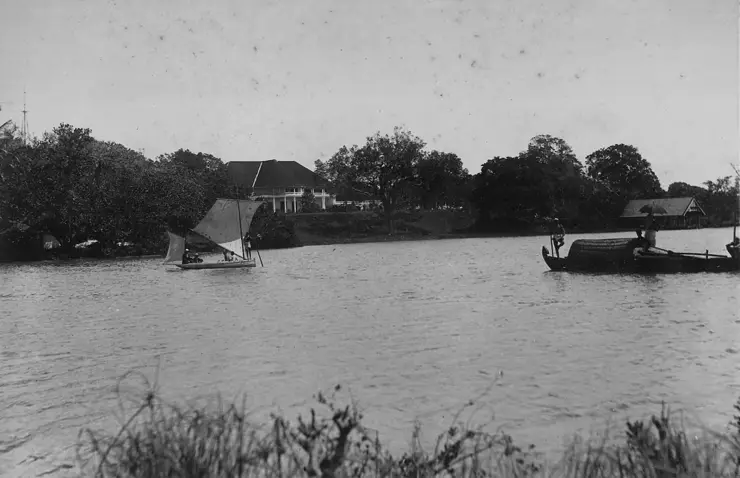
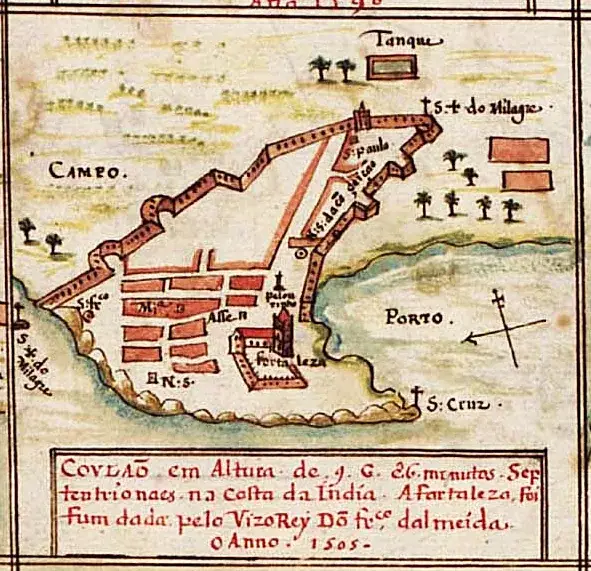
European contest for the pepper trade reshaped the shore at Thangassery, just south of the beach. The Portuguese arrived in the early sixteenth century, with a trading presence from around 1502, and raised St Thomas Fort at Thangassery in the 1510s — the year is genuinely unsettled, with 1517, 1518 and 1519 all in print across official sources, so we are not going to pick one. The Dutch took Thangassery from them in the 1660s, and here too the government’s own publications disagree: the usual date is 1658 or 1661, while the Directorate General of Lighthouses and Lightships states that the Raja gave the Dutch trading rights and permission to build a fort at Quilon in 1665. The British took it in 1795. The tumbled ramparts, old cemeteries and churches at Thangassery are the physical residue of that three-way struggle.
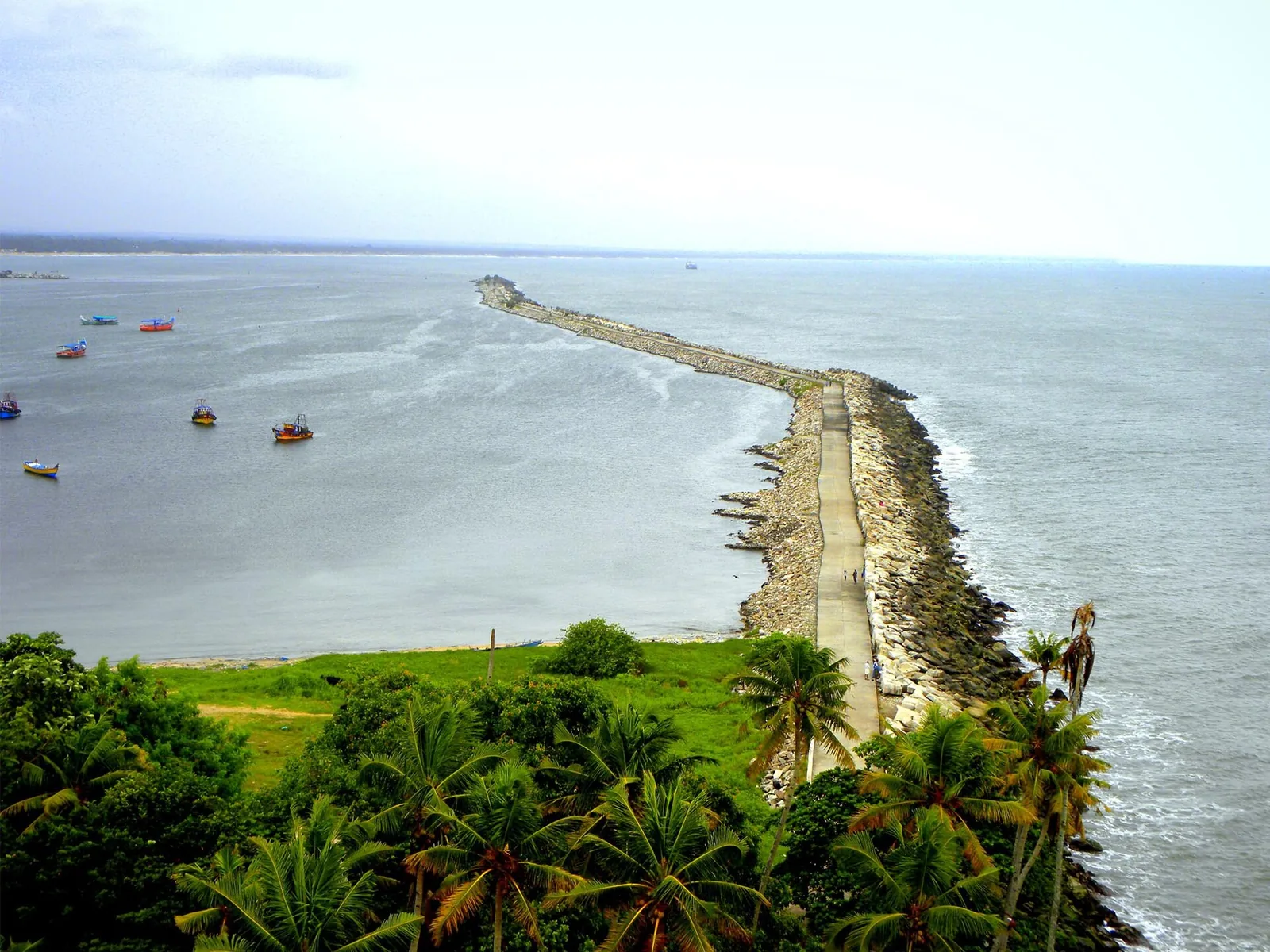
The Tangasseri Lighthouse, the red-and-white spiral-striped tower that presides over the coast just beyond the beach, was commissioned in 1902 and stands 35 metres tall. The figure of 144 feet, or about 44 metres, that circulates widely — and stood on this page until recently — is the height of the light above its base, not the height of the tower; the DGLL's own ledger gives 43 metres base-to-vane and 38 metres to the beam. It replaced older navigational lights and long guided ships toward the port, its beam a fixed point in Kollam’s maritime life for more than a century. Nearby, the Tangasseri breakwater was built to shelter Kollam Port, which in modern times became famous as a hub of India’s cashew-processing and export trade.
The beach’s civic identity is much more recent, and its founding date is a mess — three years are in circulation and the arithmetic is set out below. What is not in doubt is that the park was laid out around the turn of the 1960s and formally opened by Zakir Husain, who went on to become President of India. That combination — an ancient spice port, a colonial frontier and a modern people’s park — is what makes a stroll here unexpectedly rich.
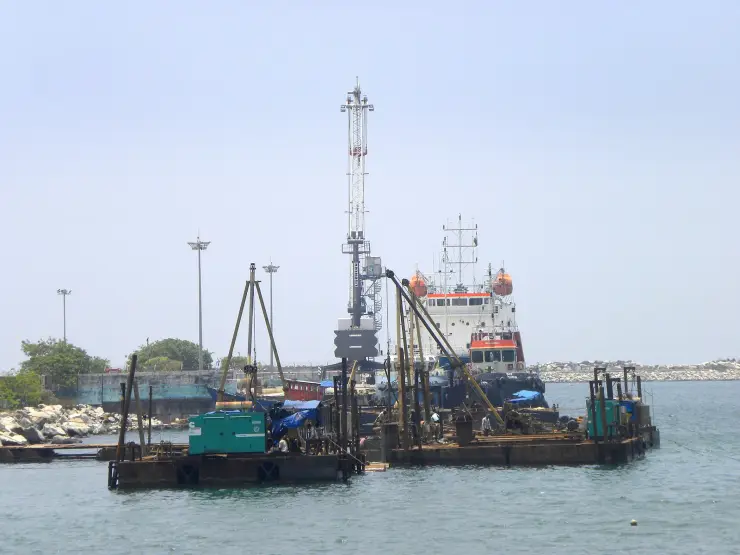
One more thing on the map, because it is easy to conflate. Mundakkal Beach, also called Mundakkal Papanasham, is a separate strand about 350 metres long a little to the south on the Kollam–Paravur coastal road, where devotees bathe to wash away sin and balitharpanam is performed in the month of Karkidakam. It briefly made the news in June 2016 when the dredger Hansitha washed ashore there. It is not this beach, and the two get merged constantly.
Sunsets over the Arabian Sea from a broad, walkable promenade — arguably the best free show in town, and the reason locals gather here every evening. Look carefully and the sun goes down behind the 2.1 km arm of the Thangassery breakwater rather than into open water.
A landscaped seaside park (Mahatma Gandhi Park) right beside the sand, with lawns, paths, a Gandhi statue, fountains and a marine aquarium of twenty-four tanks that opened in 2019.
The giant seated Matsyakanyaka — probably the second-largest mermaid sculpture in the world, and routinely confused with the reclining Guinness record-holder at Shanghumukham.
An extraordinary historical hinterland within walking distance: the 1902 Tangasseri Lighthouse and the ruined Portuguese and Dutch forts and old churches of Thangassery.
A genuine working fishing beach where you can watch catamarans launch and land, then eat fresh coastal Kerala seafood a short stroll away.
An ideal, low-effort add-on to a Kollam trip built around the Ashtamudi backwaters and houseboats — sea and lake sights within a couple of kilometres of each other.
Road km to Kollam; ghat roads and traffic vary — allow extra.
November to February for dry weather; avoid rough-sea days during monsoon warnings.
Live forecast loads in your browser.
Sun and moon are calculated for this location and shown in IST. Photography windows are the hour around sunrise and sunset; the sunset bearing is degrees clockwise from true north. Moon phase is accurate to about half a day.
Browse listed stays, food, activities, sights, shops and rentals around Kollam Beach. Check each listing’s locality and contact the business directly for current arrangements.
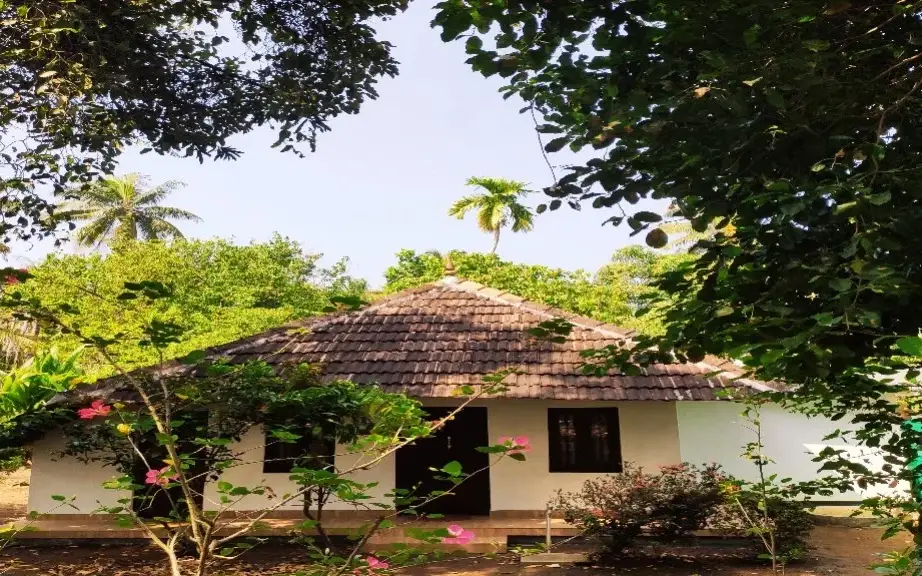
A family homestay reached by a short boat ride on Munroe Island in the Ashtamudi backwaters. Offers two AC rooms with home-cooked breakfasts.
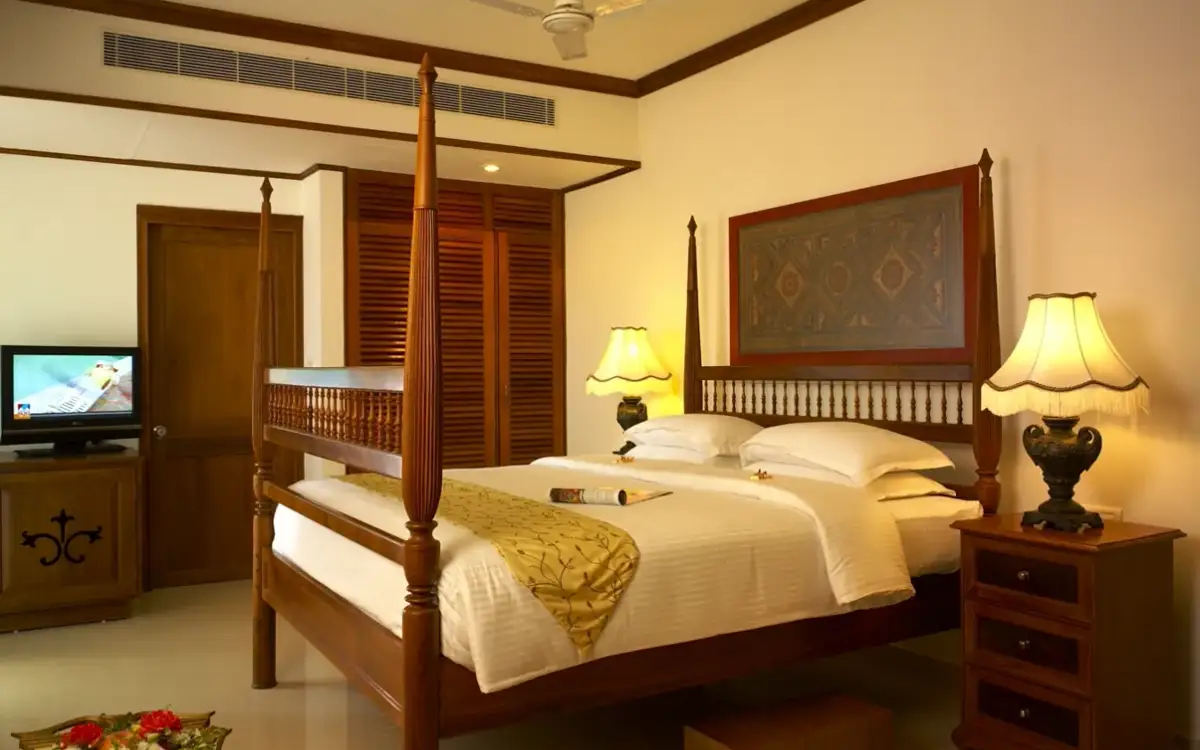
Boutique hotel with 28 rooms and original artwork in the heart of Kollam, overlooking the city's Clock Tower.
A lakefront resort where all 20 rooms and suites face Ashtamudi Lake. Runs its own houseboat cruises and shoreside Ayurveda treatments.
A backwater resort where Ashtamudi Lake meets the Kallada River. Named after Colonel John Munroe, it offers canoe tours and houseboat cruises.
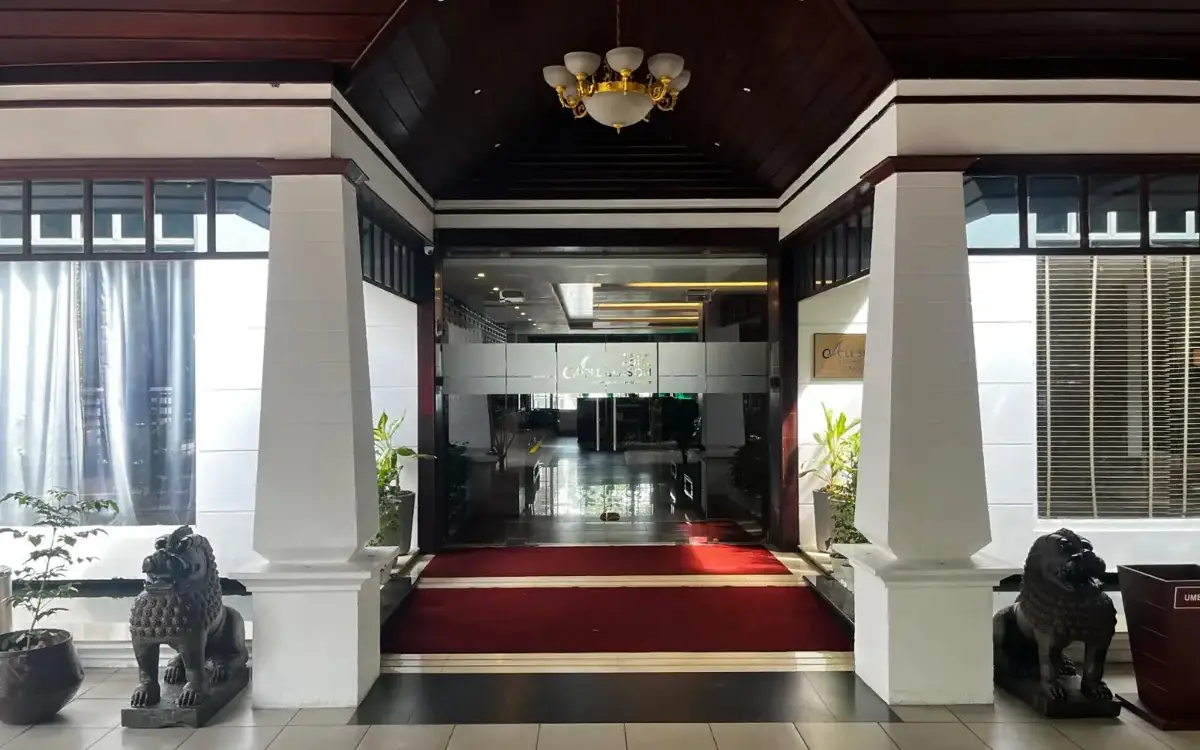
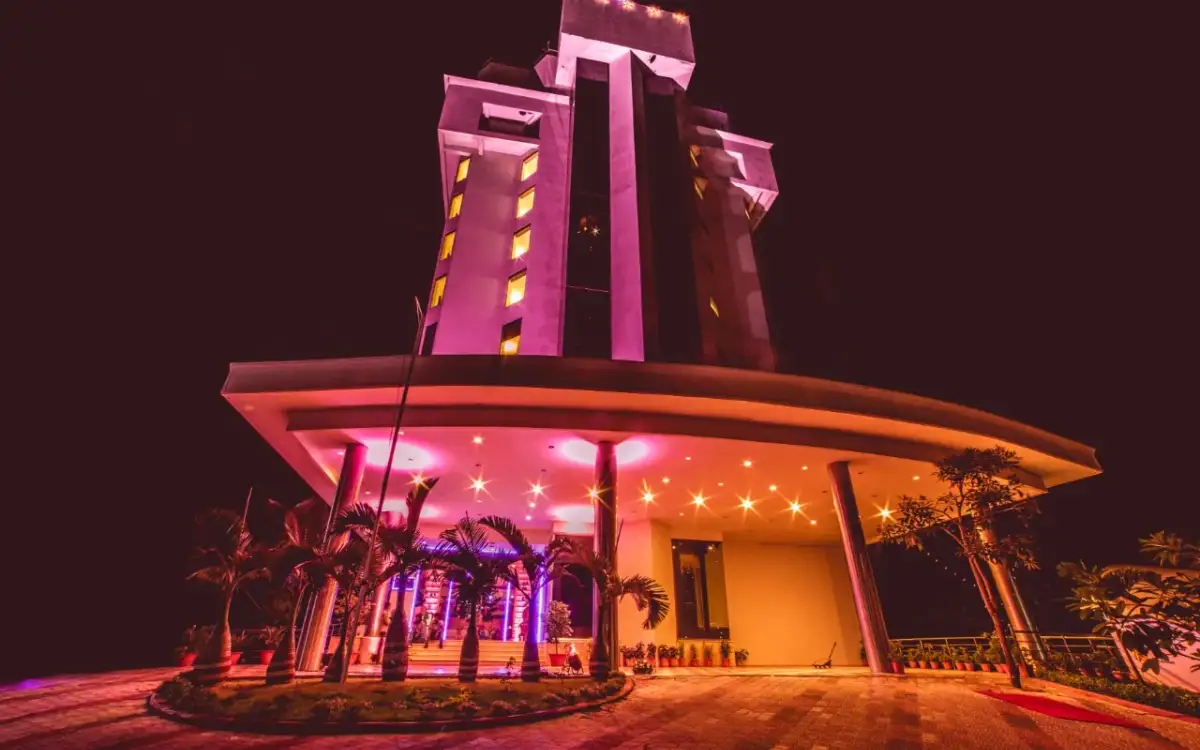
Hotel in Kollam town. Luxury beach hotel and convention centre · Kollam Beach, Hotel, Convention centre.
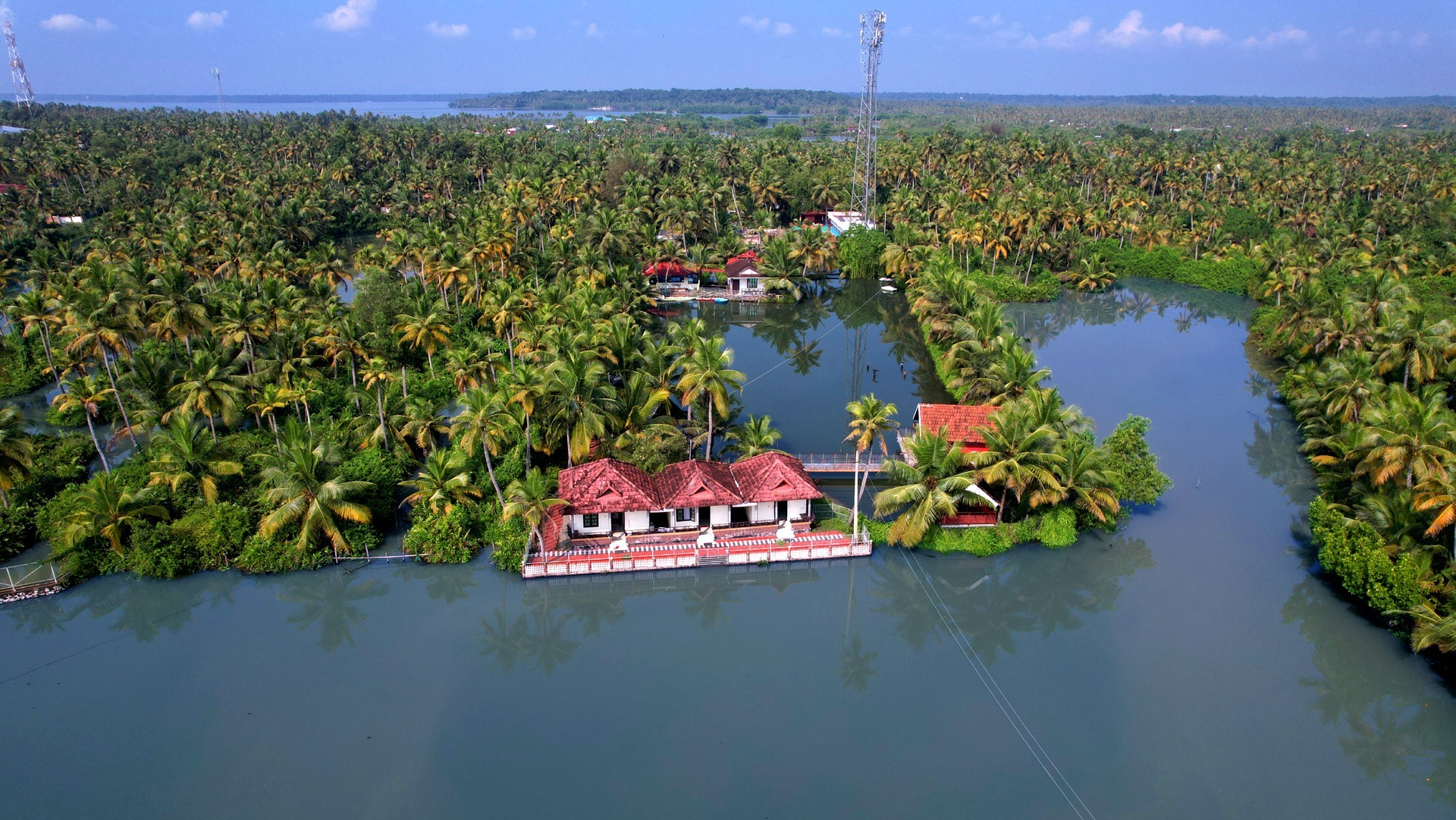
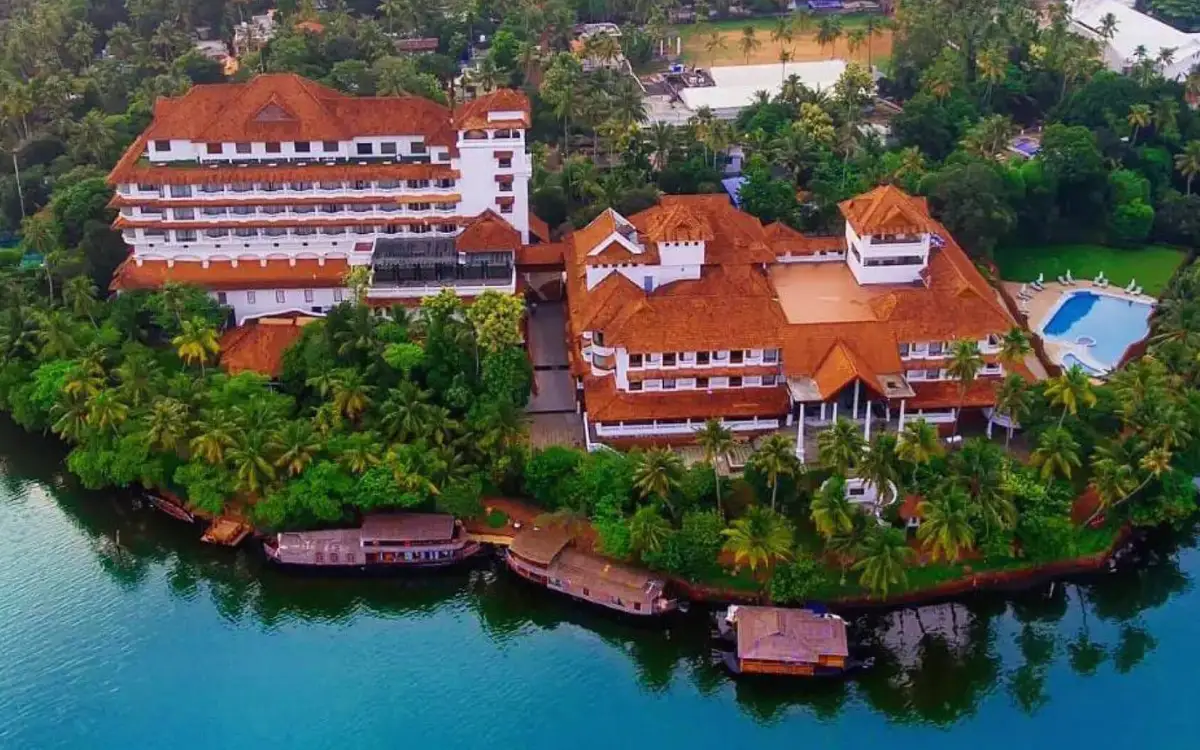
The Leela Ashtamudi is a lakefront heritage resort at Thevally Bridge, with several room types, houseboat categories and on-site dining. Its correct hotel entrance is at Thevally/Mathilil, separate from the Raviz corporate-office address previously displayed. Compare the named room or houseboat, lake view, meals, transfer, activity inclusions, total price and cancellation terms. The operator's aerial photograph shows the whole property, not a promise that every room has the same view.
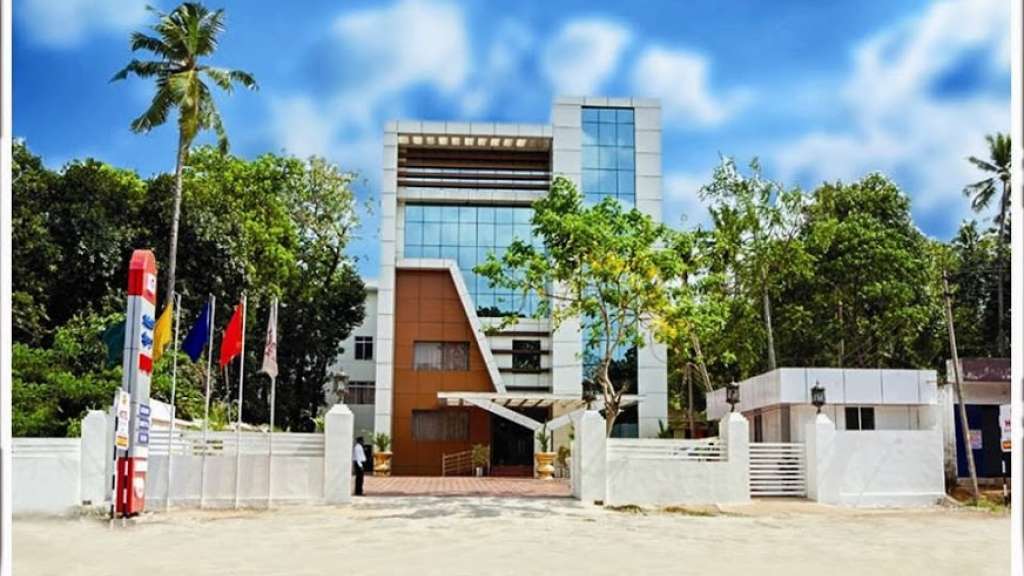
Modern budget hotel at Aadichanalloor on the Kollam–Thiruvananthapuram highway side of Kollam district, south of the town. It offers clean, value air-conditioned rooms with a restaurant and parking, a low-cost highway base for travellers passing through greater Kollam.
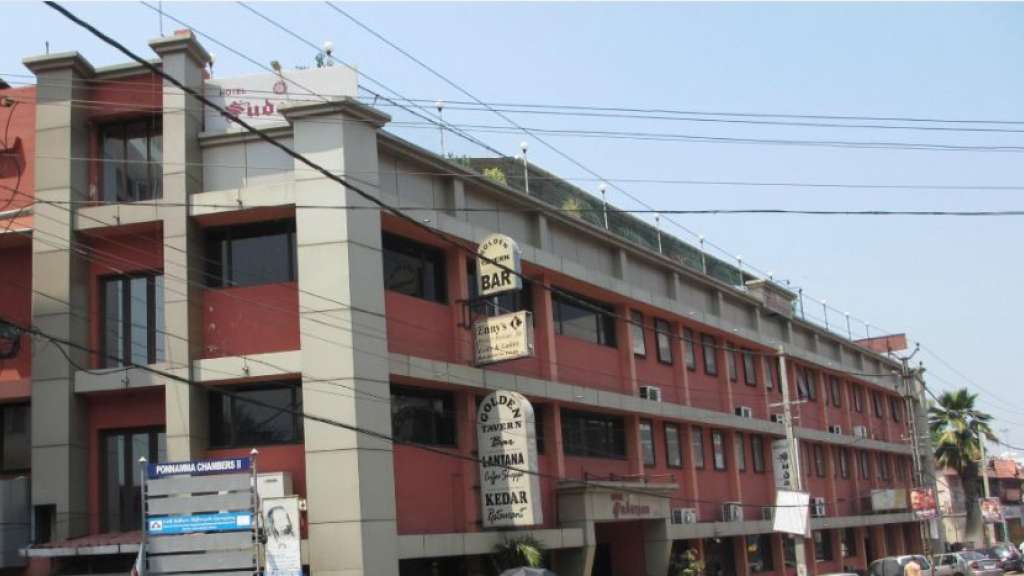
Long-running budget hotel at Parameswar Nagar in central Kollam, rated two-star class by travel directories. It offers value air-conditioned rooms with the Kedar multi-cuisine restaurant and Golden Tavern bar, a practical low-cost town-centre base for transit and business travellers.
Government-run KTDC Easy budget hotel in the Guest House compound at Ashramom, beside Ashtamudi Lake on the quiet edge of Kollam town. It offers simple, low-cost air-conditioned and non-air-conditioned rooms with a restaurant, run under the Kerala Tourism Development Corporation budget brand.
Long-running three-star-class hotel near the KSRTC bus station on Jetty Road in central Kollam, a short walk from the Ashtamudi backwater boat jetty. It offers 44 air-conditioned rooms, a multi-cuisine restaurant, bar, travel desk and boating assistance, a practical mid-range base for backwater and transit travellers.
Kerala Tourism-classified three-star hotel at Kottiyam on the Kollam–Thiruvananthapuram highway, in the southern part of Kollam district. It offers air-conditioned rooms, a multi-cuisine restaurant, bar, banquet hall and travel desk, a comfortable mid-range highway base a short drive south of Kollam town.
Kerala Tourism-classified three-star hotel on NH-47 directly opposite Kollam Railway Station, in the heart of Kollam town. It offers air-conditioned rooms, a multi-cuisine restaurant, bar, banquet and conference halls and 24-hour room service, a convenient mid-range base for rail and business travellers.
Fragrant Nature at Paravur is a lake-side resort outside central Kollam. Allow separate road journeys for Thangassery, city dining and onward rail travel.
D Fort Hotel is a Thangassery stay near the lighthouse neighbourhood. Check room and wellness packages separately from the lighthouse’s own visitor session.
A three-star resort set in a coconut palm forest on the banks of Ashtamudi Lake. Its 26 units include houseboats and floating cottages.
A budget backwater homestay on Munroe Island near Kalluvila Temple. Offers canoe and shikara trips, Ayurvedic massage, and Kerala home cooking.
Kollam houseboat operator with day cruises on Ashtamudi Lake and overnight boat options. Confirm the boarding point, route, boat and inclusions directly.
Ashtamudi resort with both floating and land-based accommodation. Compare the exact room category and booking eligibility; confirm dining and lake activities separately.
A central Kollam homestay near Sankers Hospital. Its own site publishes room choices and direct booking details.
An Asramam homestay for visitors who want a Kollam base away from the railway-station cluster. Ask about the current room and arrival route.
A restored ancestral home in Uliyakovil, Kollam. Ask the host how its room layout and access work for your group.
A Kureepuzha homestay beside Ashtamudi Lake. Ask the host about the room, meals, arrival route and any separately arranged boat trip.
Samiira is a small heritage-style resort at Sarayu Nagar in Asramam, beside Ashtamudi Lake. Its official site distinguishes two Heritage Cottages with separate living rooms from eight Lake Front Verandah Rooms with private verandahs. Choose the layout you need, then confirm the exact room, view, meal plan, transfer and total price. Kayaking and spa experiences are described by the property, but ask whether they operate and whether they are included in your booking. The property's own exterior photograph shows its veranda, not a guarantee of the room you will receive.
Book with the place itself. India’s cyber-crime coordination centre warned in April 2025 that convincing copies of hotel and pilgrimage booking sites are being pushed through sponsored search and social ads, taking payment for rooms the property never hears about. Use the contact and source details on each profile to confirm the exact business and booking channel. A directory entry or map pin alone does not establish an operator’s identity or current availability. Roampedia takes no commission and does not collect booking payments. If a booking page reached you through an ad, check the address bar against the property’s own site before you pay. Fraud can be reported on cybercrime.gov.in or on 1930.
Find food, accommodation and activities across Kollam town. Browse the guides for places to eat, stay and explore along your route.
Walking routes start at Kollam Beach. Check the route and access before setting out, especially where a road, gate or waterway separates the stops.
13 more places around Kollam town. Open a guide to plan the visit and onward journey.
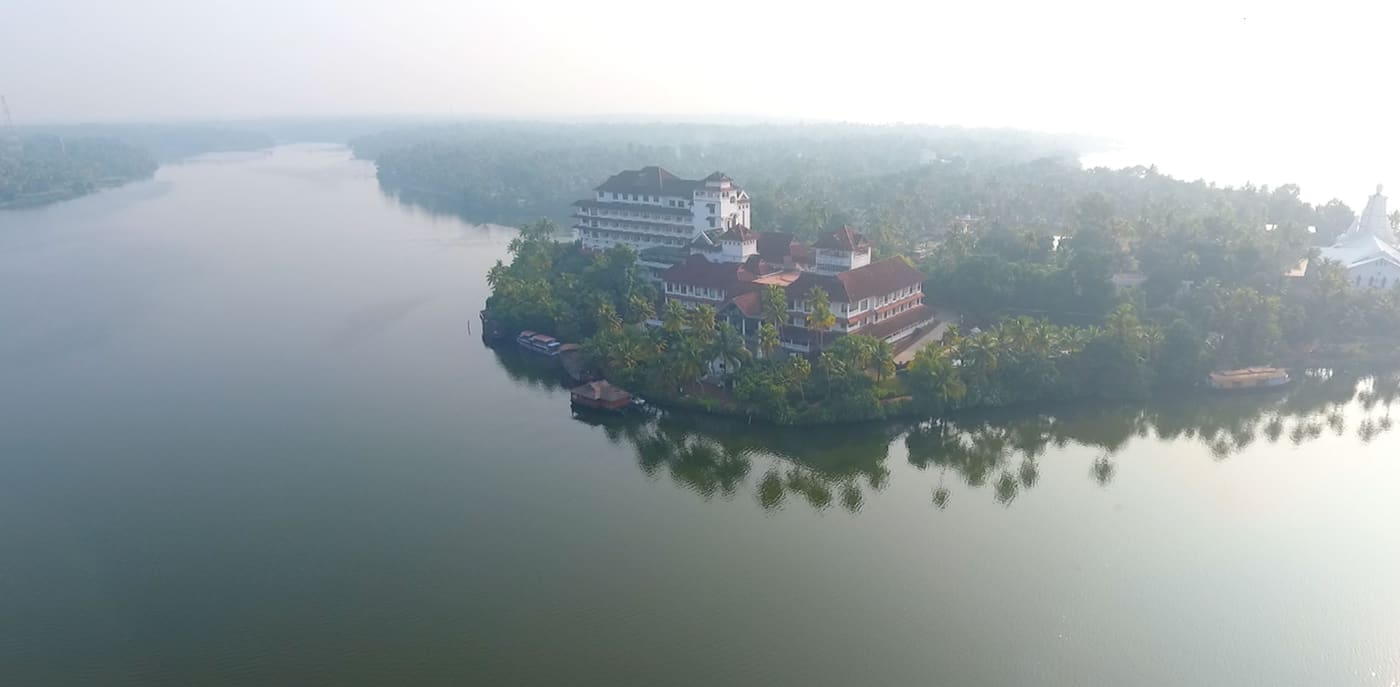
17.7 km · 22 min drive
Large palm-fringed backwater system and houseboat base around Kollam.
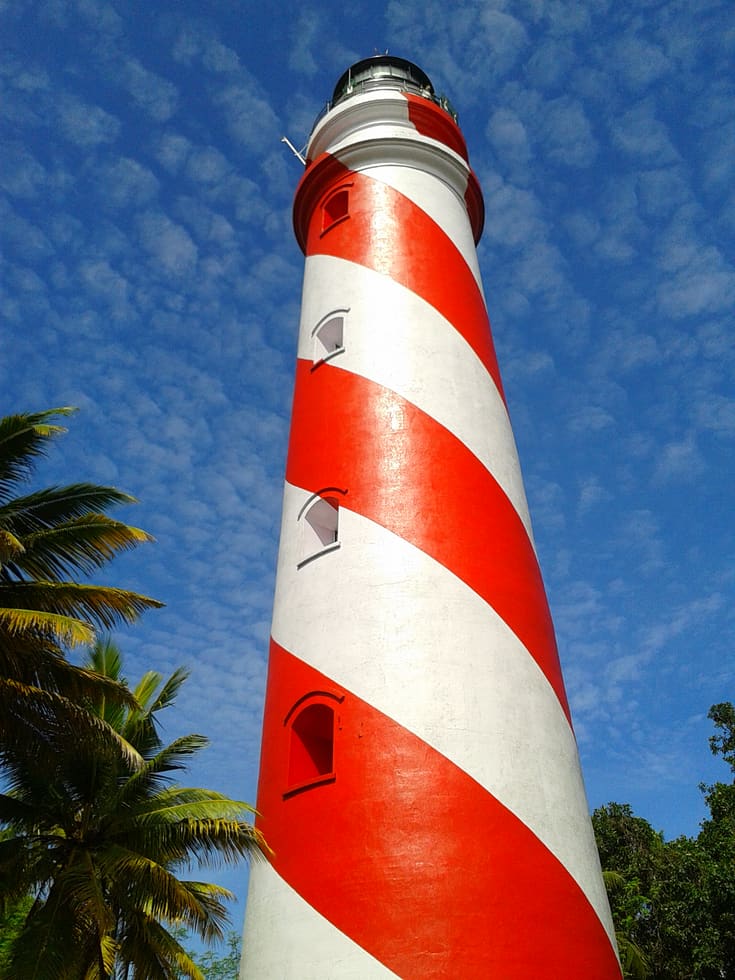
2.9 km · 4 min drive
Thangassery Lighthouse raises Kollam’s sea view above a historic coastal neighbourhood. The red-and-white tower is a working navigation landmark with a separate visitor session.
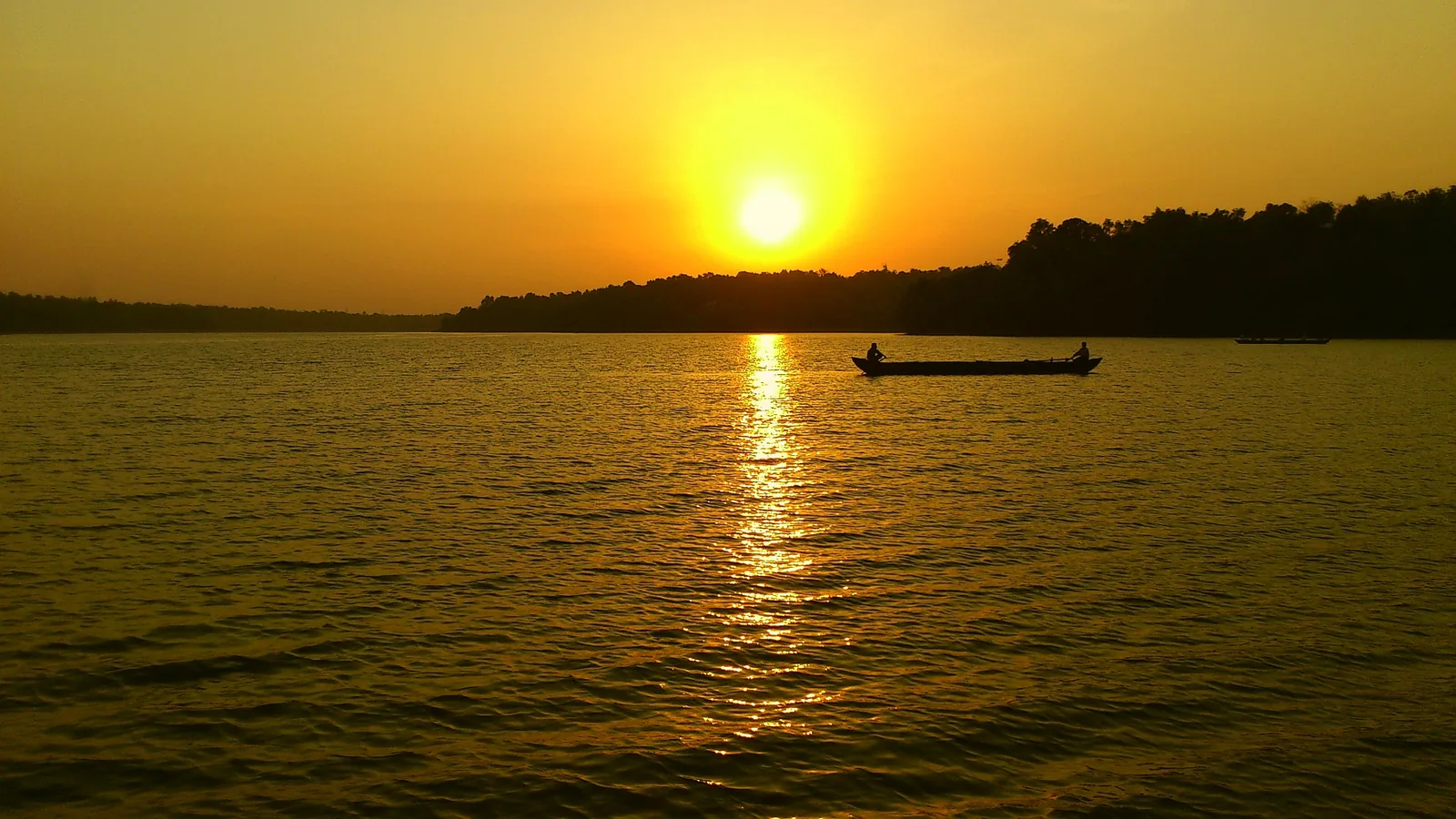
Kerala’s largest freshwater lake, a Ramsar wetland ringed by hills and a Sastha temple, north of Kollam.
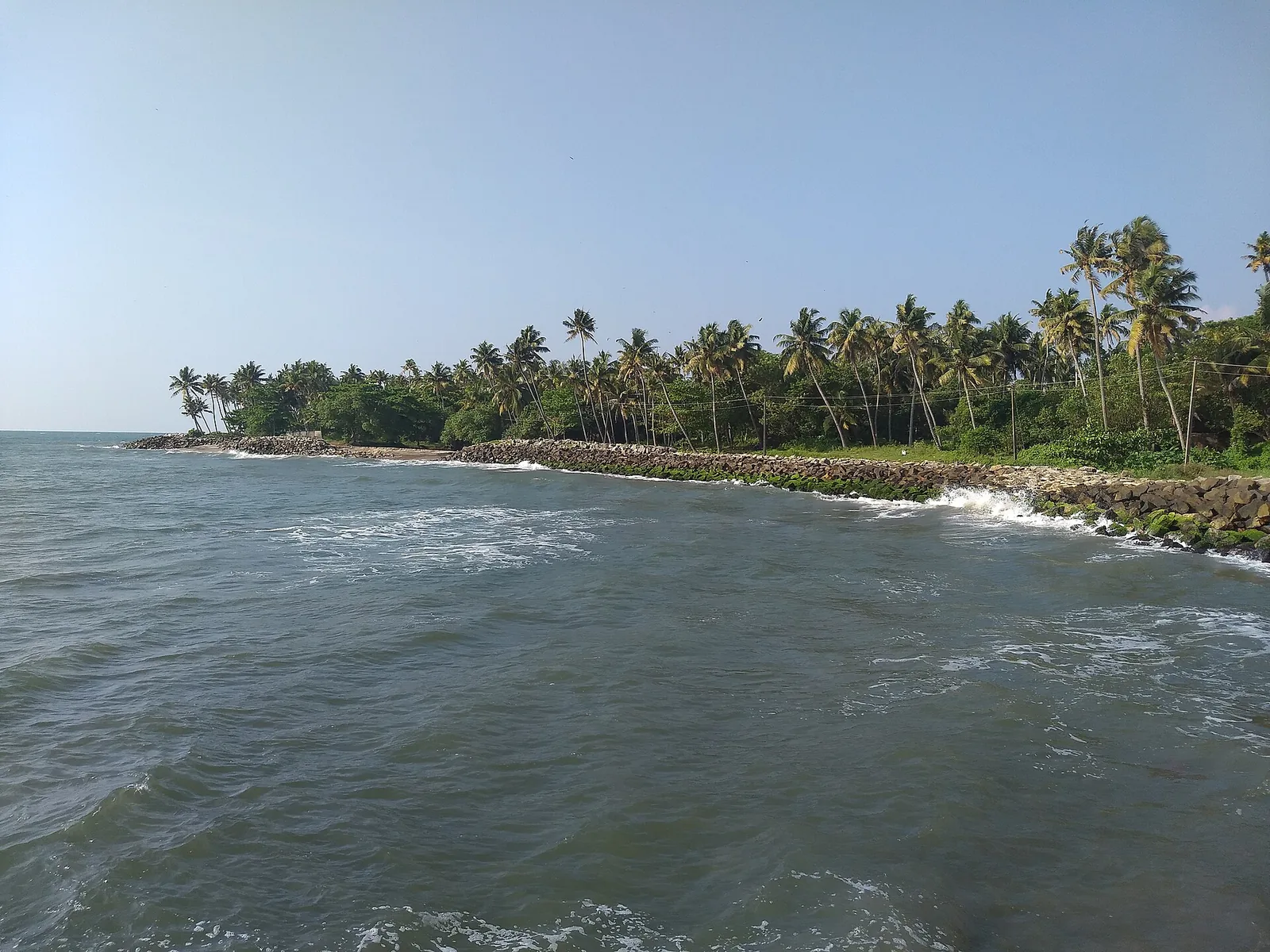
5.4 km · 7 min drive
A quiet, curved bay beach west of Kollam town, calmer than the city beach and good for a relaxed evening.
4.0 km · 6 min drive
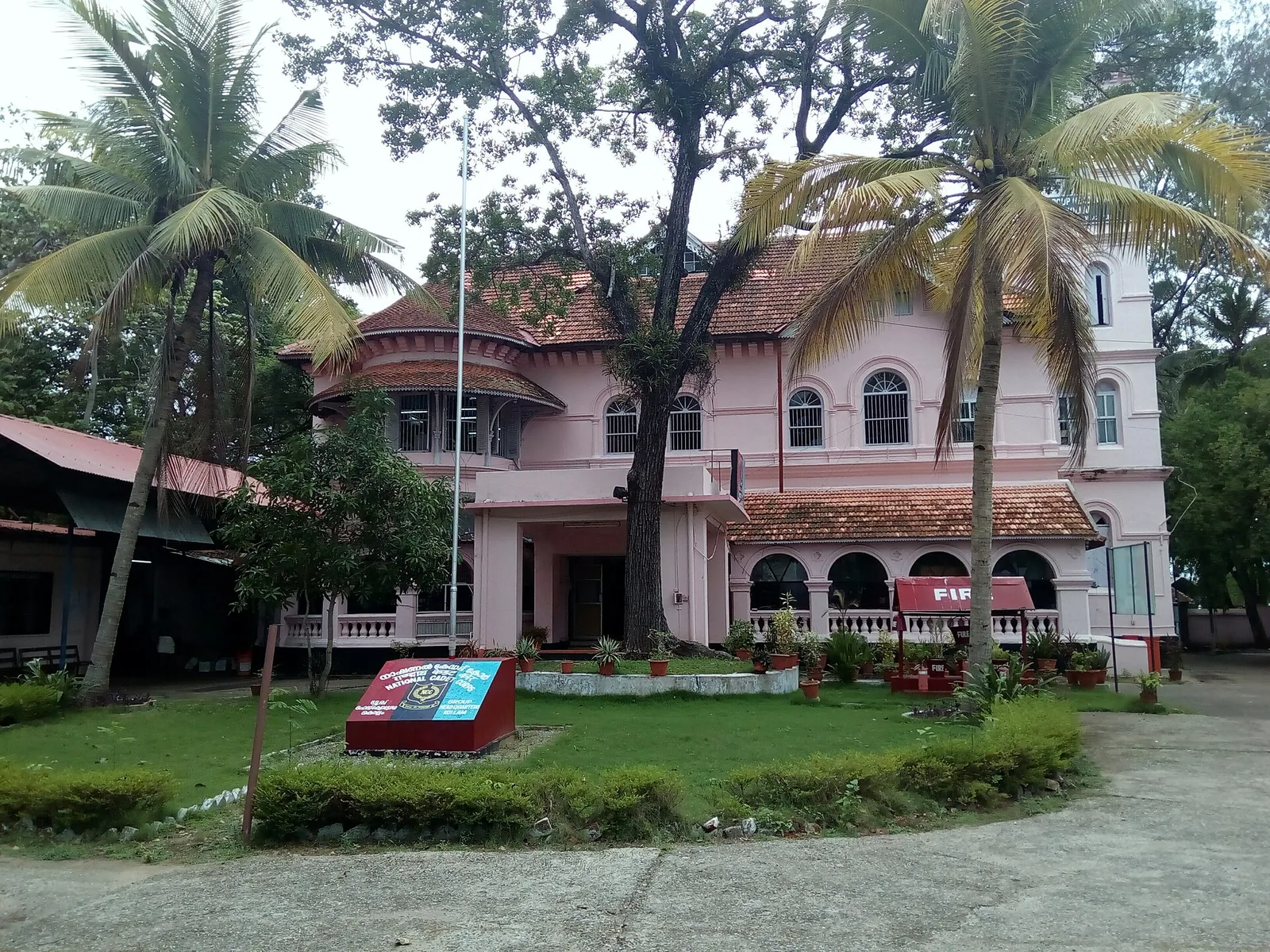
A Travancore royal residence on the Ashtamudi shore in Kollam, built to be arrived at by boat and now a working NCC establishment — viewed from outside or from the water.
3.0 km · straight line
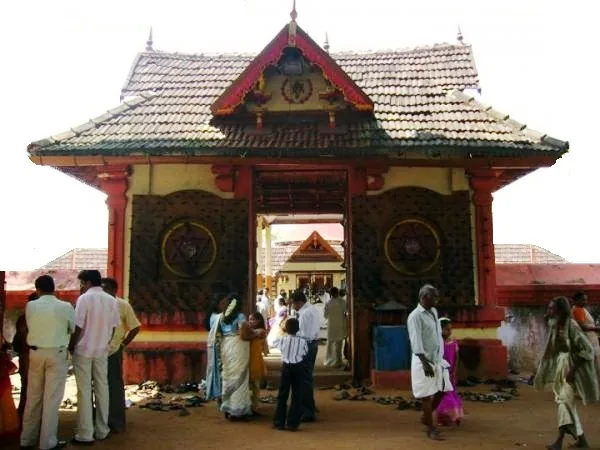
Anandavalleeswaram is an active Shiva temple in Kollam, with an Anandavally shrine and a ten-day annual festival in March or April. Ritual processions and cultural performances bring another dimension to the temple visit. Follow its worship session, admission and photography rules.
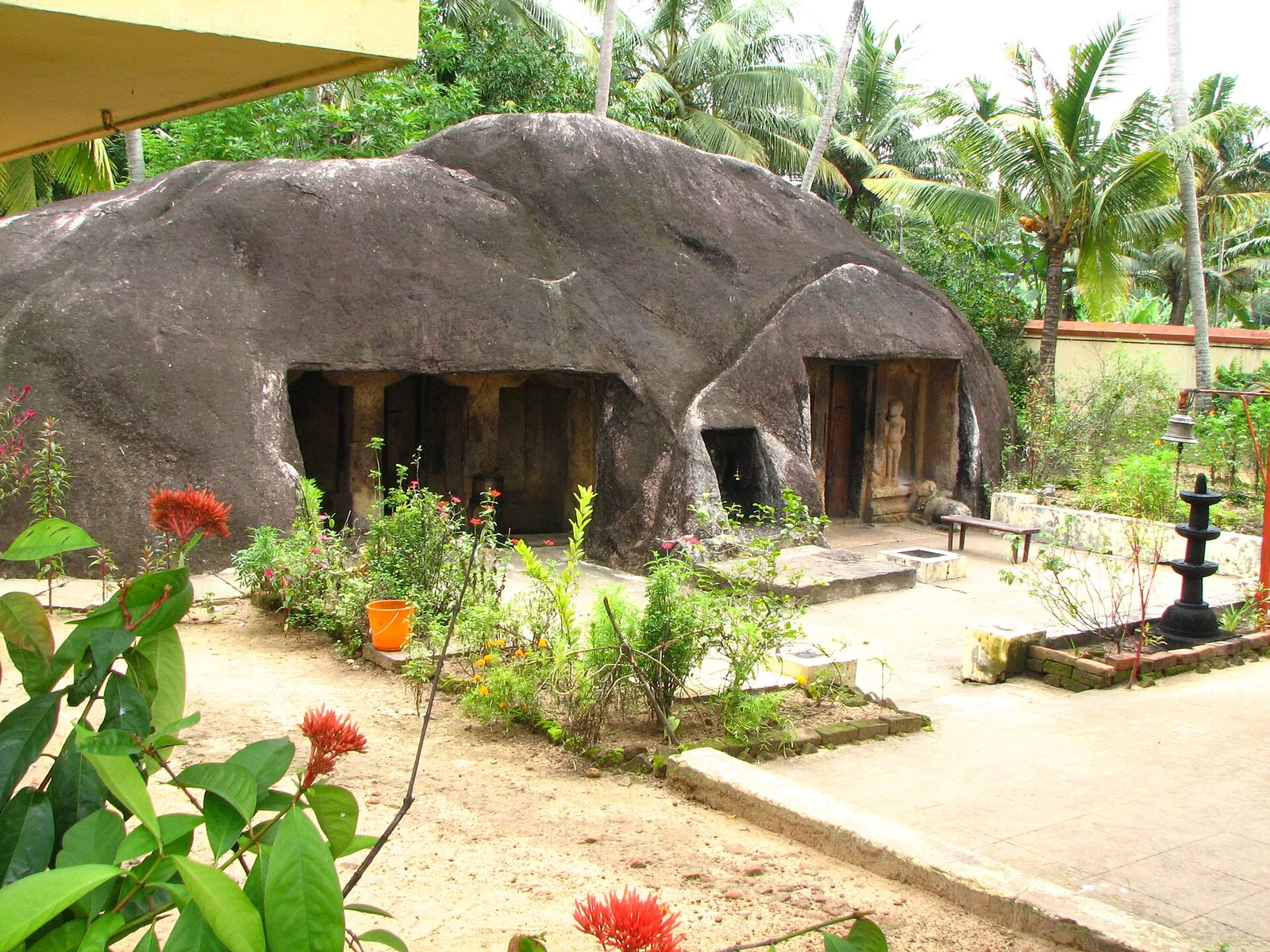
A monolithic rock-cut cave temple near Anchal/Kadakkal in south Kollam, carved with a Shiva shrine.
10.5 km · 14 min drive
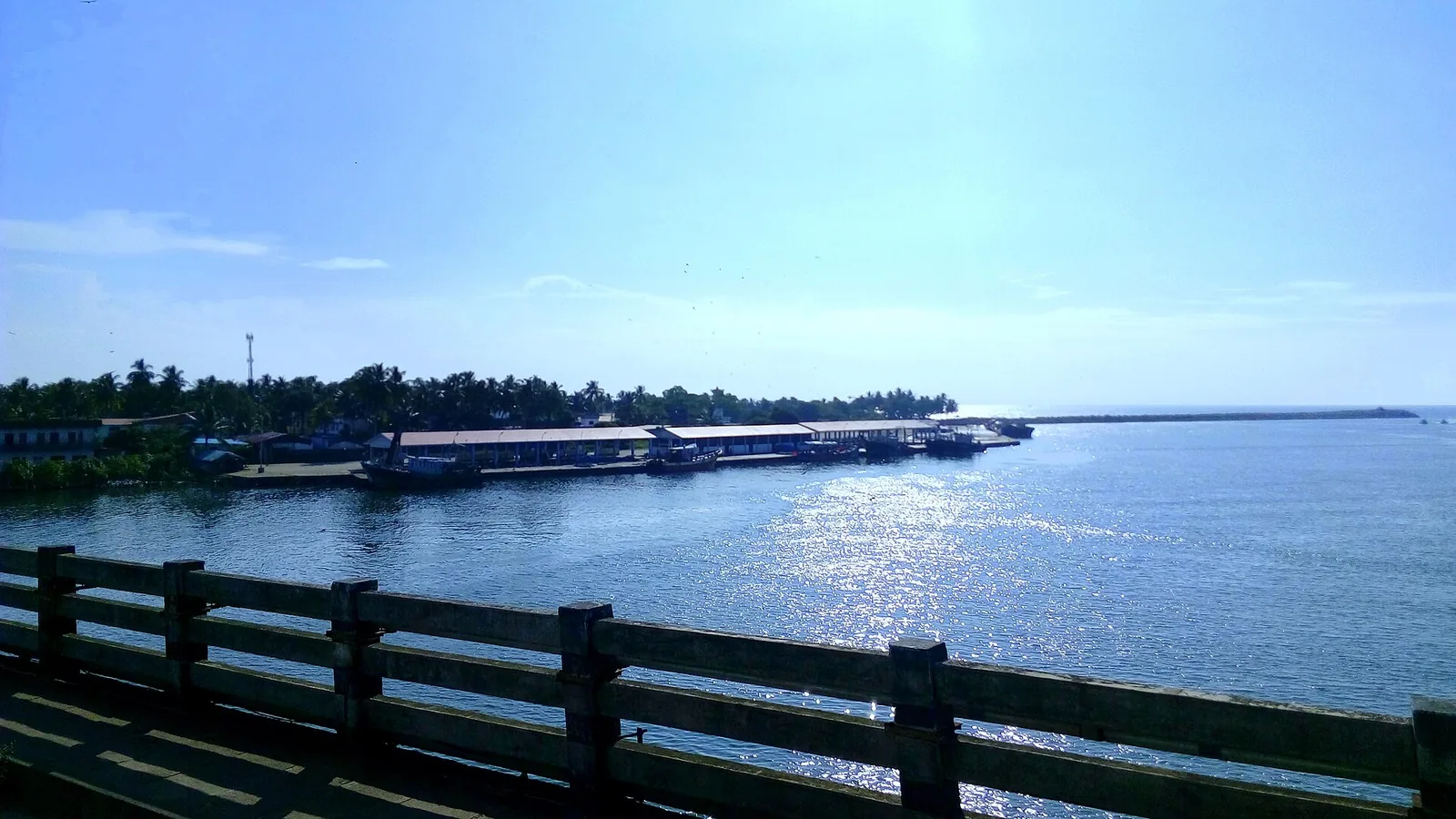
By most accounts Kerala’s largest fishing harbour, at the mouth of Ashtamudi Lake about 9 km from Kollam town, and where Indian fishing was mechanised; two bridges cross the confluence and the early-morning auction is the sight to catch.
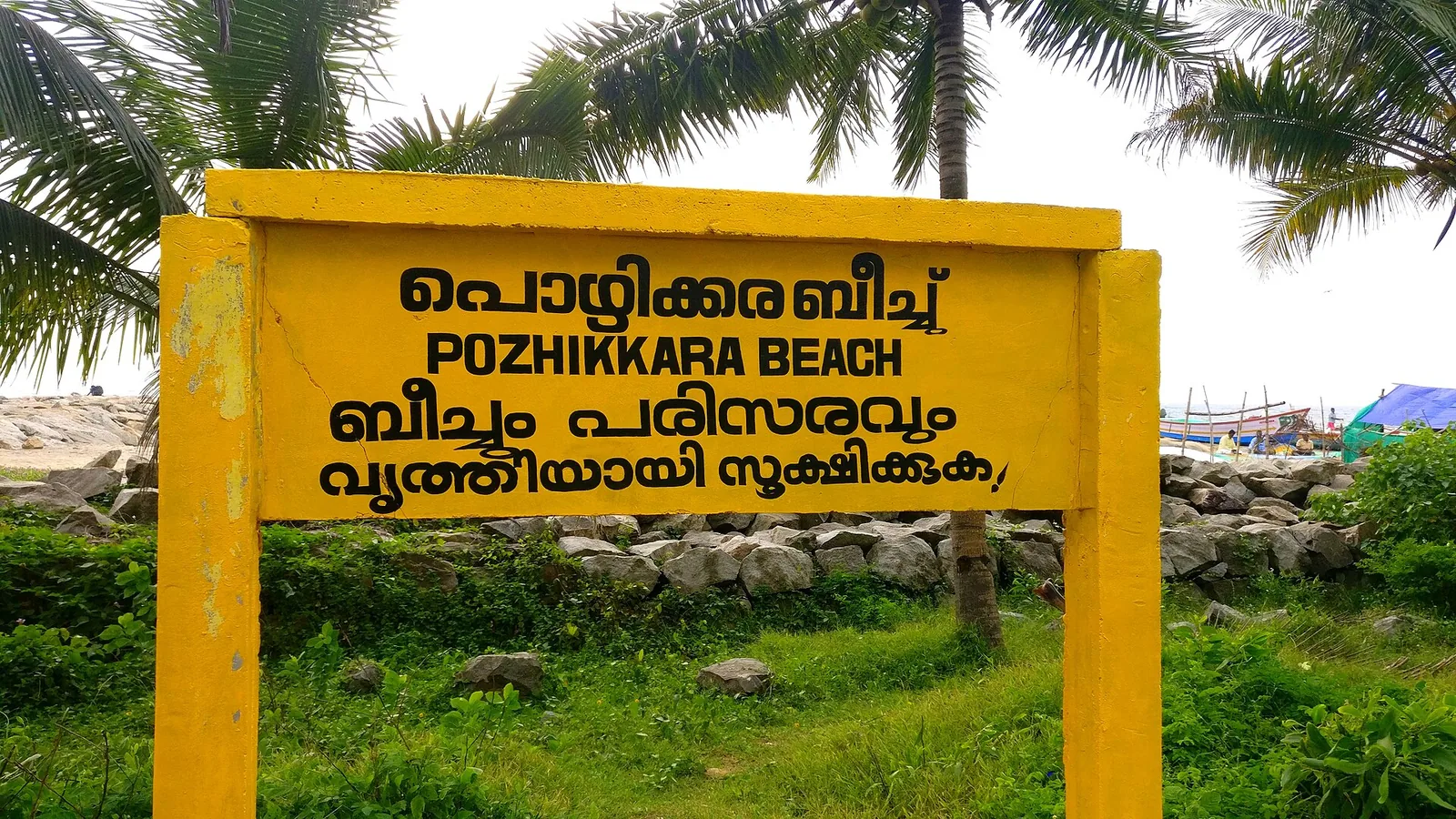
11.8 km · 15 min drive
The estuary and beach at Paravur south-east of Kollam, where the Paravur backwaters meet the sea across a sandbar — a quiet spot known for its regulator bridge, the TS Canal and calm backwater-and-sea scenery.
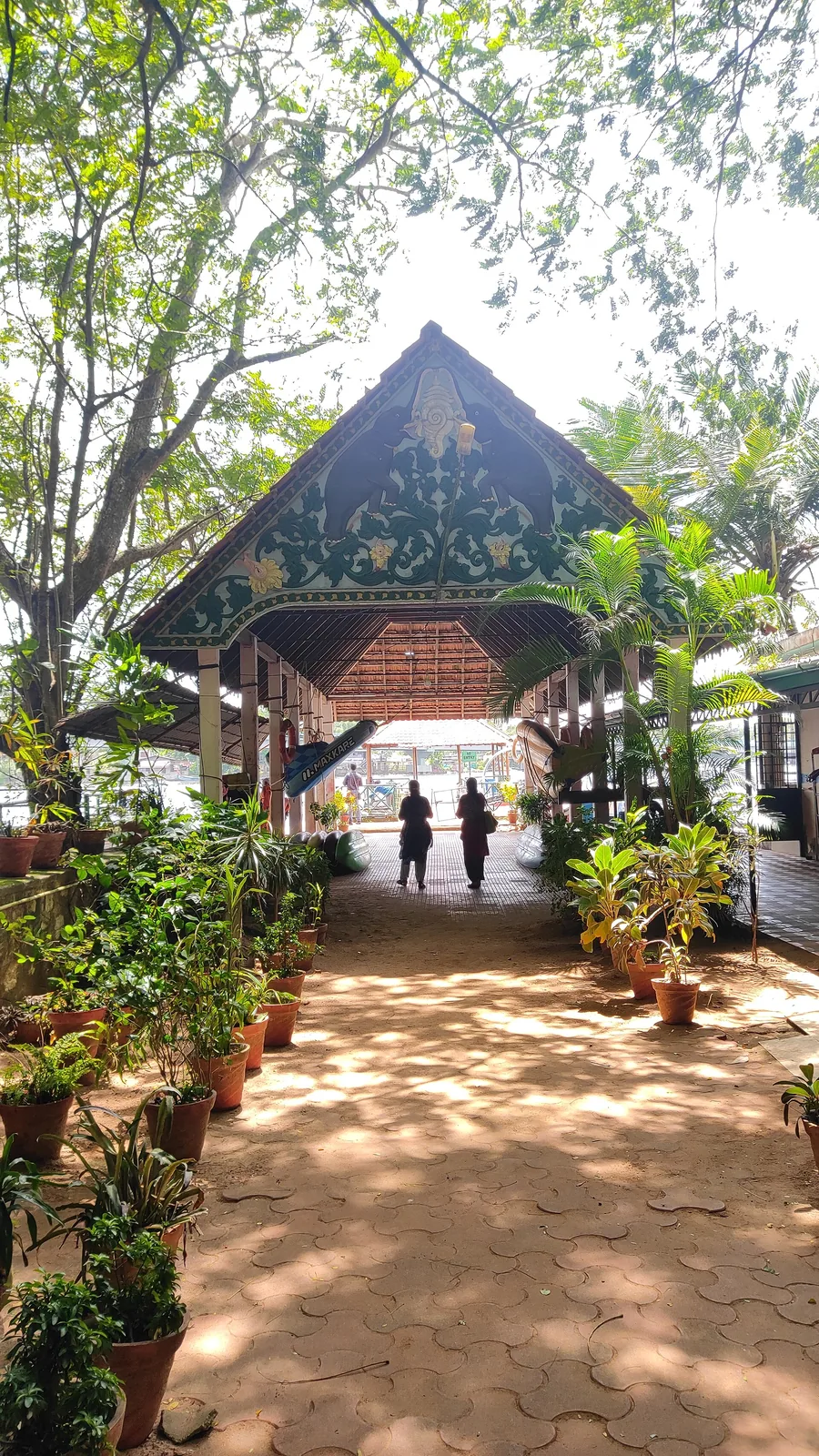
2.6 km · straight line
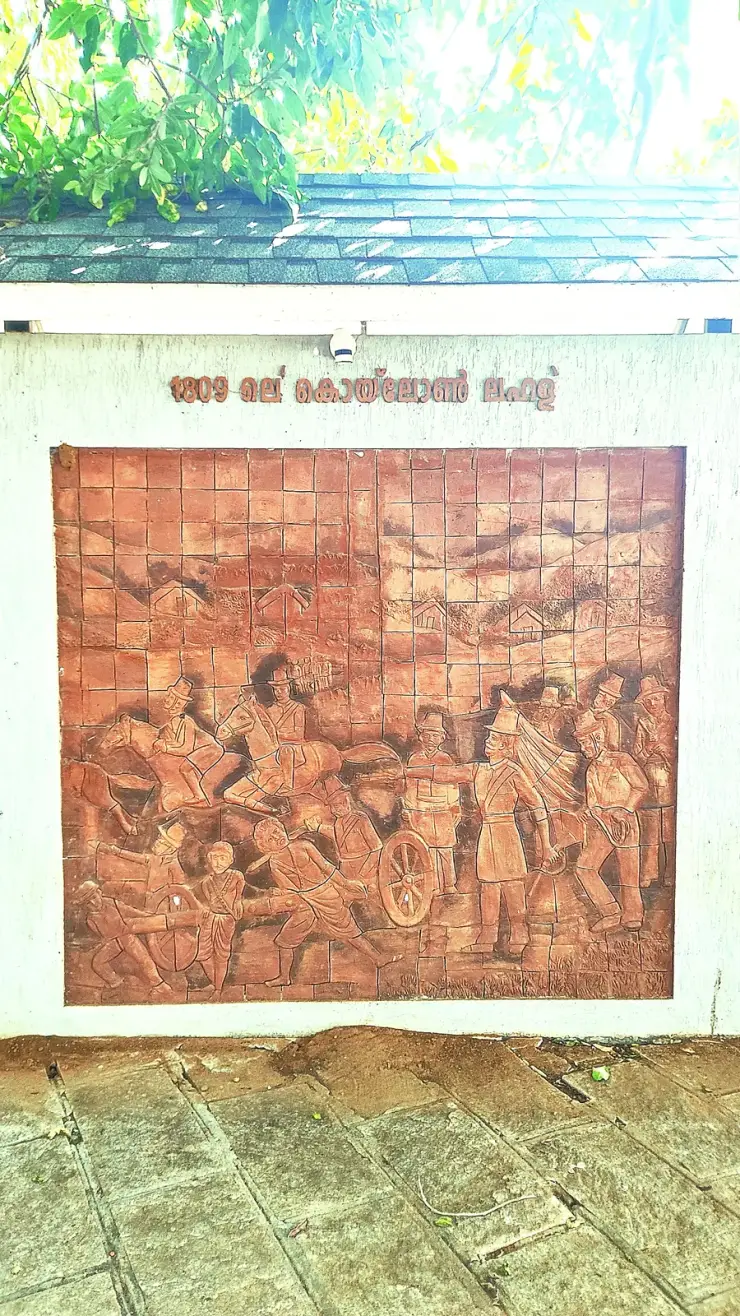
Forty-eight acres of municipal park on the Ashtamudi shore in the middle of Kollam, run by the DTPC — boating and kayaking off a painted jetty, ziplines and rope courses, a heritage walkway of terracotta reliefs, contemporary sculpture left behind by a 2012 festival, and a mangrove wetland with a state biodiversity heritage tag.
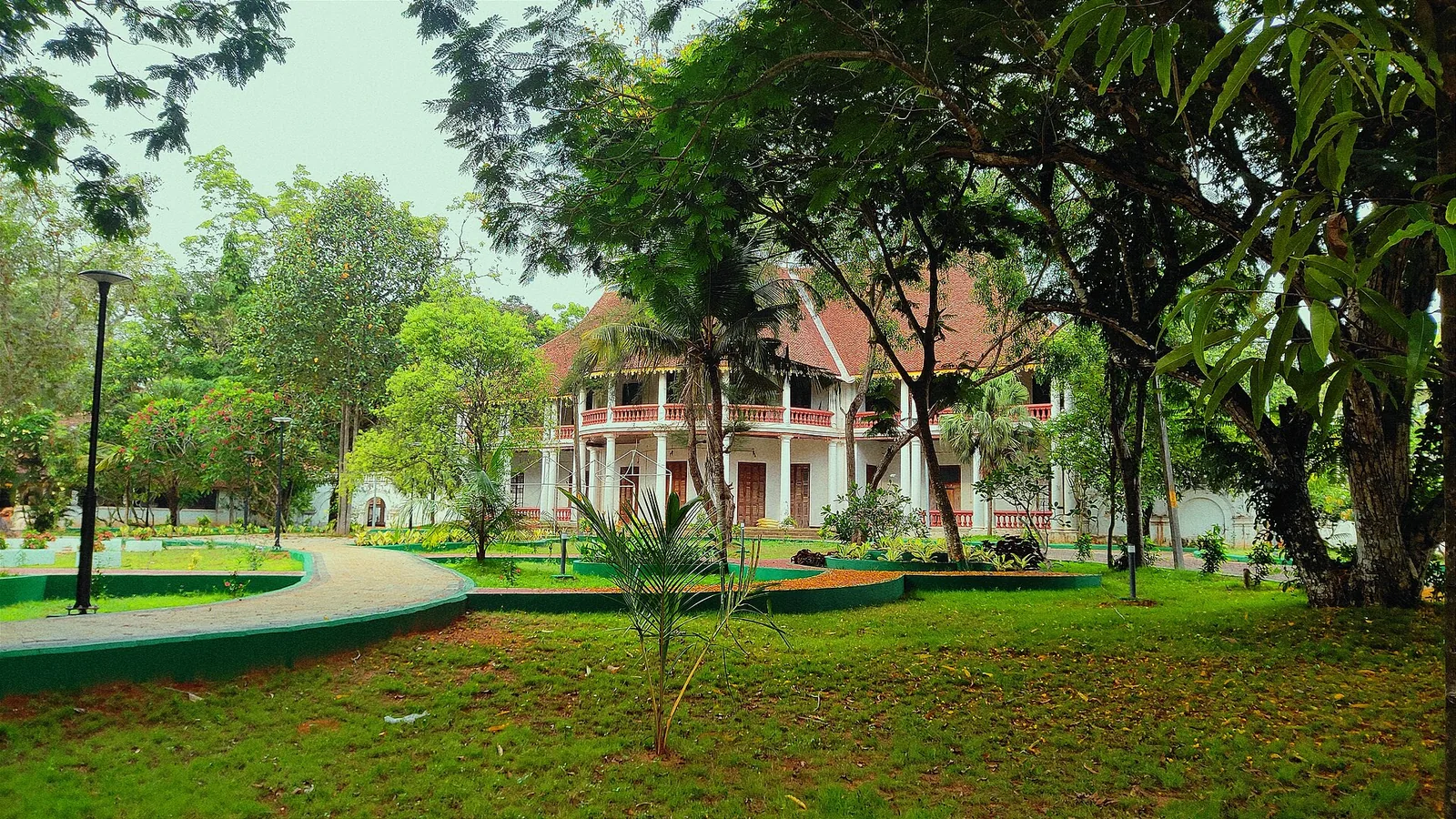
2.6 km · straight line
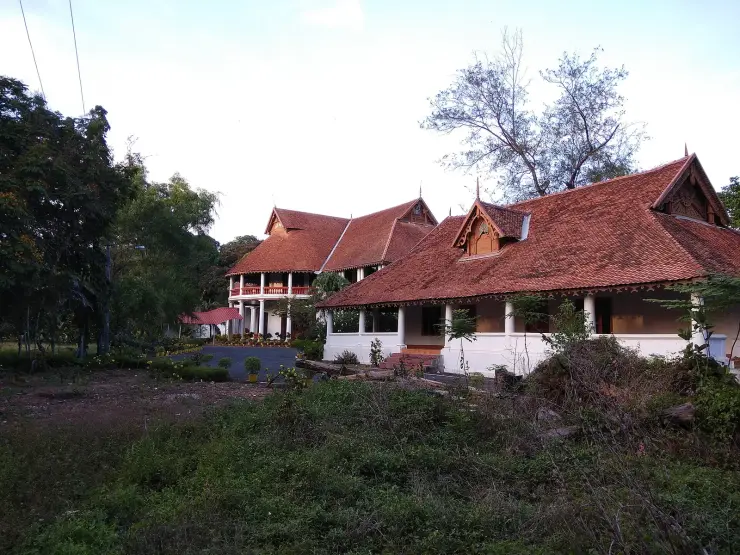
The former British Residency at Asramam survives as a government guest house beside Kollam’s backwater landscape. Its architecture is the attraction, with access governed by its working use.
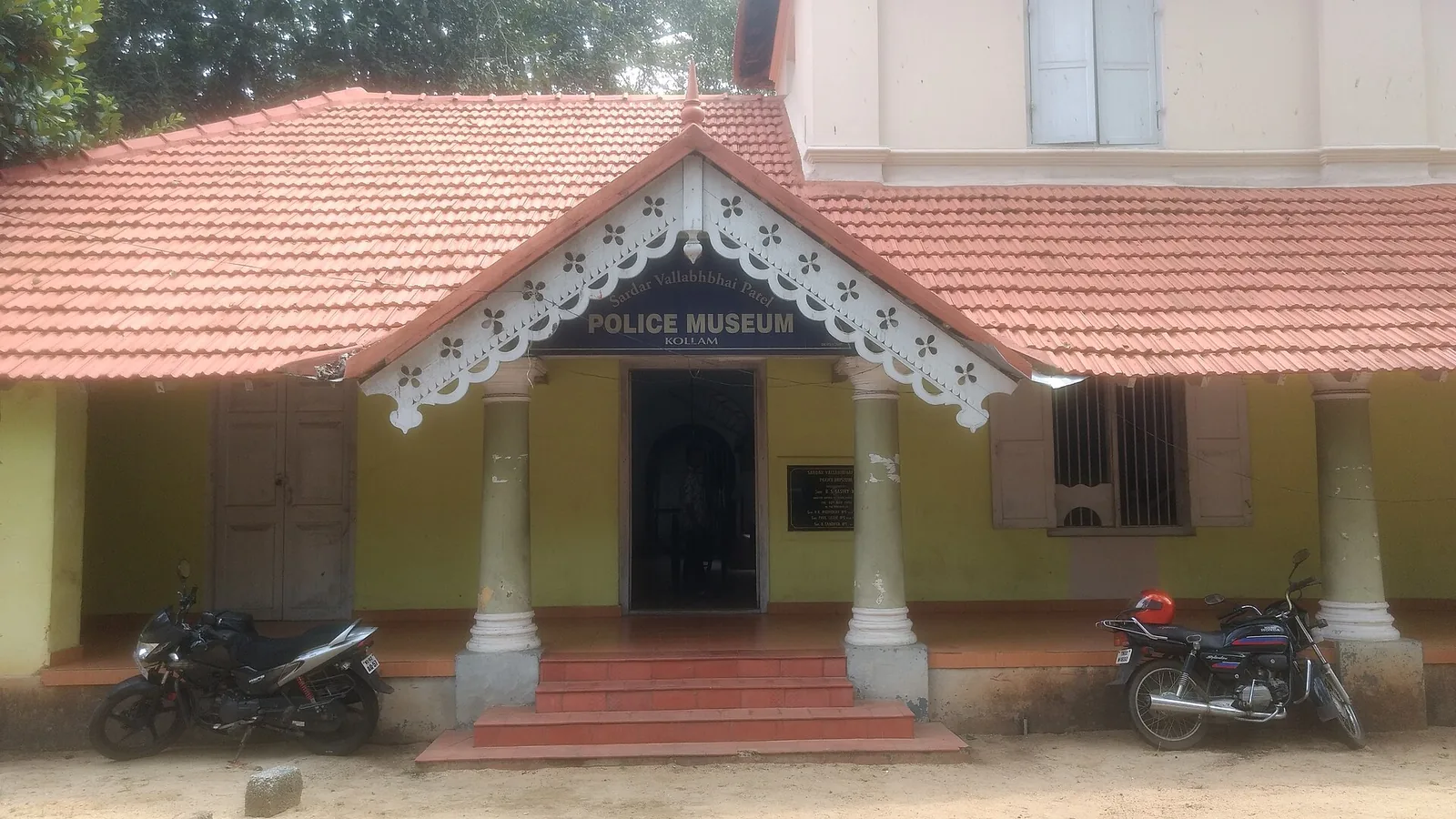
1.1 km · straight line
Kollam’s Sardar Vallabhbhai Patel Police Museum introduces the history of policing through arms, equipment and investigation displays. It offers an indoor history stop during a city outing. Check the museum’s session before choosing your day, and leave time to read the displays.
1.0 km · straight line
The working wharf and breakwater at Thangassery, conventionally founded in AD 825 — the event the Malayalam calendar counts from. A short cargo quay and a long public breakwater walk, above a seabed that has produced Tang and Song coins and Lower Palaeolithic tools.
Roampedia is commission-free — own or know a stay, eatery, guide or shop near Kollam Beach? Submit public business details for review.
Add a nearby businessEntry: No entry fee for the beach; the adjacent Mahatma Gandhi Park and the Tangasseri Lighthouse may charge a small ticket, with extra fees for any rides or camera use.
Festivals: The beach and waterfront come alive around the Kollam Pooram festival and the town’s famous President’s Trophy Boat Race season on the nearby Ashtamudi Lake; onam and coastal fishing-community festivals also draw crowds.
Photography: Free for personal phone and camera photography on the beach; the promenade, palms and sunsets are highly photogenic. Any tripod, drone or commercial shoot may need permission, and separate ticketed sites like the lighthouse can charge a camera fee.
If you are travelling by bus or ferry, check the return service with the operator before setting out. Leave time to reach the stop or jetty after your visit.
Ask at the bus stand for the time of the last service back, not the next one. If you miss it, an auto or app cab is the fallback — agree the fare before you get in.
If you need step-free access, contact the site before travelling. Ask about a level entrance, steps along the route, the nearest drop-off point, seating and accessible toilets.
Charge cap and free-transaction limits: Reserve Bank of India, ATM FAQ updated 4 July 2025; checked 4 October 2026.
These services are listed within about 1.2 km of Kollam Beach. Walking distances follow mapped routes; access and opening hours can change. Other services may be closer but are not included here.
Published emergency and visitor-assistance contacts. For an immediate emergency, call 112. Shared Kerala contact sources checked 4 October 2026; publication does not establish a tested live response.
The working wharf and breakwater at Thangassery, conventionally founded in AD 825 — the event the Malayalam calendar counts from. A short cargo quay and a long public breakwater walk, above a seabed that has produced Tang and Song coins and Lower Palaeolithic tools.
1.0 km · straight lineKollam’s Sardar Vallabhbhai Patel Police Museum introduces the history of policing through arms, equipment and investigation displays. It offers an indoor history stop during a city outing. Check the museum’s session before choosing your day, and leave time to read the displays.
1.1 km · straight lineForty-eight acres of municipal park on the Ashtamudi shore in the middle of Kollam, run by the DTPC — boating and kayaking off a painted jetty, ziplines and rope courses, a heritage walkway of terracotta reliefs, contemporary sculpture left behind by a 2012 festival, and a mangrove wetland with a state biodiversity heritage tag.
2.6 km · straight lineThe former British Residency at Asramam survives as a government guest house beside Kollam’s backwater landscape. Its architecture is the attraction, with access governed by its working use.
2.6 km · straight lineThangassery Lighthouse raises Kollam’s sea view above a historic coastal neighbourhood. The red-and-white tower is a working navigation landmark with a separate visitor session.
2.9 km · 4 min driveAnandavalleeswaram is an active Shiva temple in Kollam, with an Anandavally shrine and a ten-day annual festival in March or April. Ritual processions and cultural performances bring another dimension to the temple visit. Follow its worship session, admission and photography rules.
3.0 km · straight lineA Travancore royal residence on the Ashtamudi shore in Kollam, built to be arrived at by boat and now a working NCC establishment — viewed from outside or from the water.
4.0 km · 6 min driveA quiet, curved bay beach west of Kollam town, calmer than the city beach and good for a relaxed evening.
5.4 km · 7 min drive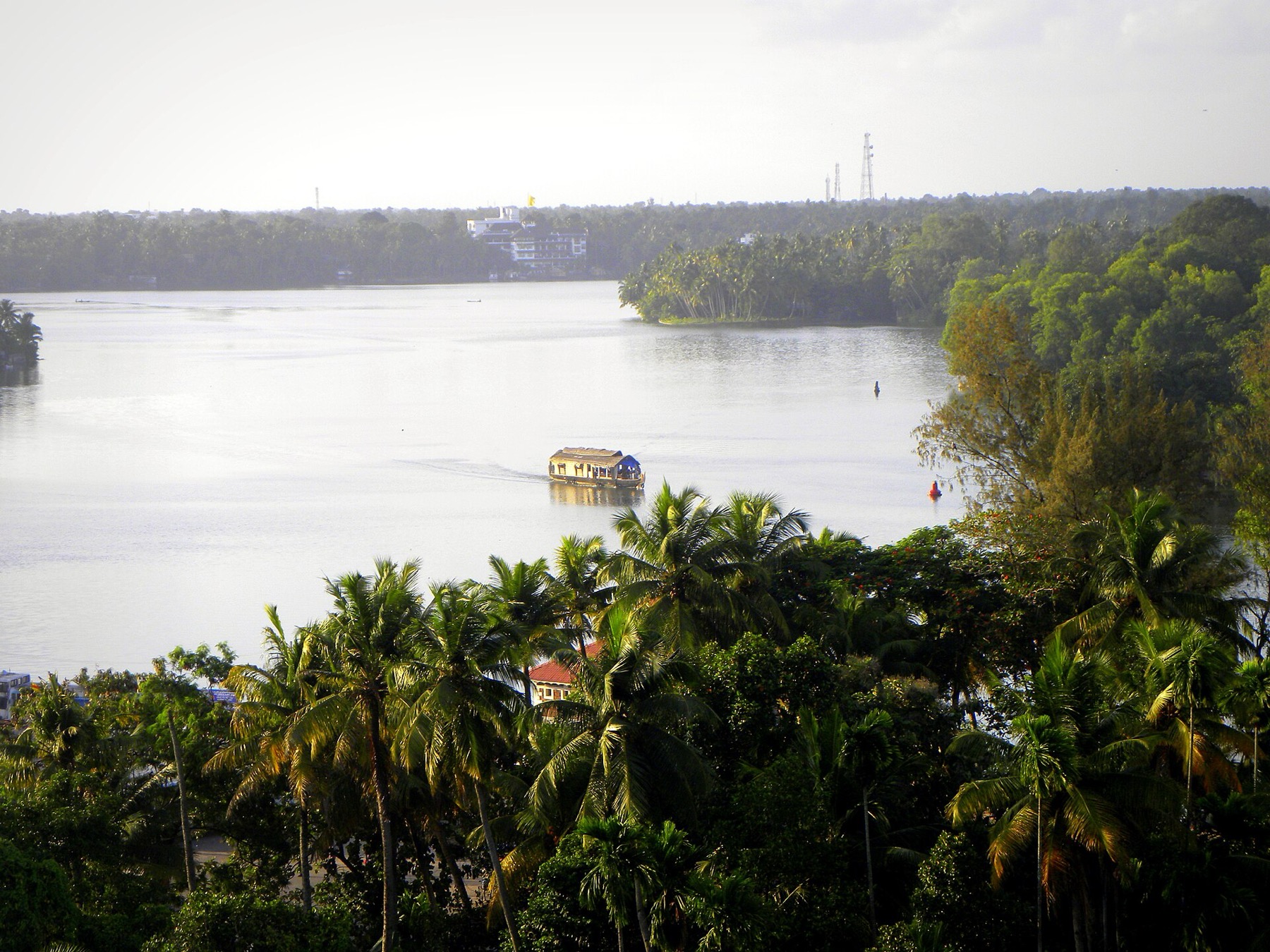
The open-water outlooks on the Munroe Island and Perumon side of Ashtamudi, where the lake widens out — the wide views the canal trips themselves do not give you.
9.3 km · straight lineBy most accounts Kerala’s largest fishing harbour, at the mouth of Ashtamudi Lake about 9 km from Kollam town, and where Indian fishing was mechanised; two bridges cross the confluence and the early-morning auction is the sight to catch.
10.5 km · 14 min driveThe estuary and beach at Paravur south-east of Kollam, where the Paravur backwaters meet the sea across a sandbar — a quiet spot known for its regulator bridge, the TS Canal and calm backwater-and-sea scenery.
11.8 km · 15 min driveLarge palm-fringed backwater system and houseboat base around Kollam.
17.7 km · 22 min driveRoad and walking figures are route estimates, with travel times dependent on access, traffic and conditions. Figures marked “straight line” show direct separation and do not describe a road or walking route. Fare estimates use Kerala’s 26 April 2022 auto/taxi notification and exclude waiting, night and applicable one-way surcharges. Confirm the current meter or operator quote before travelling. Routing: © openrouteservice.org by HeiGIT | Map data © OpenStreetMap contributors
Nearby toilets, pharmacies, ATMs, seating and vets are community-mapped and may be incomplete or out of date. Map data © OpenStreetMap contributors | Walking times © openrouteservice.org by HeiGIT
Yes, they are the same shore, and locals use both names interchangeably. One honest caveat: we could find no Government Order, Corporation resolution or gazette entry actually conferring the name — every source is circular, and the beach appears to be called Mahatma Gandhi Beach simply because the park beside it is Mahatma Gandhi Park. Treat it as the name in use rather than an official designation, and be wary of any site that offers you a Gandhi visit or a naming date to go with it; there is no record of either.
Plan a shore visit rather than swimming or wading, and follow local warnings. A warning board on the beach records fifty-one lives lost in ten years, and reporters covering it believe the true figure is over a hundred. The danger is depth rather than surf: the bottom drops to about a metre and a half at the water's edge and more than three metres just two metres out, and scoured sand leaves hidden pits. Lifeguards have been posted since 2005 but were seven strong against a requirement of twenty as of late 2025, on duty roughly 07:00 to 19:00 — so the beach is unguarded in the evening. Keep children away from the water and do not assume that a rope or shallow-looking water establishes a safe swimming area.
It is very close — roughly 2 to 3 km from Kollam Junction railway station and the town centre, an easy auto-rickshaw ride or a walk for the energetic.
The old Thangassery quarter just to the south is the highlight, with the 1902 Tangasseri Lighthouse, the ruins of Portuguese and Dutch forts and 18th-century churches. The Ashtamudi backwaters, boat jetty and houseboat cruises are also close by.
The lighthouse is generally open to visitors during set afternoon hours for a small fee, and the climb rewards you with sweeping views of the coast and town. Opening days and hours vary, so check on the day.
Late afternoon into sunset is the most rewarding time of day, and October to March is the most comfortable season. The June to September monsoon brings heavy rain and rough seas. One practical note: lifeguard cover ends around 19:00, so if you come for the sunset crowd, treat the water as unsupervised.
We could not substantiate it, and the balance of evidence is against it. The claim rests on an unsourced sentence that appears to originate with a hotel immediately behind the park which markets itself as Kerala's top beach-wedding destination. Kerala Tourism's own first destination-wedding centre was inaugurated at Shanghumukham Beach in Thiruvananthapuram on 17 November 2023, with the first couple married there on 30 November. Kollam Beach is a long-established venue for beach weddings; it is not documented as the state's first.
Yes, and quickly. Reporting from October 2025 describes the shore losing roughly twenty metres of sand a year, from an original width of about 150 metres, with about six metres of usable beach left in places and the lifeguards' safety rope moved back nearly to the road. The southern stretch, Vedikkunnu, is going fastest, and Kollam Beach has no proper seawall. Causes are disputed — fishermen point to Kollam Port and the Thangassery breakwater interrupting the drift of sand along the coast, while experts quoted in the same reporting attribute it to monsoon winds and seasonal sea incursion. A study by the Kerala State Coastal Area Development Corporation with IIT Madras was commissioned in March 2022; we found no evidence that the resulting works were built.
Entry: No entry fee for the beach; the adjacent Mahatma Gandhi Park and the Tangasseri Lighthouse may charge a small ticket, with extra fees for any rides or camera use. Timings: Open daily, 24 hours as a public beach, though the pleasant window is roughly early morning to about 10 pm; the adjacent Mahatma Gandhi Park keeps its own fixed hours, typically around the afternoon and evening.
Base yourself in Kollam town or a nearby town in Kollam, then confirm the last-mile route locally before leaving. Arrive before sunset if you want photos and a calmer walk; beach roads can slow down in the evening. If the visit depends on forest, temple, boat, ferry, weather or seasonal access, check the official/local rule on the day before travel.
1 to 3 hours, longer if staying for food or sunset.
Nearby you can pair Port of Kollam (1.0 km, approximate straight-line separation), Sardar Vallabhbhai Patel Police Museum (1.1 km, approximate straight-line separation), Asramam Adventure Park (2.6 km, approximate straight-line separation), British Residency, Asramam (2.6 km, approximate straight-line separation).
Do not swim during rough-sea warnings. Avoid isolated stretches after dark unless with a trusted local/operator.
Written about Kollam Beach itself — its history, its legends and the arguments about them.
These guides explore Kollam town and the surrounding area. Choose a visit that fits your interests, allowing separately for travel between stops.
Route-level itineraries and practical guides for the rest of Kerala.
Photographs: Akash Dominic (CC BY-SA 4.0), Akhilan (CC BY-SA 4.0), Arunvrparavur (CC BY-SA 3.0), Sreekuttanvpillai (CC BY-SA 4.0), jay8085 (CC BY 2.0), MalavikaM05 (CC BY-SA 4.0). Wikimedia Commons.