Nilambur is a municipality of some 46,000 people on the Chaliyar, forty kilometres up the valley from the plains and about sixty from Kozhikode, at the point where Malappuram district runs out of flat ground and climbs into the Nilgiris. Everything about it was arranged around timber. The Nilambur Rajas held the largest estates in old Ernad from a kovilakam at Thacharakkavu; the British planted the world’s first scientific teak plantations on the river bank in the 1840s; a railway was built in 1927 for the single purpose of taking the logs out, and it still ends here. What the visitor finds now is a hot, busy market town with two forest depots, a terminus station under trees, a temple to a hunter-god, and — beyond the last bus stop — the New Amarambalam forests, where one of the last cave-dwelling communities in India still lives.
The town reads as one long street. Traffic backs up under old roadside trees between the municipal bus stand and the Kovilakam road, and the registration plates all read KL-71, Nilambur having had its own transport office since the taluk headquarters settled here. The municipality covers 30.79 square kilometres and recorded 46,366 people in the 2011 Census; the taluk around it covers 1,343 square kilometres and held 574,059. That ratio is the town in one line — a small urban knot serving an enormous, mostly forested hinterland of eight panchayats, from Edakkara and Chungathara in the west to Karulai, Amarambalam and Vazhikkadavu against the Tamil Nadu border.
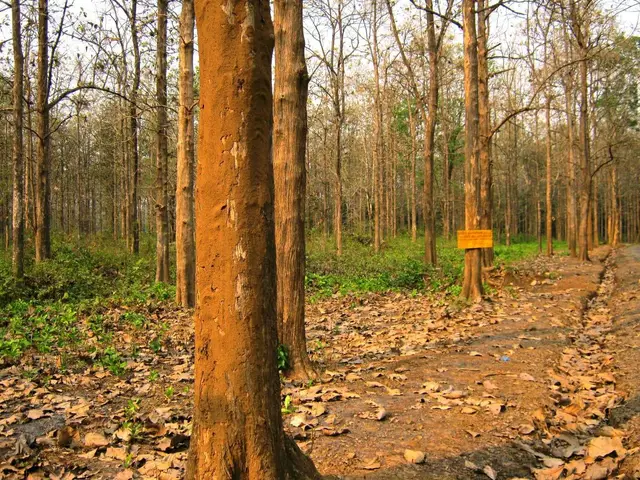
Two things still make this a timber town rather than a town that used to be one. The first is the Forest Department’s depots. Trees inside the preservation plots are only sold after they have fallen of their own accord, and when one does the auction can be extraordinary: on 10 February 2023, at the Nedumkayam depot, a 114-year-old Nilambur teak of about eight cubic metres was cut into three and sold for ₹23 lakh, ₹11 lakh and ₹5.25 lakh — ₹39.25 lakh for one tree. Across Nilambur’s two depots roughly 6,000 cubic metres are sold in a normal year, most of it to buyers from Kerala, Tamil Nadu, Karnataka and Andhra Pradesh, and most of it destined for house-building rather than anything grander.
The second is the name itself, which is now legally protected. Nilambur teak became the first forest produce in India to be given a Geographical Indication, on application number 543 filed on 18 January 2016 by the Kerala Agricultural University together with the Nilambur Teak Heritage Society, the Kerala Forest Research Institute and the state forest department. Sources differ on the year the tag was actually granted — some report the approval reaching Kerala in the last week of 2017, others date the registration to 2018, and we have not been able to reconcile them. The registered area is Nilambur taluk plus the Edavanna panchayat of Ernad taluk. What is being protected is a colour and a grain: a deep golden brown, unusually straight boles, close growth rings and a resistance to fungus and termite that made the wood worth carrying halfway round the world.
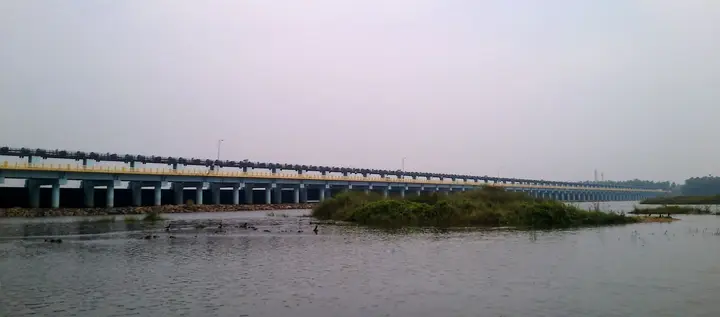
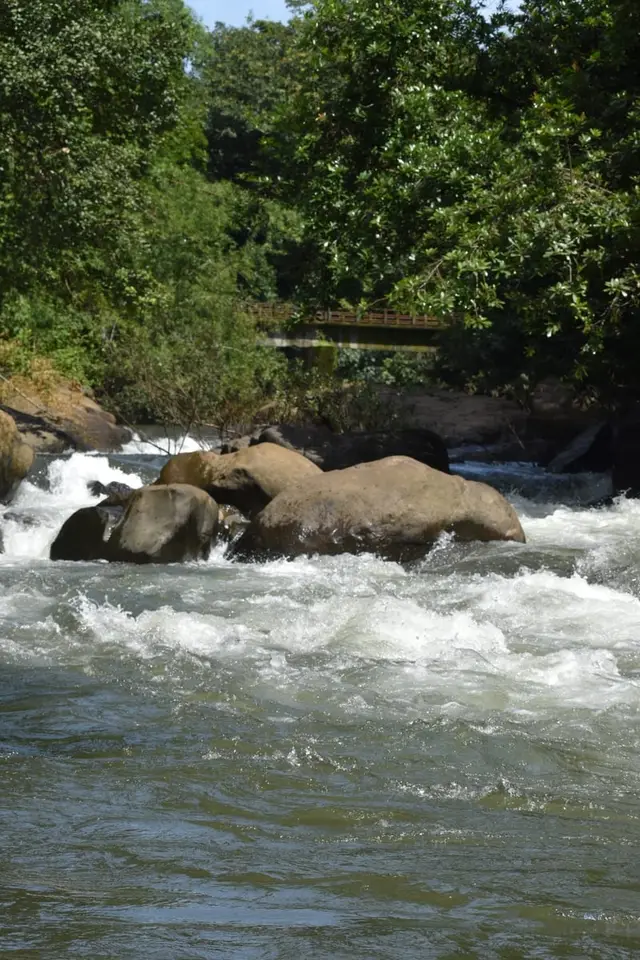
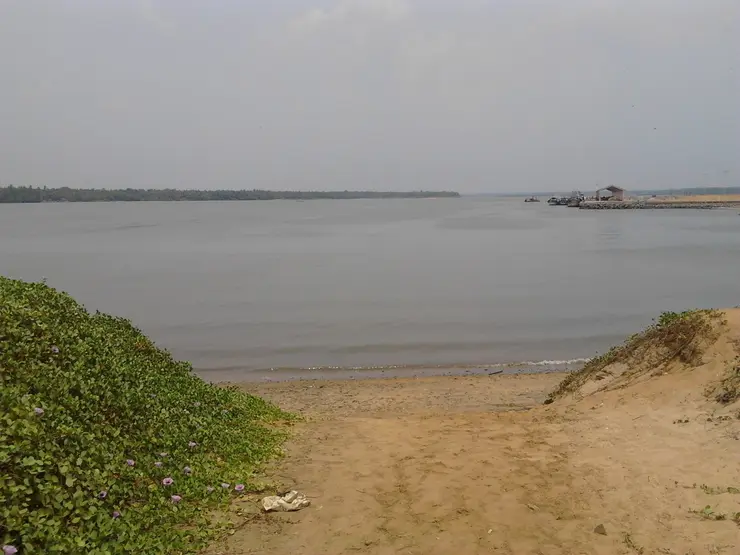
The Chaliyar is the reason the town is where it is. It rises in the Nilgiri hills across the Tamil Nadu line, runs 169 kilometres to the sea at Beypore and is the fourth-longest river in Kerala, and for the better part of a century it was Nilambur’s only export route — logs rolled in at the kadavus and floated down on the monsoon flood to the mills at Kallayi. That trade is finished; forest protection ended it and the ships are built now from imported plantation wood. The river also carries gold, genuinely rather than figuratively: surveys in the Chaliyar valley at Nilambur have reported placer deposits of the order of 2.5 million cubic metres carrying about 0.1 grams of gold per cubic metre, which is a real deposit and a hopeless one to work.
What happened to that river afterwards is one of the defining environmental stories in Kerala, and it is worth being exact about the geography, because Nilambur is not where it happened. Under a contract signed with the state government on 30 May 1958, the Birlas’ Gwalior Rayons built the world’s first bamboo-based rayon pulp plant at Mavoor, about fifty kilometres downstream in Kozhikode district. The state supplied bamboo from its own forests at a rate reported as one rupee a tonne, along with subsidised water and power. For thirty-eight years the plant discharged into the Chaliyar. The fish went first, then the fishing families, then the people.
The agitation against it was led from Vazhakkad by K. A. Rahman (1940–1999), who founded the Chaliyar Action Committee and ran what may be the only village cancer register in Kerala compiled by a layman: 213 cancer deaths recorded in his own village. An agreement known as the Rama Nilayam pact was signed with the management in 1974 and settled nothing. In December 1998 Rahman marched roughly 7,000 people to the factory gates and demanded closure outright. He died of cancer the following year. The plant stopped and was wound up — sources give early 2000 for the shutdown and 2001 for the permanent closure, and we print both — and the Chaliyar has, by every account since, come back. Total deaths attributed to the effluent are usually put at around 300, which is an estimate and should be read as one.
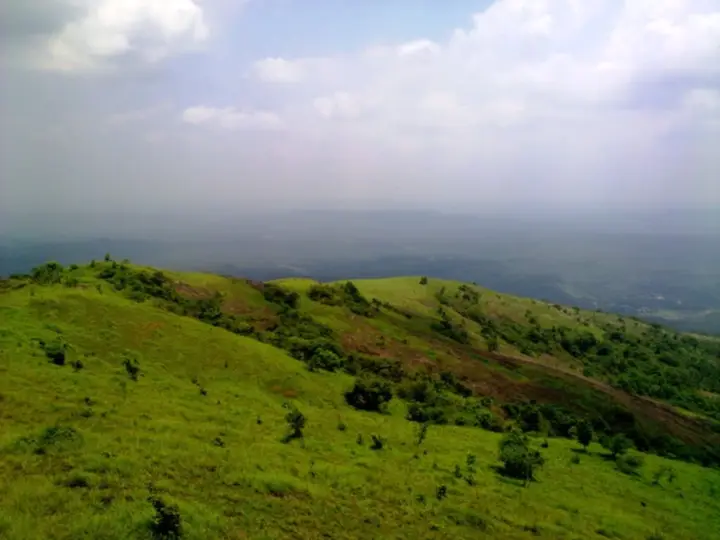
East of the town the land stops being agricultural and becomes something else. The Karimpuzha Wildlife Sanctuary was notified on 3 July 2020 over 227.97 square kilometres of the revenue villages of Karulai, Moothedam and Amarambalam, taking in the New Amarambalam Reserved Forest — country that runs up against Silent Valley and the Nilgiris and holds some of the least-disturbed evergreen forest left in the state. It is also home to the Cholanaikkan, a Particularly Vulnerable Tribal Group who live in shallow rock shelters, the alai, in hamlets scattered through Karulai, Manjeeri, Kuppamala, Uchakulam, Kalkkulam and Poochapara.
They are not a sight and this page will not treat them as one; there is no visitor access to their settlements and none should be sought. What can honestly be said is that they are among the very few communities in India still living substantially in caves, that they speak their own Dravidian language, and that the published population figures disagree so sharply that no single number can be quoted. The 2011 Census counted 124. The Nilambur tribal development office told Mongabay-India in November 2025 that the figure is probably nearer 250. Other reference sources cite 360 at the 1991 Census and 191 more recently, and researchers put the community at around 400 in the 1960s. C. Vinod, the first Cholanaikkan to complete postgraduate study and go on to doctoral research, has spent it documenting what is being lost: a 2023 study recorded 102 plant species traditionally used by the community, many of which have become hard to find as drought, Lantana and Senna spread through the understorey.
The last thing to know about Nilambur is that it sits under unstable hills. On the evening of 8 August 2019, after a week in which the Malappuram subdivision took 189.4 millimetres of rain against a normal of 114.3, the Muthappan hill came down on the settlement of Kavalappara near Pothukallu, in this taluk. Fifty-nine people were killed. It remains one of the worst landslides in Kerala’s recent history, and it is the reason that anyone reading the forest road network here as simply scenic is reading it wrong.
Legend & myth
The god of this town is a boy who was given a knife on condition that he stop using his bow. Vettakkorumakan — the name is usually read as “the son born for the hunt”, and he is also called Vetteykkoru Swami, Kirata Sunu and Hara Sutan — is the family deity, the paradevata, of the Nilambur Kovilakam, and his temple stands in the Kovilakam grounds at Thacharakkavu. Nilambur is one of only three principal seats of his worship; the others are the Balussery fort near Kozhikode, the seat of the Kurumbranad Rajas, and the Nambumala or Nambumilai fort over the ghat at Gudalur. He is described in the tradition as a guardian of the highlands, which is exactly the country the Nilambur rajas held.
His parentage comes from an episode we deliberately do not retell here. Shiva and Parvati took the form of a Kirata hunter and his huntress wife in the forest, and out of that forest marriage a child was born. The duel with Arjuna over the boar, the testing of the archer and the granting of the Pashupatastra belong to Kadampuzha, further west in this same district, and our record for that temple tells the episode in full. What belongs to Nilambur is not the fight but the child, and the child’s story goes somewhere the Arjuna story never does.
He was, by every telling, an appalling infant. The boy had his parents’ power and none of their restraint, and he made life impossible for gods and men alike, hunting with a divine bow because nobody had thought to tell him not to. The solution was a trick rather than a punishment. Vishnu came to him disguised as an old hunter and offered him a churika — a short heavy dagger-sword, beautiful enough that the boy wanted it immediately — and named a price: he could have the blade only if he gave up the bow and turned from harming people to protecting them. He agreed. It is a small, strange, very specific bargain, and it is the whole theology of the deity: a weapon accepted in exchange for a weapon surrendered, and a hunter converted into a guard. He then travelled south into Kerala and, in the telling, entered the fort at Balussery first.
The way he is honoured here is unusual enough to have its own name. The Nilambur Pattu is a distinctive local form of kalamezhuthum pattum — the ritual in which the deity’s image is drawn on the temple floor in coloured powders and then sung to, and finally erased. The Kovilakam’s own records call the observance the pattu adiyanthiram, an obligation of the household rather than a public entertainment, and the singing is performed by the Kuruppanmar, the Kurup families whose hereditary work this is. The festival falls in the Malayalam month of Dhanu, December into January, and runs six days.
The tradition attached to it is that the people of the surrounding forests came down out of the hills at this season to sing before the deity and to be received by the Kovilakam, and that the relationship ran in both directions — the raja’s authority over the forest was acknowledged in the songs, and the forest’s claim on the raja was acknowledged in the reception. It is a plausible account of how a hill kingdom actually worked, and we would like it to be well documented. It is not: the fullest statements of it we can find are the Malayalam-language temple accounts and an English encyclopaedia article that is itself flagged for want of citations, and we would rather say so than dress it up.
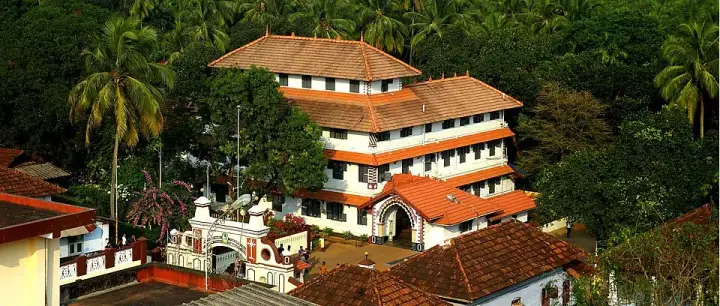
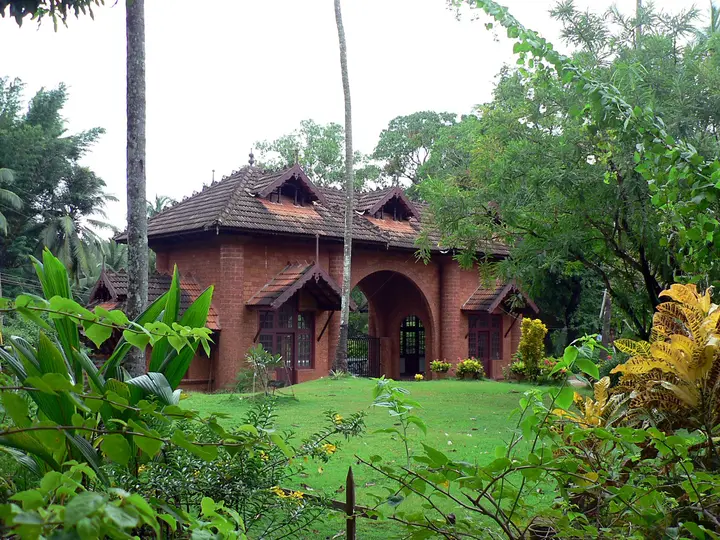
What has certainly happened is that the festival has escaped the family. The Nilambur Pattu Utsavam is now run as a town event by the municipality and the traders’ associations, with participants of every religion, and the Kovilakam — which once held the largest landholdings in old Ernad, reaching south over the ghat into what is now Gudalur in Tamil Nadu, and which gave the elephant later famous as Guruvayur Kesavan to the Guruvayur temple in 1922 — is today an ordinary family living in an old house behind an arched gatehouse on a public road.
Two legends have to be refused before they attach themselves to this town. The first is the story of the great teak that bled red sap when a contractor raised an axe to it, so that misfortune fell on him and the tree was spared. That tree is Kannimara, and it stands in the Parambikulam Tiger Reserve in Palakkad, some 150 kilometres away. Nilambur has its own old tree with a near-identical name — Kannimari, in the preservation plot on the river — and the two are constantly and understandably confused. The bleeding-axe story is Parambikulam’s, and we leave it there. The second is anything presented as Cholanaikkan belief. Fragments circulate; we have not found a source for any of them that we would trust enough to publish, and second-hand sacred material taken from a community of a few hundred people is not ours to print. Their absence from this section is a decision, not a gap.
More about Nilambur
History
The oldest claim made for Nilambur is one we can only report at second hand. The Malayalam Wikipedia article on the town states that a copper plate dated to 470 CE was found near the Karikkat temple, which would make it one of the earliest documents from this part of Malabar. We can find no scholarly citation for it and a fifth-century Kerala copper plate would be a remarkable object, so we record the claim, name where it comes from, and do not build on it.
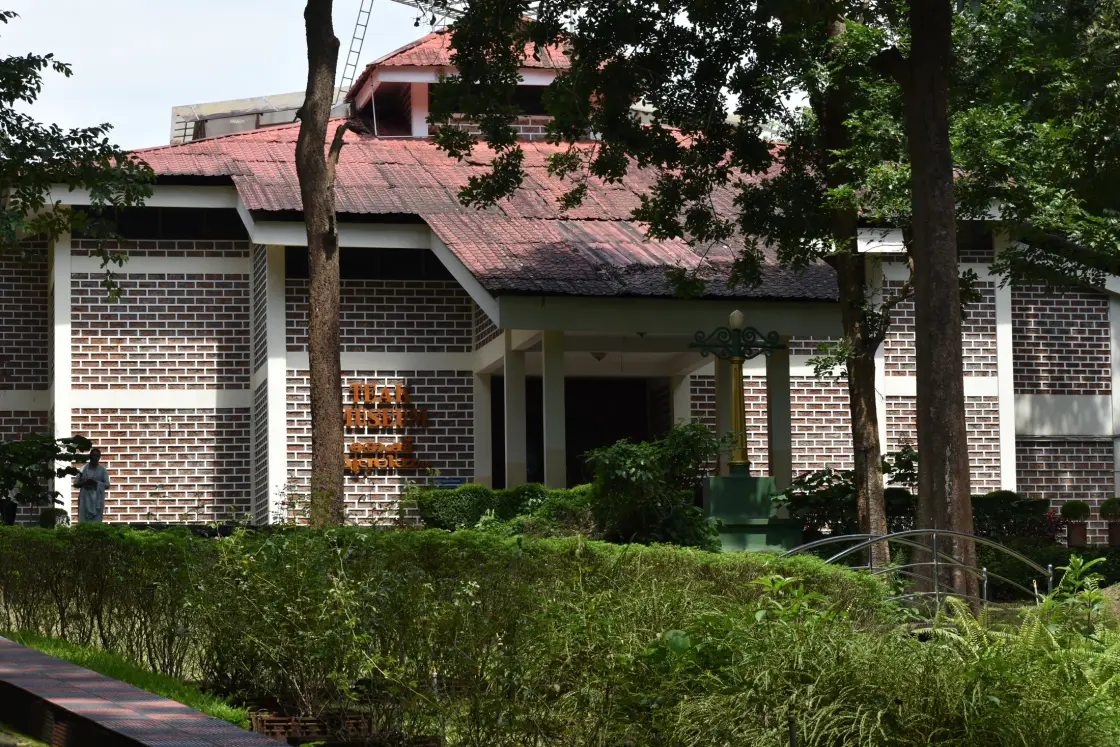
The documented history is a feudal one. The Nilambur Rajas held their kovilakam at Thacharakkavu, traced their descent from the Nediyirippu Swarupam and ruled as vassals of the Zamorin of Calicut, and by the nineteenth century held the largest landed estates in the old Ernad country, extending south over the ghats into present-day Gudalur. It was these forests that the Madras administration wanted. Under Henry Valentine Conolly, Collector of Malabar from 1841 to 1855, teak seed was first broadcast on the Chaliyar bank in 1842 and the first nursery-raised, pre-treated seedlings went in in 1844 — the work of Chathu Menon, Sub-Conservator of Forests, who solved the germination problem and is buried at the plot. The surviving preservation plot is commonly dated to 1846. Our records for Conolly’s Plot and the Teak Museum tell that story properly; what matters here is that it turned a hill town into a supply depot for an empire.
The railway followed, eighty years later. In 1923 the Madras Presidency contracted the South Indian Railway Company to build a line from Shoranur to Nilambur so that the timber could reach the main coastal route. It opened in three pieces in a single year: Shoranur to Angadipuram on 3 February 1927, Angadipuram to Vaniyambalam on 3 August 1927, and the full run to Nilambur on 26 October 1927. During the Second World War the track was lifted for military use elsewhere; public pressure got it relaid on the same alignment after independence, reaching Angadipuram again in 1953 and Nilambur in 1954. It is 66 kilometres of single broad-gauge line through eleven intermediate stations, it was fully electrified on 1 January 2025 when the Melattur traction substation was commissioned, and it remains one of the shortest and least-hurried main lines in India.
The line that was never built matters almost as much locally. A rail link from Nilambur through Wayanad to Nanjangud in Karnataka has been proposed since 1881 — 236 kilometres of broad gauge that would give Kerala a second route into the Deccan. The Planning Commission costed it at ₹4,266 crore in 2010; more than 22 kilometres would cross the Bandipur tiger reserve and the Wayanad wildlife sanctuary; the Kerala High Court rejected a petition to compel it in 2013 on the ground that road links already existed, and the Railways have treated it as economically unviable. Reference sources describe the project as shelved, while news reports from January 2024 describe a final location survey getting under way with Kerala funding. Both statements are in circulation and we do not pick between them; nothing has been built.
The civic history is short. A panchayat was constituted in 1936 under British administration; the town attained municipal status in 2010 and was raised from third-grade to second-grade municipality in 2014, and it is the headquarters of Nilambur taluk. On 2 September 2022 Nilambur joined the UNESCO Global Network of Learning Cities. The constituency of the same name covers eight grama panchayats — Amarambalam, Chungathara, Edakkara, Karulai, Moothedam, Nilambur, Pothukal and Vazhikkadavu — and returns a member to the Kerala Legislative Assembly.
The most recent history is the forest reasserting itself and the state finally recognising it. Karimpuzha Wildlife Sanctuary was notified on 3 July 2020 over 227.97 square kilometres of Karulai, Moothedam and Amarambalam, protecting the New Amarambalam forests that had been logged, leased and surveyed for a century. Eleven months earlier, on 8 August 2019, fifty-nine people had died at Kavalappara in the same taluk when a hillside gave way. The two dates belong together.
Why visit
It is the only railhead in Kerala whose entire reason for existing was a tree, and the terminus platform under its canopy is worth the branch-line journey on its own.
The Kovilakam temple at Thacharakkavu is one of just three principal seats of Vettakkorumakan anywhere, and the six-day Nilambur Pattu in Dhanu is a form of kalamezhuthum pattum found nowhere else.
The Chaliyar here is broad, quiet and backed by the Nilgiri ridge — and it is a river that was written off as dead and has recovered, which is rarer than the view.
Nilambur is the practical base for the whole eastern hill belt of Malappuram, with two forest depots, the taluk offices and the district’s best onward road and rail links in one place.
The teak auctions at the depots are a genuine working spectacle rather than a staged one, and they are the only place the GI-protected timber can be seen as timber.
It is a real market town, not a resort: eat where the bus crews eat, and expect heat, traffic and no view of yourself as a tourist.