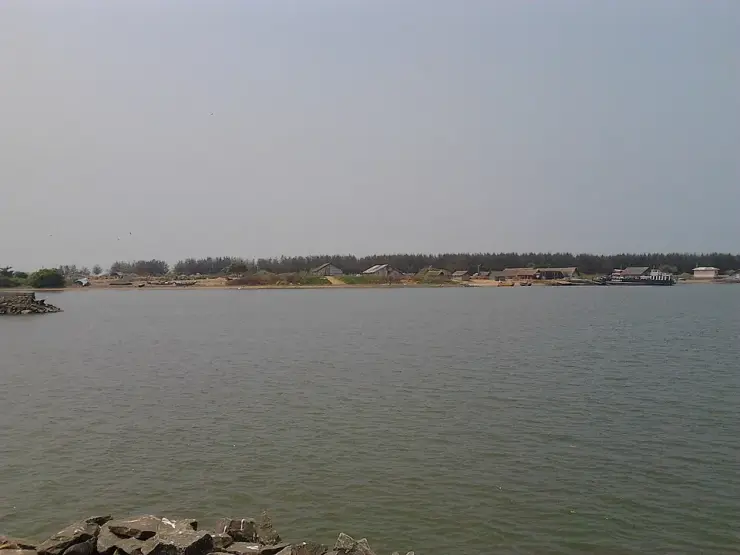
Sand is not usually the point of a place. Here it is the whole of it. Padinjarekkara is a bank of sand a little over a kilometre long, thrown up between a river and the sea and held there by trees somebody planted — open surf down one side, still water down the other, and a road that comes six kilometres down the coast and simply stops. On a Sunday evening it is one of the busiest pieces of coast in Malappuram, and almost nobody on it has come from Ponnani, whose lights are visible across the water.
The story of Padinjarekara Beach
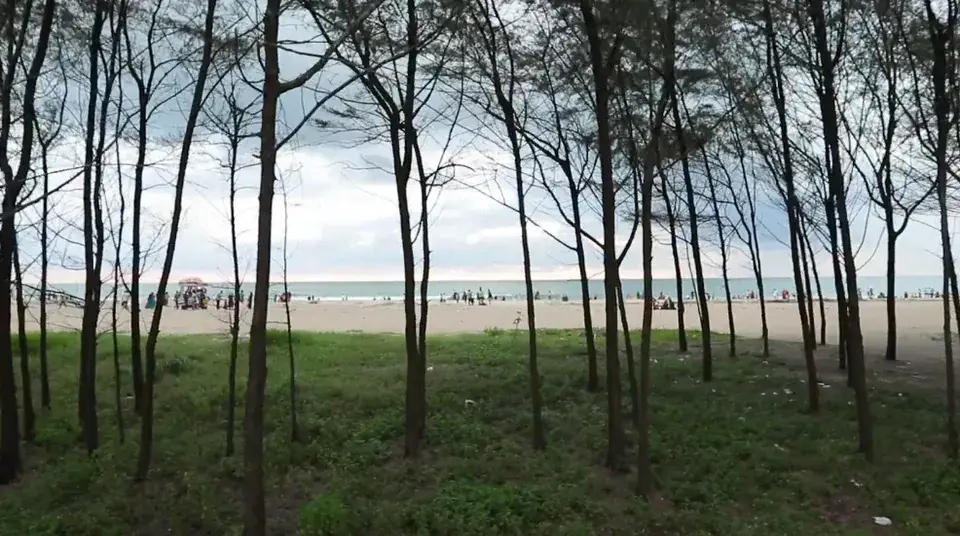
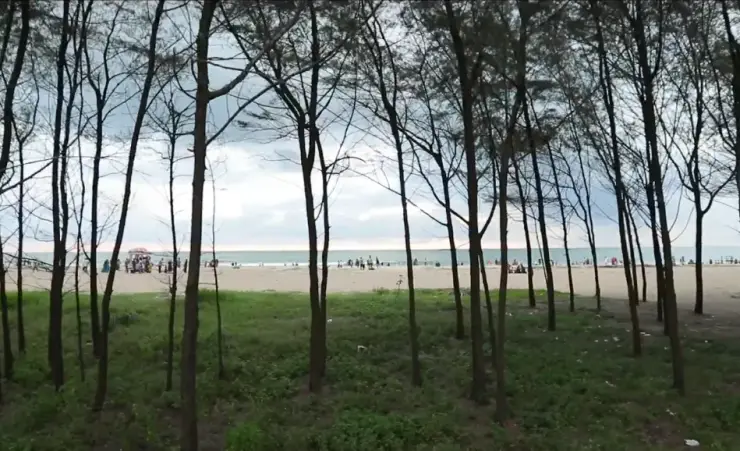
Start with the trees, because they are the reason the beach is usable. A continuous belt of casuarina runs the length of the spit between the sand and the water behind it — thin grey trunks set close, a high thin canopy, and bare ground and grass underneath. Casuarina is not a Kerala tree. It is an Australian coastal species planted along this coast for shelter: it holds loose sand, it takes salt wind, and it grows fast enough to be worth putting in. What it makes is shade with a breeze through it, which on a west-facing beach at four in the afternoon is the difference between an hour outdoors and ten minutes. The district tourism council calls them pine trees and Kerala Tourism calls them casuarina; they are the same trees, and the whistling sound people describe is the wind through their needles.
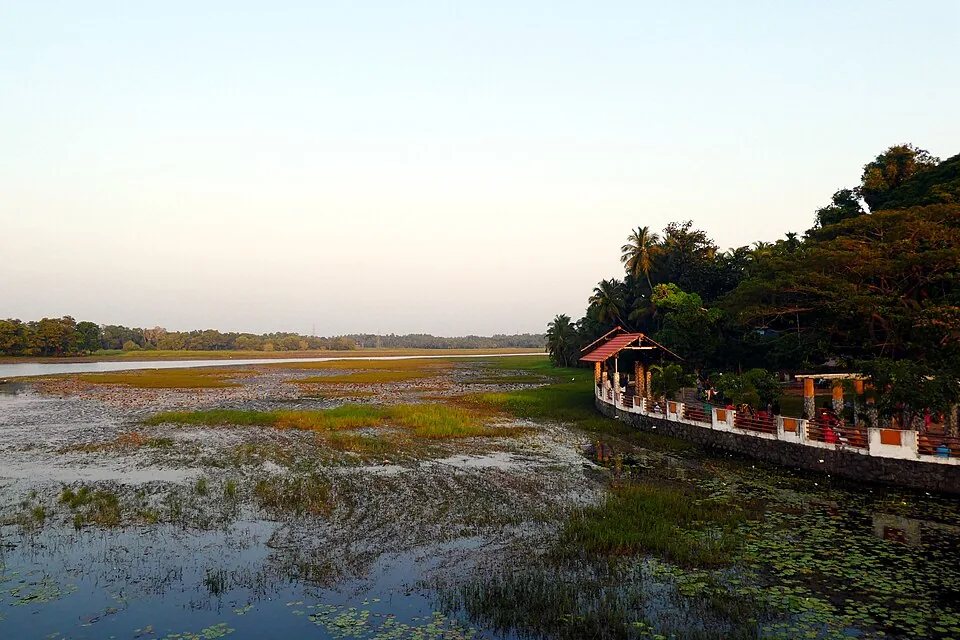
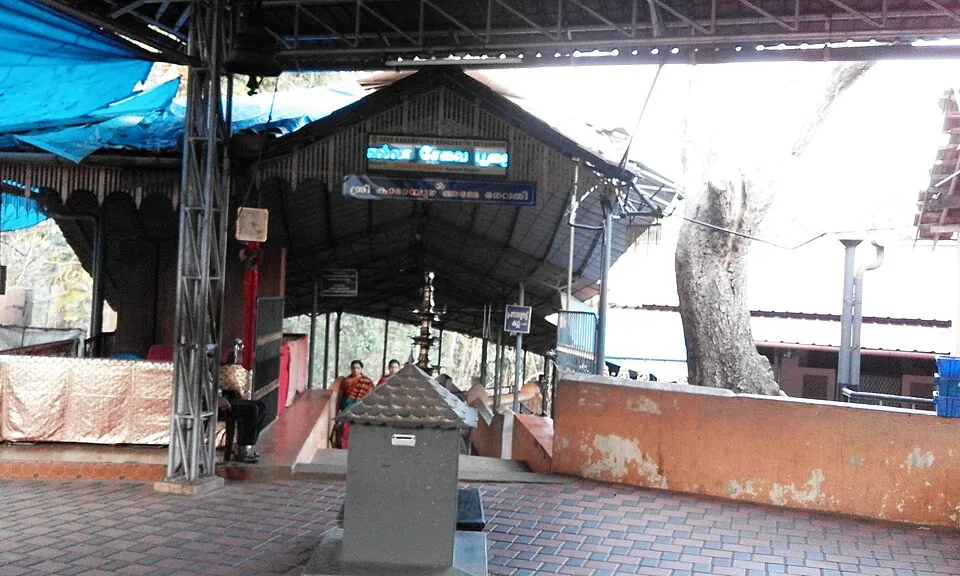
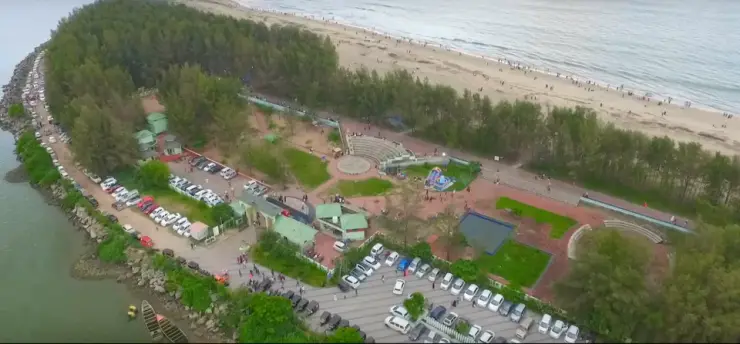
Behind the trees is the park. It is a government one — mapped as such, operated as such — and it is the reason families come rather than just couples at sunset. The tourism authorities list an amenity centre, an amphitheatre, eco-shops and a children’s play area beside the beach. What none of them list is a time or a price for any of it, and no other authority publishes one either. It behaves as public open ground with buildings on it rather than as an attraction with a gate.
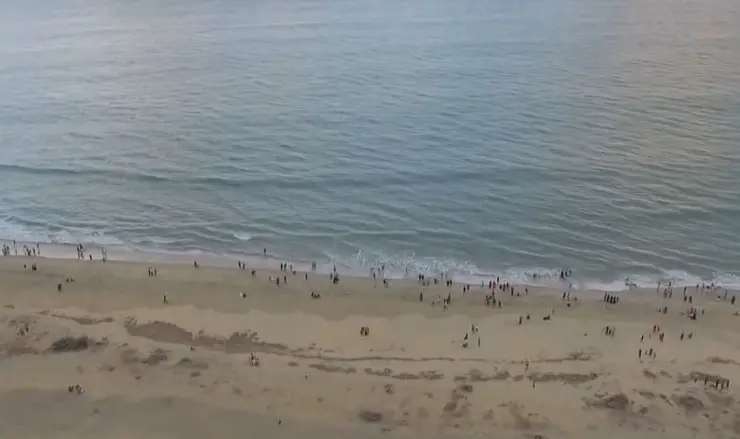
The sand itself is wide, pale and flat, and it shelves into a direct shore break. Aerial photographs of a weekend evening show the crowd strung out in a thin line along the waterline for hundreds of metres with the whole upper beach empty behind them — which is exactly how an open, unpatrolled surf beach gets used when the water is interesting and nobody is going far into it. There is no rock, no cove and no headland; it is a straight edge of the Arabian Sea, and the light goes down into it without anything in the way. That is the sunset people drive out for.
The name is a description, not a title. പടിഞ്ഞാറേക്കര breaks into padinjaru, west, and kara, the shore or the land — the western shore, which is what this is from anywhere in Purathur. It is a common enough construction in Malayalam that other Padinjarekkaras exist elsewhere in Kerala and are nothing to do with this one, which is worth knowing if you are searching for the place rather than standing on it.
The wind is the other thing that organises the beach, and it explains two of the things on it. This is a west-facing shore with an onshore sea breeze that gets up through the afternoon: it is what makes the belt of casuarina audible — the whistling the trees are named for is air going through those fine branchlets — and it is what makes a wide flat beach with a steady onshore breeze close to an ideal place to launch a powered parachute. The same wind that makes the shade pleasant is the reason there is an engine overhead at weekends.
The year divides sharply. The district tourism council recommends September to March, early morning or evening, and that is the honest window: through those months the sea is workable, the evenings are long and the belt fills up. March to May is hot on open sand and the visit is an evening one or nothing. From roughly June to September the south-west monsoon comes in from directly ahead — the beach faces into it — and the surf stands up. That is the half of the year in which almost everything here except the trees and the road stops being a reason to come.
Look at the trees closely, because they are not what they appear to be. Casuarina equisetifolia has no needles and no pine in it. What hangs off the branches in fine grey-green threads are jointed photosynthetic branchlets, and the real leaves are the rings of minute scale-like teeth at each joint, so small you have to hold one to see them. Underground it does something more unusual still: it carries root nodules full of Frankia, a filamentous soil bacterium, and fixes its own nitrogen out of the air. That is why it will start on bare salt sand where very little else germinates, and why a belt of it can be established on a spit in a few years rather than a generation. It is Australian and South-East Asian by origin and has been on the Indian coast for over a century, under a shelf of names — Australian pine, whistling pine, she-oak, beefwood.
Whether belts like this one are good for a shore is an argument that is still running. After 26 December 2004 they became policy: a study by Finn Danielsen and colleagues in Science that October found that settlements behind mangrove and tree cover had been measurably less damaged by the tsunami than open ones, and casuarina — cheap, fast, salt-tolerant — became the tree of choice for the bio-shields that followed. Tamil Nadu’s forest department alone put in 4,850 hectares of bio-shield and 2,250 hectares of mangrove from 2005 at a cost of ₹21.4 crore. Ecologists pushed back hard, and the objections are specific: a single-species plantation lets almost nothing grow underneath it and displaces the low dune plants, Spinifex among them, that actually hold sand; belts were put in as evenly spaced rows that water runs straight between instead of staggered ranks that break it; and some were planted beside the village rather than between the village and the sea, which funnels wind and surge rather than absorbing it.
None of that is settled, and none of it is written on a board here. It simply means that the shade a family sits in on a Sunday evening at Padinjarekkara is also a piece of contested coastal engineering, and that the belt is doing at least two jobs — one of them the one everybody notices, which is making a hot west-facing beach pleasant at five in the afternoon.
What a visit actually looks like is this. You drive to the end of the road and park where it stops. The park is immediately there, and most families do not go much past it, because the shade is there and the sand beyond it is wide, bright and hot. Towards five the belt fills up, stalls appear along the edge of the sand, and people drift down to the waterline in a long thin line that runs for several hundred metres. Almost nobody goes far into the water. At sunset the whole line turns to face the same direction, and about ten minutes after it, everybody starts the drive back up the coast.
The other beach on this road is worth knowing about, because it is going somewhere. Koottayi, five to seven kilometres north at the top of Tipu Sultan Road, is in Mangalam panchayat rather than Purathur, is locally called Kashmir Beach, and is being worked up for Blue Flag certification — a first phase of about ₹1 crore covering parking, toilets, seating, coffee shops and marked entry points, with the district collector overseeing it and the Tirur sub-collector as nodal officer. If it comes through it would be Kerala’s third, after Kappad and Chal. Padinjarekkara has the park and the flight; the next beach up the same road is going for the certificate.
And then, at weekends, there is an engine overhead. Since March 2019 the District Tourism Promotion Council has run paramotoring flights off this beach — a powered parachute, a pilot, a passenger seat and about ten minutes in the air over the sand, the trees and the water. It costs three thousand rupees and it runs on Saturdays and Sundays. It is the only thing here you pay for, the only thing with a published price, and the only thing that turns a stretch of coast into an outing somebody plans a month ahead.
Read the full history of Padinjarekara Beach 486 more words
History
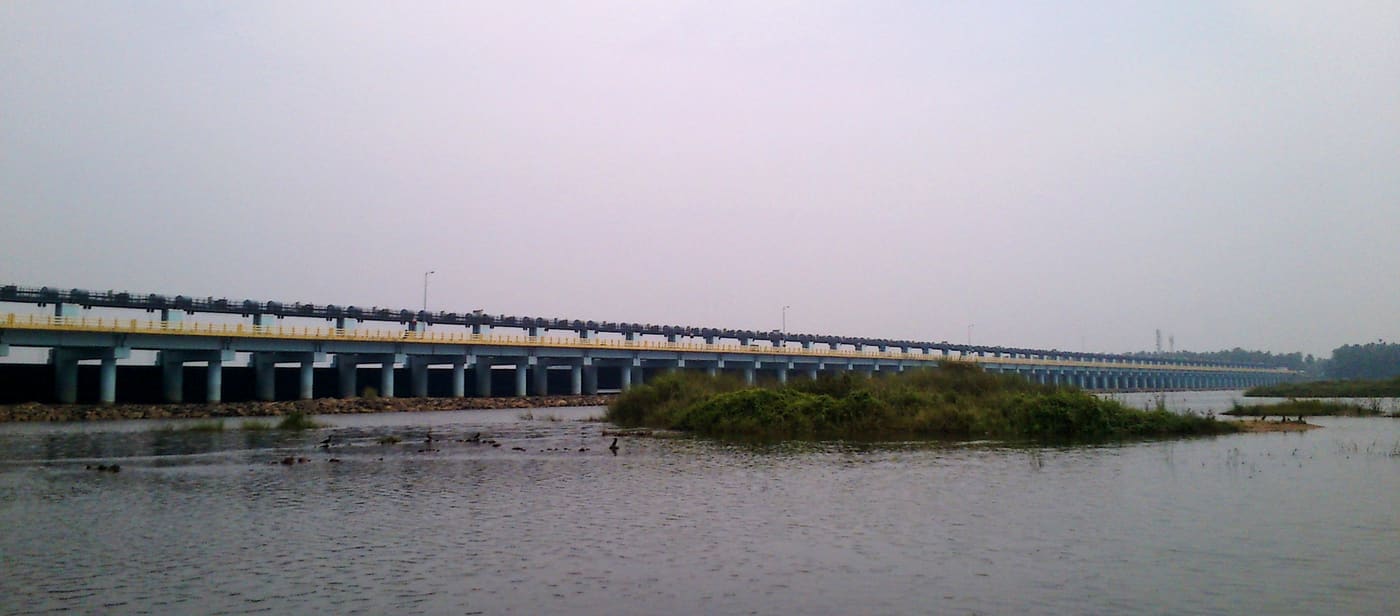
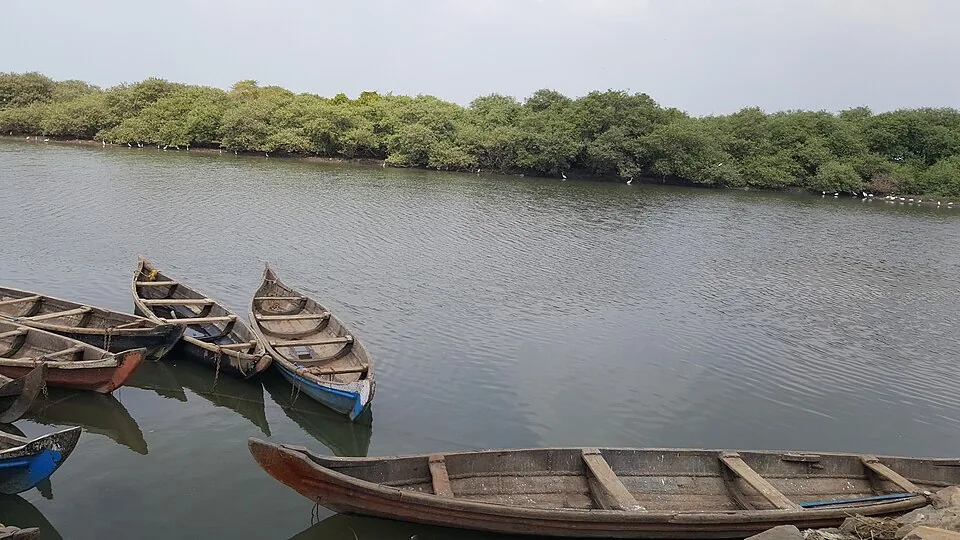
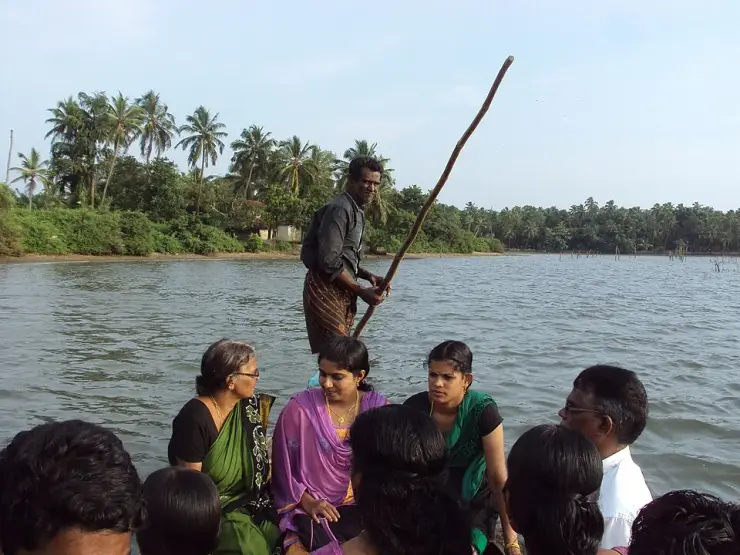
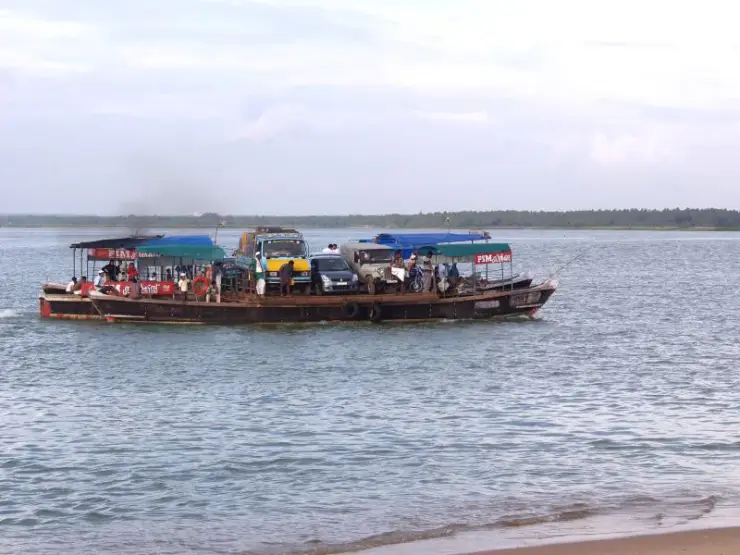
The spit has always been a crossing rather than a destination. The water behind it is the tail of the Tirur Puzha, and the settlements on it — Murikkumad among them — are islands reached by boat. A photograph from 2013 shows a country boat being punted across from Murikkumad to Gomukham on the Padinjarekkara side, loaded to the gunwales with ordinary passengers: an old woman, three women in saris, a dozen heads. That is what the water here was for.
The place it belongs to is Purathur, a grama panchayat of 19.15 square kilometres and 31,915 people at the 2011 census, in Tirur taluk. Padinjarekkara is its southernmost tip — the point where the panchayat, and the taluk, and the district’s coast all run out into the sea at once. Everything else about the panchayat is behind the beach: the islands, the river reaches, the schools, the bus stand, and the road that connects them all to Tirur.
The tourism version is recent and it is a district government project. The paramotoring was launched on 17 March 2019 by the District Tourism Promotion Council; Malayala Manorama, reporting on Purathur in January 2024, called the DTPC beach project at Padinjarekkara a considerable success — and in the same piece recorded that the block panchayat’s pleasure cruises from here had stopped, and that no authorised boat service was running to the islands and river reaches behind the spit, in a panchayat the paper described as the most suitable place in the district for water tourism.
That gap has not closed. Kerala Tourism’s destination page and the district council’s own page both still list water scooters, speed boats and idle cruises among the things to do here. Nobody publishes an operator, a landing, a timing or a fare for any of them.
Why visit
For the hour before sunset under the casuarina, which is the single best thing about the place and costs nothing.
For a beach that is genuinely local: a district park, families out of Tirur and Purathur, and no resort strip anywhere near it.
For the flight, if the weekend suits — ten minutes over a sandspit is a rare thing to be able to buy in Kerala.
For the geography, which is unusual and legible from the ground: sea on one hand, river on the other, and a strip of sand you can walk across in a couple of minutes.
For a road that ends. There are not many places in Kerala where the tarmac simply stops at the sea and everybody has to turn round, and it changes the feel of the place — nobody here is passing through.
For the trees themselves, if you like knowing what you are sitting under: an Australian species that makes its own nitrogen, has no leaves worth the name, and is the subject of a live argument about whether belts like this protect a shore or wreck it.