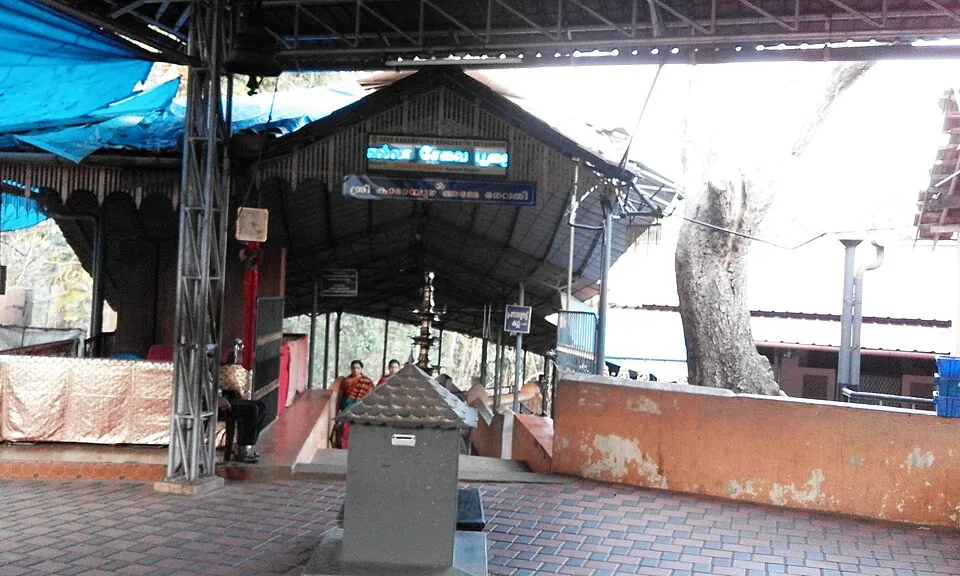
This is a working campus rather than a sight, and it is worth being clear about that before making the trip west from Thunchan Parambu. What is here is a small postgraduate university at Vakkad on the flat land towards the coast, five and a half kilometres west of the memorial by road, founded on a single stubborn idea: that a person should be able to take a master's degree in film studies, or sociology, or environmental science, in Malayalam. Almost every other university in the state teaches those subjects in English. This one was created so that one would not.
The story of Thunchath Ezhuthachan Malayalam University
The teaching is postgraduate and the subject list is wider than the name suggests. Alongside Malayalam literature and linguistics there are master's programmes in journalism and mass communication, creative writing, cultural heritage studies, environment studies, development studies and local development, history, sociology and film studies. Research degrees run across most of the same ground, with comparative literature added.
There is a second tier of shorter diplomas that reads like a list of jobs: new media, writing and presenting for television, advertising and copywriting, heritage tourism, script writing and videography, and project preparation and evaluation. For a university founded to defend a language, a striking amount of what it teaches is how to work in one.
The harder half of the project is vocabulary. Teaching science and social science through Malayalam means the words have to exist, and a good deal of the university's effort goes into making them. The Ezhuthachan Padana Kendram is compiling a lexicon of the poet the place is named for; an online Malayalam dictionary is in progress; there is a language technology centre, a heritage survey and a linguistic survey museum project.
The reach is not only local. The university established a Hermann Gundert Chair at the University of Tübingen in Germany, and the choice of Tübingen is not arbitrary. Gundert was a Württemberg missionary who reached Madras in 1836, settled in Kerala in 1838 and spent about twenty years at Thalassery on this coast. He founded Rajyasamacharam, the first Malayalam newspaper, in June 1847; he wrote a Malayalam grammar; and in 1872 he published the Malayalam–English dictionary that still underlies Malayalam lexicography. When he went home he took with him the old Malayalam documents and scriptures he had collected around Malabar, and gave them to the University of Tübingen, where they have been ever since.
Gundert was not the only one who took things home. Charles Whish, an East India Company civil servant on this coast, collected Malayalam and Sanskrit manuscripts in the 1830s and was the first European to argue, in a paper of 1832, that the mathematicians of Kerala had developed infinite series long before Newton and Leibniz — the school whose villages lie a few kilometres from this campus. His manuscripts left India too. So the written record of the language and of its most original piece of thinking is dispersed across European libraries, and a university whose subject is that language has an obvious interest in where it went.
So a university founded at Vakkad in 2012 to teach in Malayalam has endowed a chair in Swabia, next to a collection of Malabar manuscripts that left this coast in the nineteenth century. It is a small institution behaving like a large one, and it is also the tidiest possible statement of what the place is for: the language's own record is partly abroad, and somebody has to sit with it.
Kerala has a particular reason to take the question seriously. The state's own literacy is near-total and its public life is conducted in Malayalam, but its higher education has run in English for as long as it has existed, so a student who thinks in Malayalam has had to change languages at exactly the point where the thinking gets hard. The university's answer is not to translate textbooks; it is to build the terminology and then teach in it, which is slower and is the reason a dictionary project sits at the centre of a teaching institution.
What a Malayalam-medium degree actually looks like is the question the university gets asked most, and the honest answer is that it looks like any other degree with one difference: the reading list is partly in English because it has to be, and the thinking, the writing and the examination are in Malayalam. The friction is real and the university does not pretend otherwise. The argument for it is that the friction has to sit somewhere, and it is better in the reading than in the thinking.
The subject list follows from that rather than from tradition. Putting film studies, development studies and environmental science into a Malayalam-medium syllabus is a deliberate choice of the fields where the vocabulary gap is widest — nobody doubts that Malayalam can carry a discussion of Malayalam literature. The diplomas in television writing, copywriting and videography come from the other end of the same argument: the language has to be employable, not only teachable.
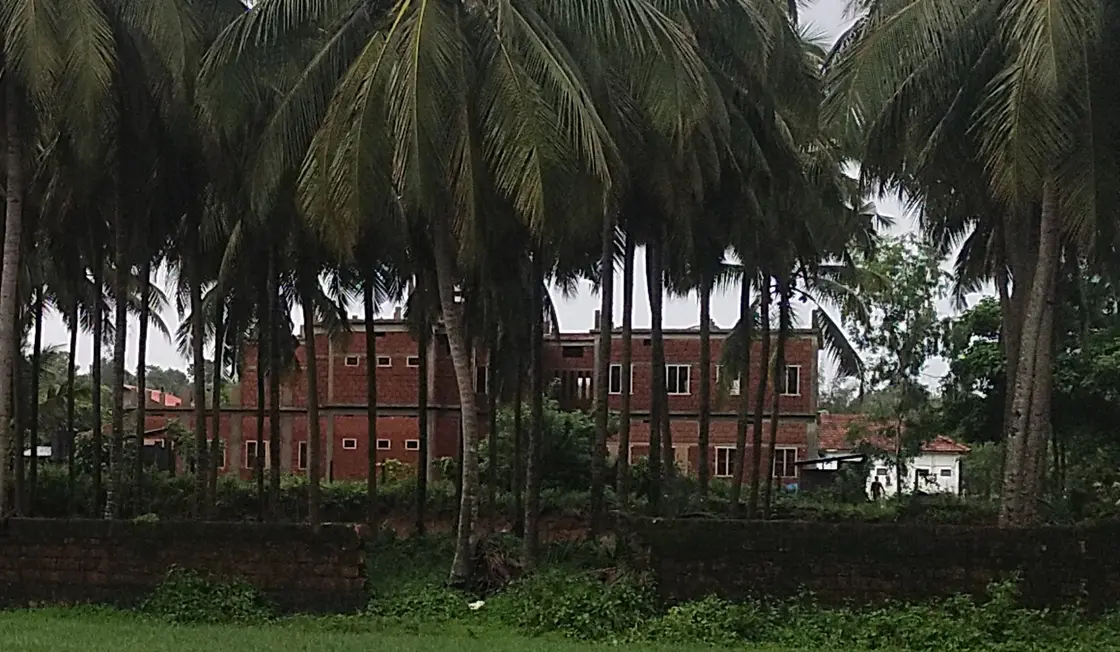
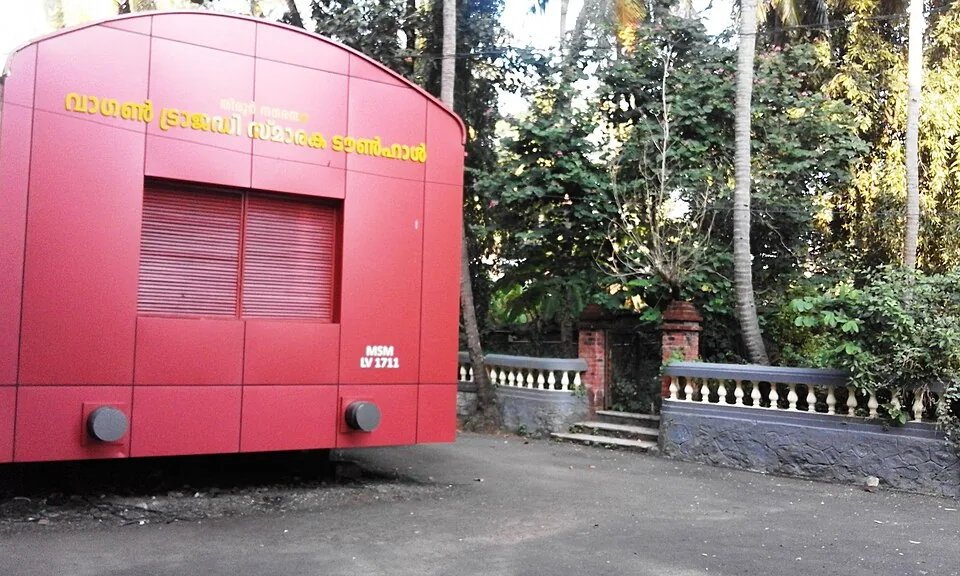
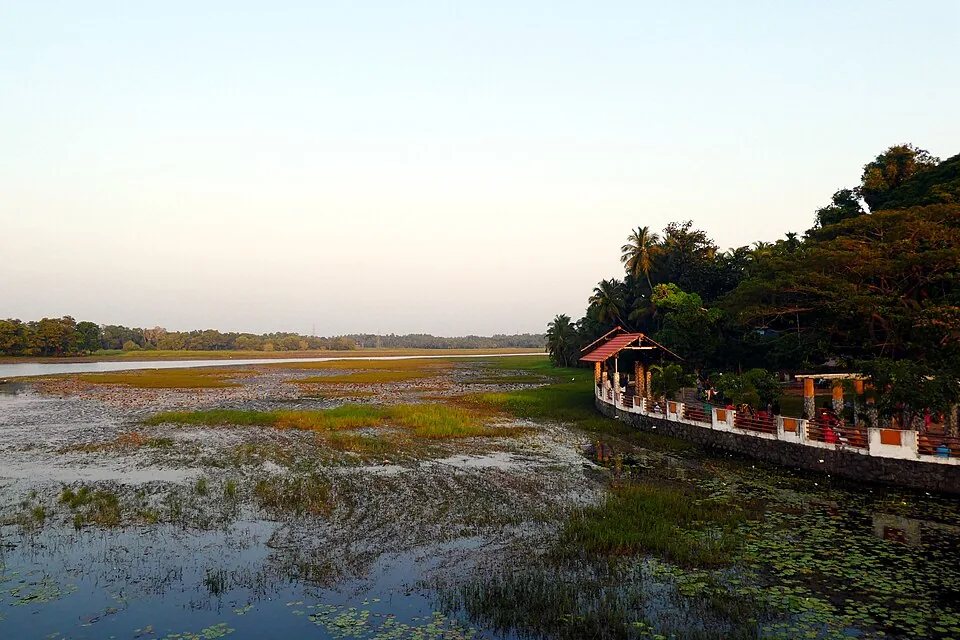
Vakkad itself is worth a sentence, because the setting explains the photographs. This is the flat coastal strip west of Tirur, paddy and coconut and water, and the university sits in the middle of it behind a low laterite wall with fields on the other side. In the monsoon the paddy floods and the water hyacinth comes into flower along the edges of it, and the newest building shows across that water as a red block behind a line of palms. It is a place in a landscape rather than in a town.
The relationship with Tirur is the ordinary one between a small university and the place it landed in. The students come in from the town and the villages around it, the buses run out along the Vakkad road, and the town's own literacy — 96 per cent at the last census — is the reason a Malayalam-medium university is not an eccentric thing to put here. Tirur reads. That is what the whole of this town's history, from the alphabet to the wagon-shaped libraries, keeps saying.
The campus is used as well as taught in. National seminars are held here on exactly the subjects the place exists for — one in March 2015 ran three days on Malayalam grammatical studies and the contemporary language — and that is the form most of its public life takes: academic meetings rather than open days. If a visitor is going to see the university doing anything, it will be that.
The name of the first campus is worth knowing because it is a small joke with a serious edge. The interim campus at Vakkad was called Aksharam. The word means a letter of the alphabet, and it also means the imperishable — that which cannot be destroyed. A university with no land and no buildings, running out of a borrowed college, named its first address after the indestructible thing it was there to look after.
The centres are where most of the work that is not teaching happens. There is a language technology centre, an Ezhuthachan study centre preparing a lexicon of the poet, a heritage survey and a linguistic survey with a museum project attached to it, and an online Malayalam dictionary in progress. None of that is visible to a visitor walking across the campus, which is the ordinary condition of a research institution and worth saying plainly before anyone makes the trip expecting exhibits.
The structure above it is the standard Kerala arrangement: the Governor of the state is chancellor, the minister for higher education is pro-chancellor, and a vice-chancellor runs it. What is not standard is the founding appointment. K. Jayakumar had been chief secretary of Kerala — the senior civil servant of the state — and he had written the project report that argued the university into existence before becoming the man who had to build it.
There is a heritage museum on the grounds at Vakkad. Its opening hours are not published, and it is a university facility rather than a public one, so anyone making the trip specifically for it should ring the university first on 0494 2631230 rather than turn up.
The motto is Shreshtam Malayalam. It sits oddly with the fact that almost everything written about the university in the wider world is written in English, which is more or less the problem it was founded to work on.
Legend & myth
The idea of a university for the language is older than the institution and had been argued for in Kerala for decades before it existed, usually against the objection that a language does not need a university of its own. The counter-argument, and the one that won, was that a language which cannot carry a science syllabus eventually stops being used for serious work — and that this is a decision a state makes rather than a fate a language suffers.
That Tirur was chosen is not sentimental. Thunchath Ezhuthachan settled the alphabet Malayalam still uses on ground five kilometres east of this campus, and the Kerala school of astronomy wrote in these villages — including Jyeshthadeva's Yuktibhasa, composed in plain Malayalam rather than Sanskrit around 1530, four hundred and eighty years before anyone drafted an ordinance about teaching in it. The university is a late instalment of an old local habit.