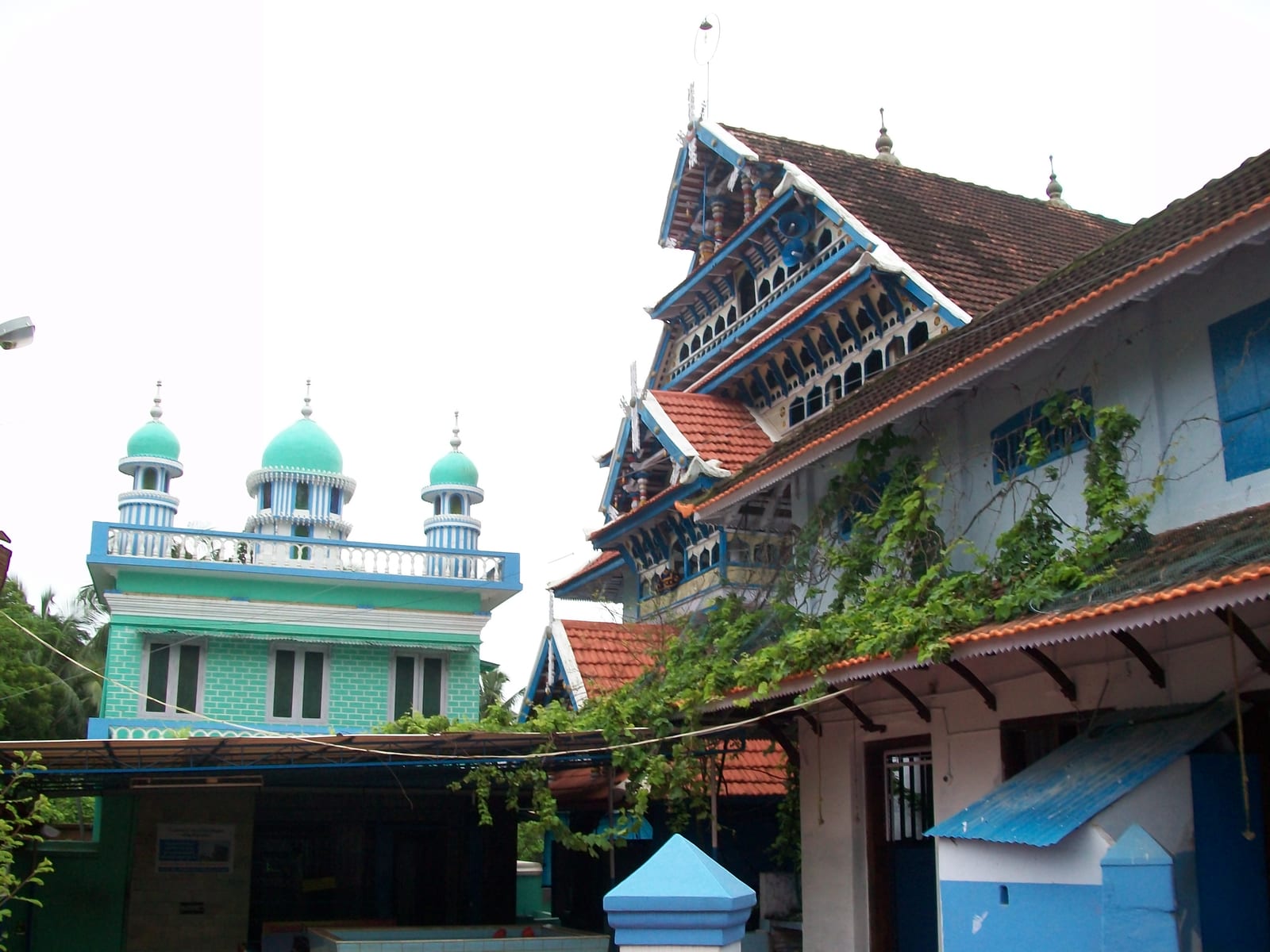
The temple is unbolted at about half past two in the morning, which is earlier than almost anywhere else in Kerala, and the reason is a story about the hour of its founding rather than a convenience for anyone living. Trikkandiyoor is a residential locality a kilometre and a half south of Tirur railway station and a little over a kilometre from Thunchan Parambu; there is no precinct and no ticket office, only a walled temple with an apsidal shrine at the centre of it and a tank on the east side as large as the temple's own ground. It is counted among the hundred and eight Shiva temples of Kerala, and it is the one at the end of a day.
The story of Trikkandiyoor Mahadeva Temple
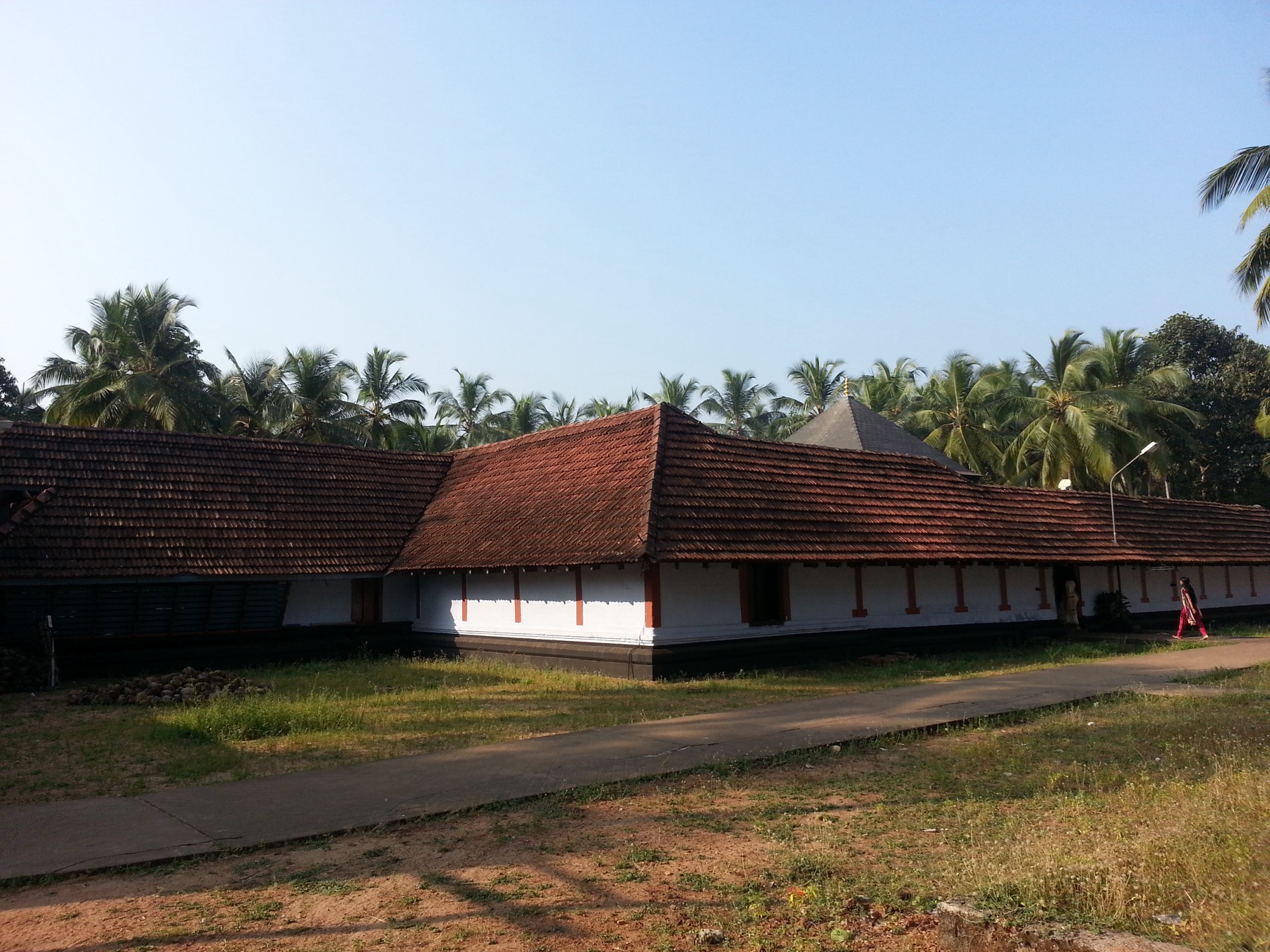
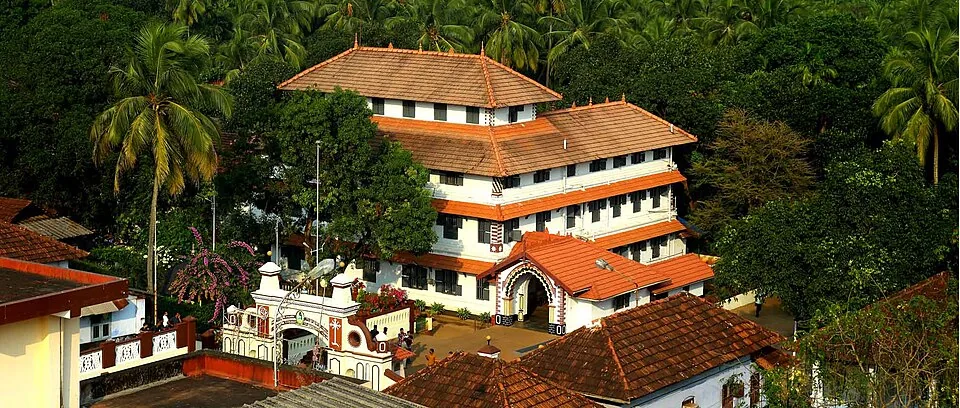
The srikovil is apsidal — rounded at one end like the back of an elephant — built of laterite and dressed stone, east-facing, with a copper-tiled roof coming down low over the walls. Descriptions of the surviving fabric place the complex in the middle of the ninth century, and it reads that way: heavy, low, dark inside, with the light coming from the doorway rather than from above.
Shiva holds the sanctum, but Mahavishnu is honoured here almost equally, which is unusual enough that visitors who come for one often leave having been shown the other. Around them the enclosure carries the full Kerala complement of sub-shrines — Ganapati, Sastha, Krishna, Parasurama, Antimahakalan, Vetteykkaran and the serpent deities under their trees.
Two associated shrines complete the establishment and both stand slightly apart from it. Bhandarakavu belongs to Parvati and is where the festival ends. Ampalakkulangara belongs to the goddess, called Bhagavathi and identified as Bhadrakali; one account of the temple describes her instead as Shiva's own daughter, and the two readings have never been reconciled.
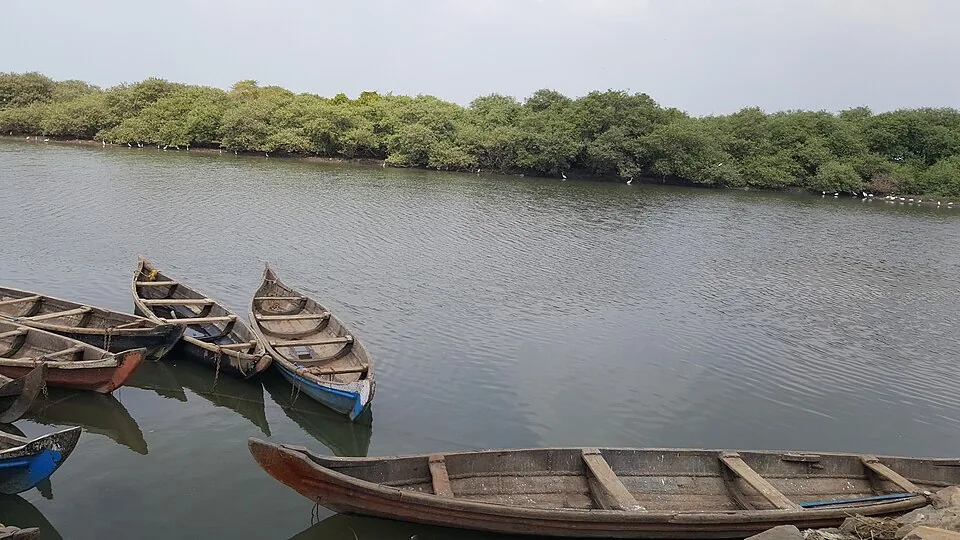
The tank on the east side is the feature most people remember, and it is not incidental to the plan. It runs to about three acres, and the local description of it is exact in an unexpected way: the water covers the same area as the temple land itself. The reason given for digging it is that the deity installed here was fierce and had to be cooled — in one telling the fires of the third eye, in another simply a temper. Whichever version is told, the result is that a village of this size has a three-acre sheet of water at its centre because of a legend.
The day begins in the dark. The doors are opened at about half past two in the morning and between roughly half past three and four comes the sharkara puja, an offering of jaggery — five kilograms of it, by the usual account — made for the union of Shiva and Shakti. By the time an ordinary visitor arrives the temple's own day is largely finished, which is why the other hour that matters here is the evening one.
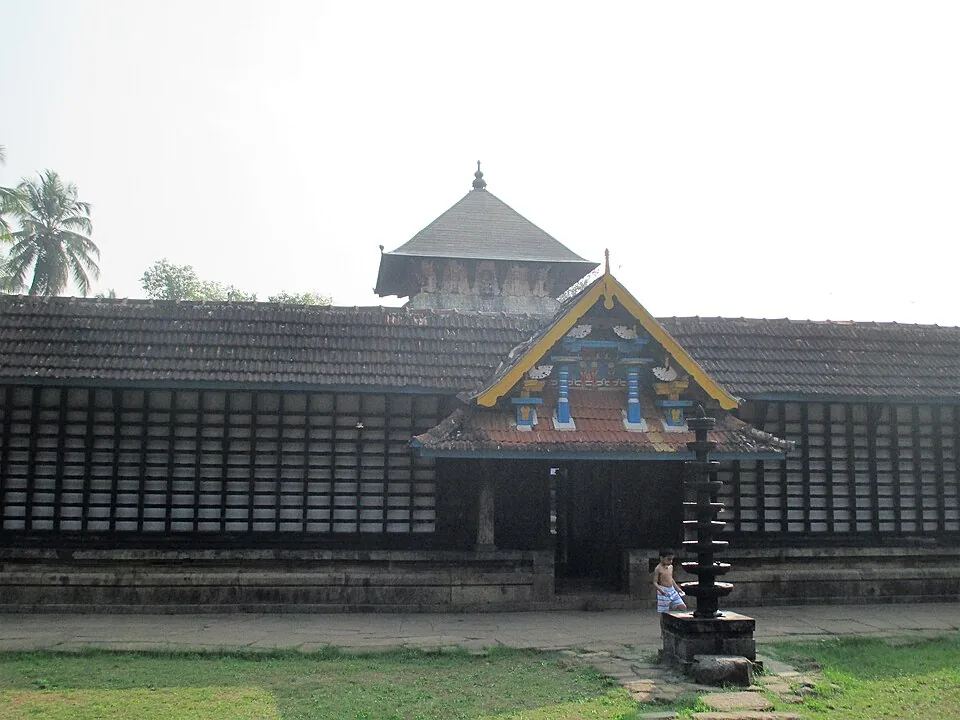
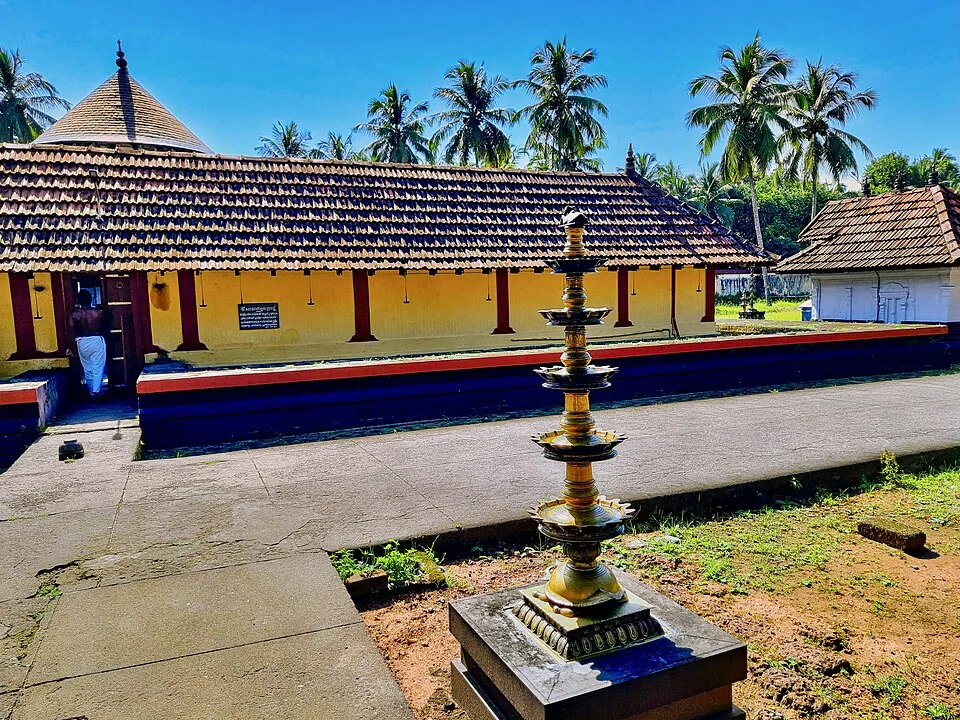
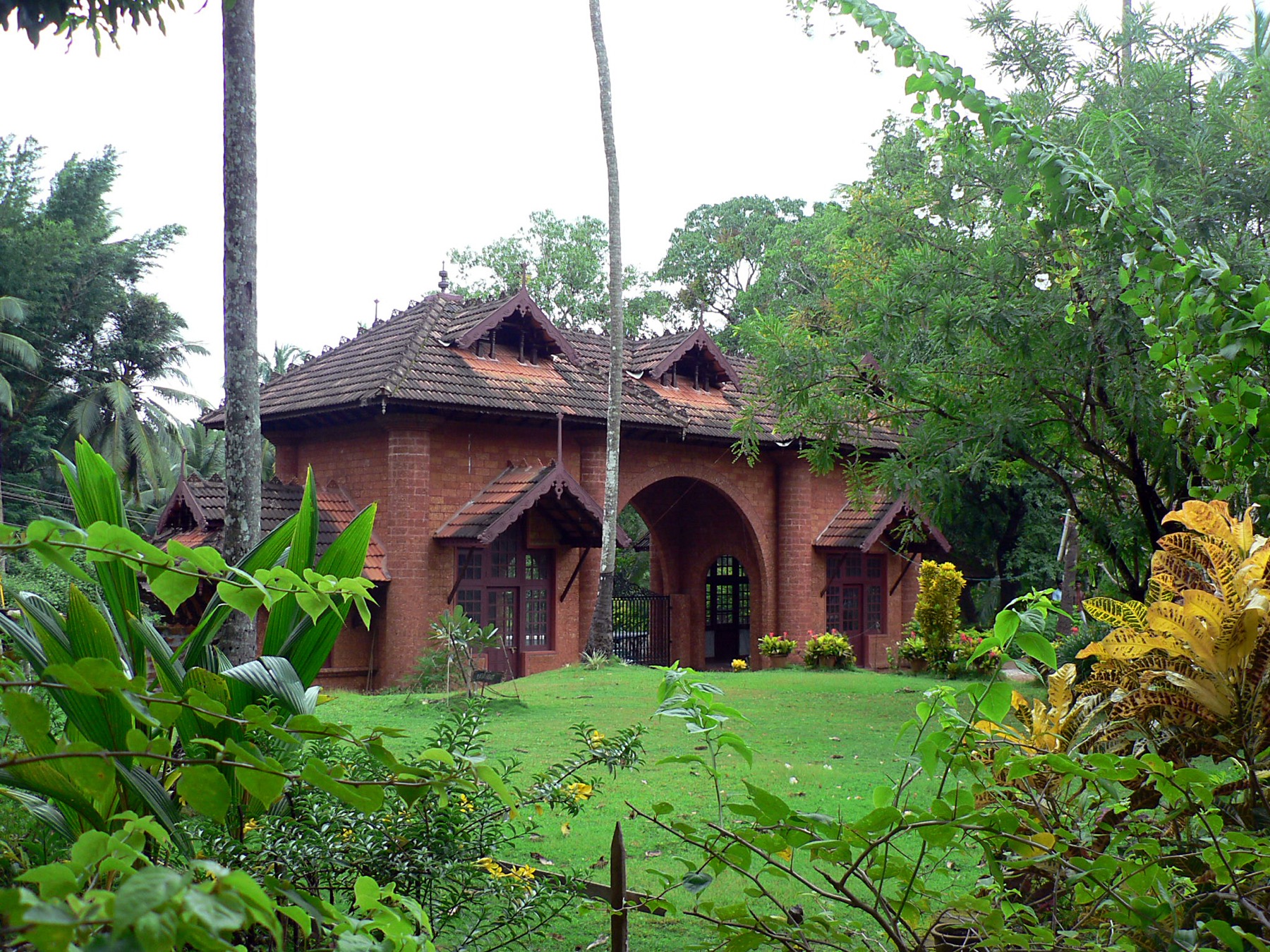
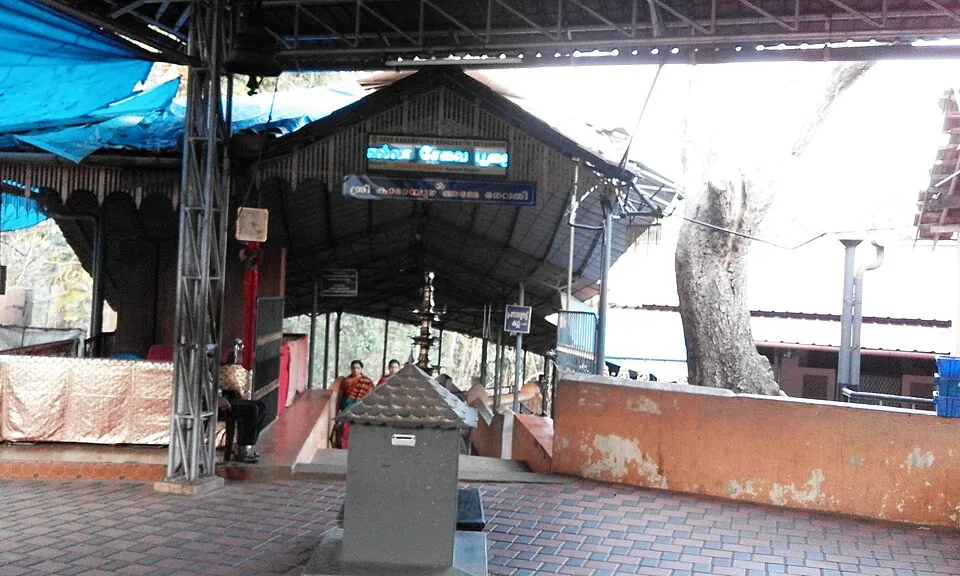
What you actually walk into is the standard Kerala arrangement, and it is worth knowing the parts because they are the same at every old temple in Malabar and they are never labelled. Outside the enclosure stands the deepastambham, a tiered iron lamp column on a stone base, on the axis of the shrine. Inside the wall runs the chuttambalam, the covered cloister that goes right round; between it and the shrine is the namaskara mandapam, the pillared square where the offering is made, and in front of that the balikkallu, the low stone on which the ritual food is set. The shrine itself sits on a moulded plinth and is roofed in copper or tile with a gilded finial on the ridge.
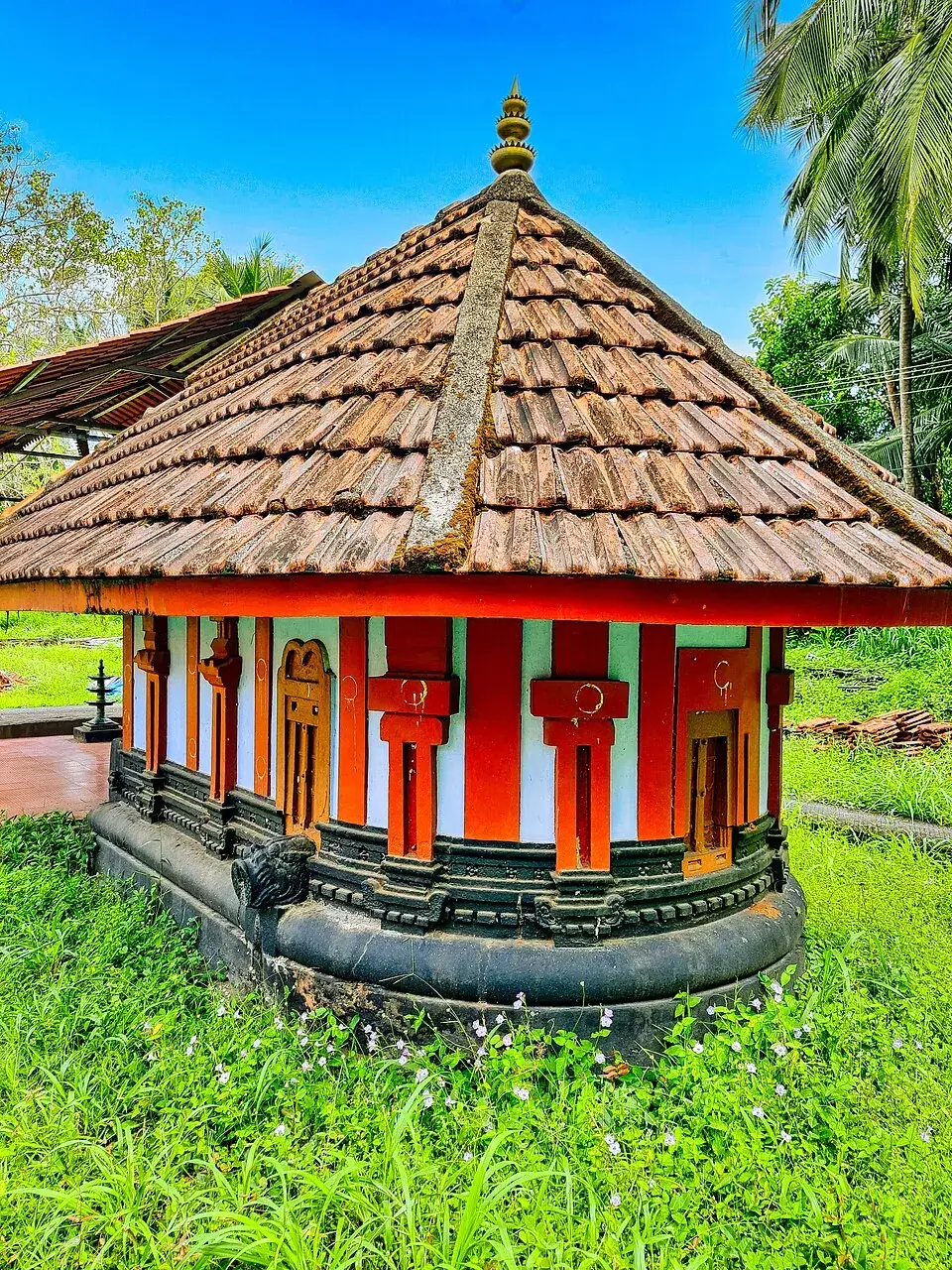
The enclosure holds more than one kind of shrine, and the shapes are not decorative choices. Kerala builds its sanctums square, apsidal or circular, and this ground carries examples of at least two: the main shrine is the apsidal one, and there is a free-standing circular shrine in the grass with a conical tiled roof and a moulded round plinth. The circular plan is the rarer of the two and, in most places where it survives, the older.
The masonry tells the same story of long use. Some of it is bare laterite, cut in blocks and laid up in courses, weathered to the colour of rust and left unrendered. Other parts have been plastered and painted in the red-and-white vertical stripes that Kerala temples wear now. The two finishes sit within a few metres of each other, which is what a thousand years of repair looks like when nobody has tried to make it uniform.
The standard accounts name four villages as the ground the Kerala school of astronomy and mathematics actually stood on — Trikkandiyur, Alathiyur, Triprangode and Shukapuram. This is the first of them, and the lane outside the temple is where the men of that school lived. Who they were and what they worked out belongs to Tirur's own page.
Legend & myth
Parasurama, who is held to have raised Kerala out of the sea, is said to have installed three Shiva lingas on a single day at three places along this coast: at Thiruvannur in Kozhikode in the morning, at Mannur near Feroke at midday, and here at dusk. The three sites lie roughly fifty-five kilometres apart end to end down what is now NH 66, which makes the legend one of the few in Kerala that arrives with a route attached.
The belief that follows from it is specific. Worship at all three on the same day, each at the hour of its own installation, and the worshipper is held to obtain sarvakarya siddhi — the accomplishment of every undertaking. It is not a claim about any one of the temples; it is a claim about doing all three in the right order, and people still drive it.
Because the installation here fell at dusk, the deity is Pradosha Shiva and the pradosha twilight worship carries more weight at this temple than at most. That is the practical residue of the story: an ordinary visitor who cannot be at a temple door at half past two in the morning can be at this one at dusk, which is the hour the whole legend is built around.
The hundred and eight is worth being clear about, because it is quoted at almost every old Shiva temple in Kerala and is rarely explained. The tradition holds that after Parasurama raised the land between Gokarna and Kanyakumari he consecrated a hundred and eight Shiva temples across it, and a hundred and eight temples of the Goddess besides. The list is preserved as a Malayalam devotional text, the Hundred and Eight Shivalaya Nama Stotram, which is simply the names recited in order; Vadakkunnathan at Thrissur is counted the first and Thrikkariyoor the last. Being on that list is a statement about a temple's antiquity and standing rather than about anything visible in its fabric.
The tank has its own explanation, and it is the sort of folk reasoning that turns a difficulty into a landscape. The deity was too hot, so water was put beside him. Nobody claims it worked; everybody points at the water.
Read the full history of Trikkandiyoor Mahadeva Temple 806 more words
History
Temple tradition credits the building to a Chera Perumal in 823 CE. Independent description of the surviving fabric puts the complex in the mid-ninth century, which is close enough to that date to be consistent with it without confirming it, and both figures are worth holding loosely — a Kerala temple is rebuilt many times and the date attached to it is usually the date of a founding rather than of anything now standing.
The line of management is better recorded than the building. The temple was first held by forty-eight families known as the Shivadwijanambi, passed from them to the Alathiyoor Namboothiri Sabha, then to the Vettathu — the rajas of Tanur, a small coastal principality whose territory this was — and finally, through the East India Company's arrangements after Tipu Sultan's cession of Malabar, to the Zamorin of Calicut. It is administered today by the Malabar Devaswom Board with the Zamorin as hereditary trustee.
The temple was damaged in Tipu Sultan's campaigns in Malabar and was rebuilt afterwards; Mandayapurathu Krishna Menon is named among the patrons who paid for that work. What stands now is therefore a ninth-century foundation with a late-eighteenth-century interruption in the middle of its history, which is the ordinary biography of an old Malabar temple and is seldom mentioned on the boards.
The Vettathu rajas who held this temple for part of its life are a small kingdom with an outsized cultural record. Their country, Vettathunad or Tanur, ran along this stretch of coast with its headquarters placed at Puthiyangadi in the Tirur area, and they were vassals of the Zamorin. It is the political weather in which the astronomers of these villages worked and in which the alphabet was settled a kilometre from this gate, and the temple passing through Vettathu hands is the ordinary administrative trace of it.
One consequence of that history is a nuisance for visitors rather than for historians: the temple has been known by several spellings, and the name is a near-twin of another. Trikkandiyoor, Thrikkandiyur and Trikandiyur all refer to this place, and Triprangode — a different ninth-century Shiva temple seven kilometres south with a completely different legend — is routinely given in directions meant for this one. The safest instruction to a driver is the locality name and the road, not the temple name alone.
The festival year has two fixed points. The Padahadi utsavam runs nine days, beginning on the seventh lunar day of the dark fortnight of Tulam and ending with the irakkapuja at Bhandarakavu on the new moon. Shivaratri falls in Kumbham, in February or March, and is the night the temple is busiest.
The nine days of the Padahadi are the one time the temple is loud. An utsavam in Kerala is a sequence rather than a single event: the flag goes up, the deity is taken out in procession on successive evenings with drums and lamps, and the last day closes it. Here the close is the irakkapuja at Bhandarakavu on the new moon, which is why the outlying shrine matters more than its size suggests — the festival does not end where it began.
Shivaratri is the other kind of night altogether. It is a vigil rather than a procession: the temple stays open and the worship runs through the dark. At a shrine whose deity was installed at dusk and whose doors open at half past two in the morning, a festival built around staying awake is more at home than it would be almost anywhere else.
Between festivals the rhythm is domestic. This is a neighbourhood temple with a large history, on a lane of houses, and most of what happens is people coming and going before work. There is no queue system, no cloakroom and no ticket, and the enclosure is small enough to walk round in ten minutes — which is why the thing to plan is the hour rather than the length of the visit.
Why visit
It is one of the hundred and eight Shiva temples of Kerala, and the only one whose founding hour has produced a working itinerary that people still drive.
The apsidal ninth-century shrine is a plain, heavy piece of early Kerala building of a kind that has mostly been replaced elsewhere.
The pradosha twilight worship is this temple's signature hour, and it is the one hour of its day an ordinary visitor can actually attend.
The three-acre tank covers the same ground as the temple itself, and the reason given for digging it is a story about cooling a deity's temper.
It is 1.2 km from Thunchan Parambu and 1.4 km from Tirur station by road, so the temple and the memorial are a single morning on foot.
An ordinary residential lane here is one of the four addresses the Kerala school of astronomy actually worked at.