Triprangode Maha Shiva Temple

Triprangode is a west-facing Shiva temple on the Alathiyur–Codacal road south of Tirur, and the direction it faces is the whole of its story. The tradition is that Yama came for the boy Markandeya on his sixteenth birthday, that the boy ran to the temple and threw his arms round the linga, and that when the noose came down the stone burst open and Shiva came out of it in fire and struck Death down. That form is Kalasamharamurti, and the temple is named for it in the record. The gods then asked for Yama back, on the reasonable ground that with Death gone nothing on earth would end, and he was revived.

Triprangode Maha Shiva Temple, Tirur
Practical guide

Plan Triprangode Maha Shiva Temple

Who's going?Tailor Triprangode Maha Shiva Temple to your trip
Before you go to Triprangode Maha Shiva Temple

Entry rules not verified for this temple. Some Hindu temples admit only Hindus, and most enforce a dress code at the door. We have not verified the rule for this particular temple, so please check before you travel — especially if you are not Hindu or are visiting from outside India.

We report each site's own published rules neutrally, and only where we can source them.

Typetemple
Nearest baseTirur
DistrictMalappuram
Best timeOctober to March, for the same reasons…
Time neededAbout an hour for the enclosure and the…
EntryNo ticket is charged for entry
Places to visit7Listed businesses5

What stands is a walled complex of about six acres with nine shrines in it. The main sanctum is a two-storeyed apsidal vimana on a gajaprishta plan, facing west, over a linga held to have appeared of itself. Inscriptions of the tenth-century Chera ruler Goda Ravi Varma have been recovered here, and a fifteenth-century Sanskrit messenger-poem already treats the place as a landmark. Five ponds surround it, each with a use rather than a view, and people come with prayers about illness and long life rather than for a festival.

The story

Almost every old Shiva temple in Kerala is entered from the east. This one faces west, and the reason given is that the god turned to meet something coming at him. Triprangode stands among paddy and coconut on the Alathiyur–Codacal road, nine kilometres south of Tirur station by road, a walled complex of some six acres with nine shrines inside it and five separate ponds around it, and the whole of it is organised around a single moment: the one in which Shiva came out of the linga to stop Death.

The story of Triprangode Maha Shiva Temple

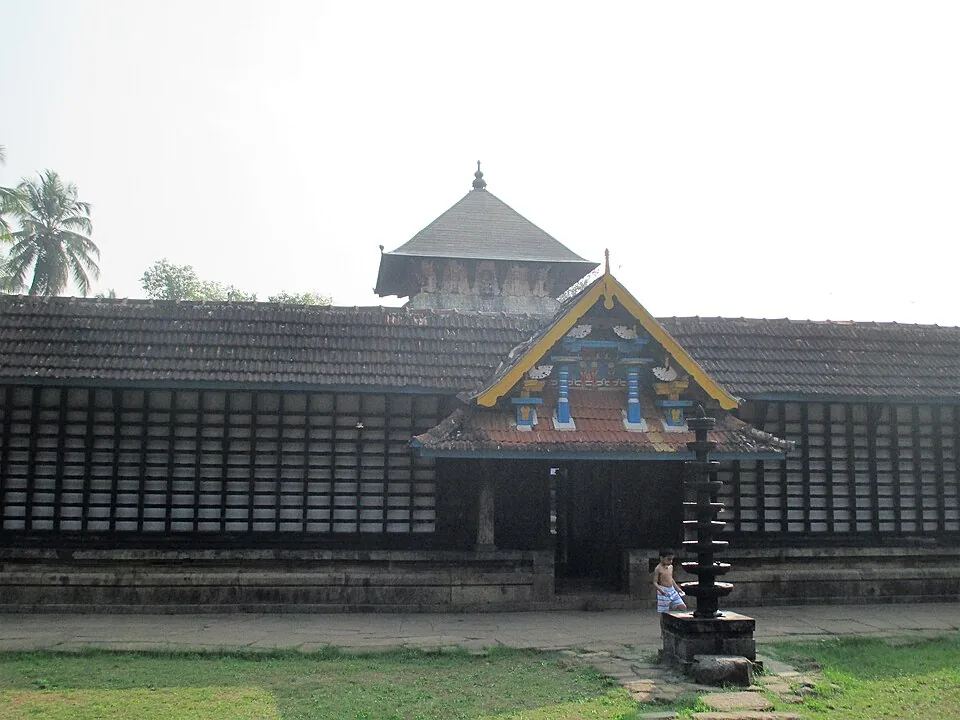
The main shrine is a dvitala vimana — two storeys — on a gajaprishta plan, rounded at the back like an elephant seen from behind, and it faces west. Inside is a swayambhu linga, one held to have appeared of itself rather than to have been installed. Parvati's shrine stands to its left, and the arrangement is read as Ardhanarishwara, the god and goddess as one body, split across two doorways.

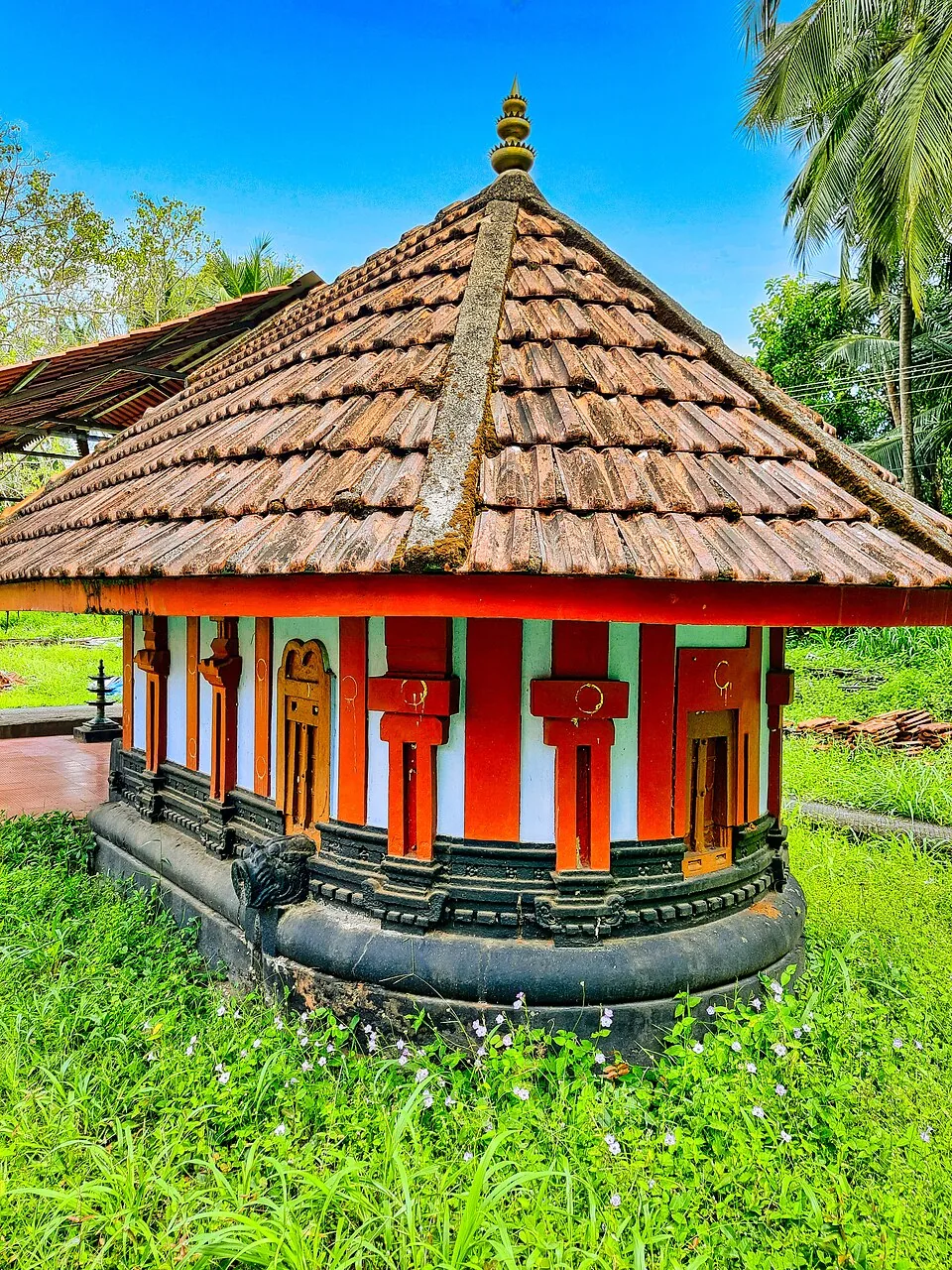
The complex has nine shrines and they are not decoration. Four more Shivas stand within the walls, one of them the Karanayil temple, described as the original seat — the place the deity was before the present shrine existed. Three further shrines mark the steps Shiva is said to have taken to reach Yama, which is an unusual thing to build: the temple has laid out the choreography of its own legend in stone.

The rest of the enclosure fills in the Kerala pattern with a few surprises. Nandi sits in the namaskara mandapam facing the shrine. Ganesha is on the south-western door. There is a four-armed Vishnu with conch, discus, mace and lotus; Vettakkorumakan and Bhadrakali behind the Karanayil shrine; Ayyappa on the southern side; Krishna in his cowherd form as Gosalakrishna; and the serpent deities and a Brahmarakshas at the edges.

A stone image of Shiva as Mrityunjaya — the conqueror of death — stands in the complex, and it carries damage from Tipu Sultan's campaigns in Malabar. It is a small thing to look at and the single most direct piece of evidence on the site that the eighteenth century happened here.

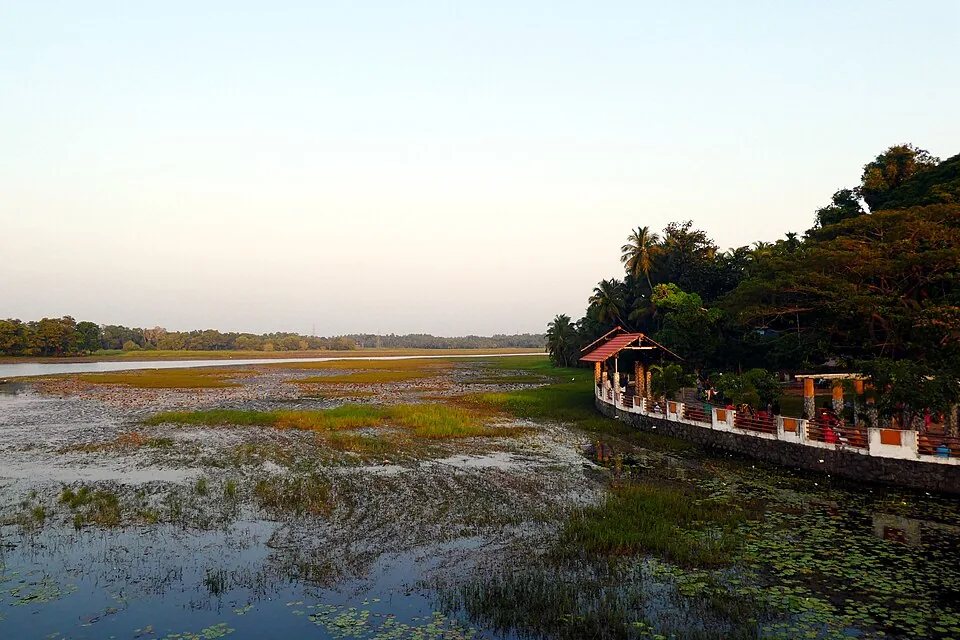
The ponds are the other count that matters. There are five, and each has a use rather than a view. Santhikkulam is where the priests bathe. Vellottukulam lies out by the fields. One at the south-western corner is the pond in which the Lord is said to have washed his trident afterwards. A fourth sits in front of the Karanayil shrine, and the fifth, on the north-eastern side, is the large public one.

The mandapam is where the age of the place is easiest to see. Its ceiling is a coffered timber grid, each panel carved with a rosette and the beams around them run with a band of ornament, all of it cut in wood and all of it still carrying the marks of the tools. Kerala temple carpentry of this kind is often the oldest surviving fabric on a site, because timber is repaired piece by piece rather than replaced wholesale, and it is almost always overlooked in favour of the stone.

There are murals here too, painted on the shrine walls in the ochres, reds and whites of the Kerala tradition — the same palette of earth pigments used at Mattancherry and Ettumanoor, worked in the flat outlined style with figures filling the panel edge to edge. Under the gables, where the roof timbers meet, runs a white stucco frieze of small seated figures, repeated along the whole width.

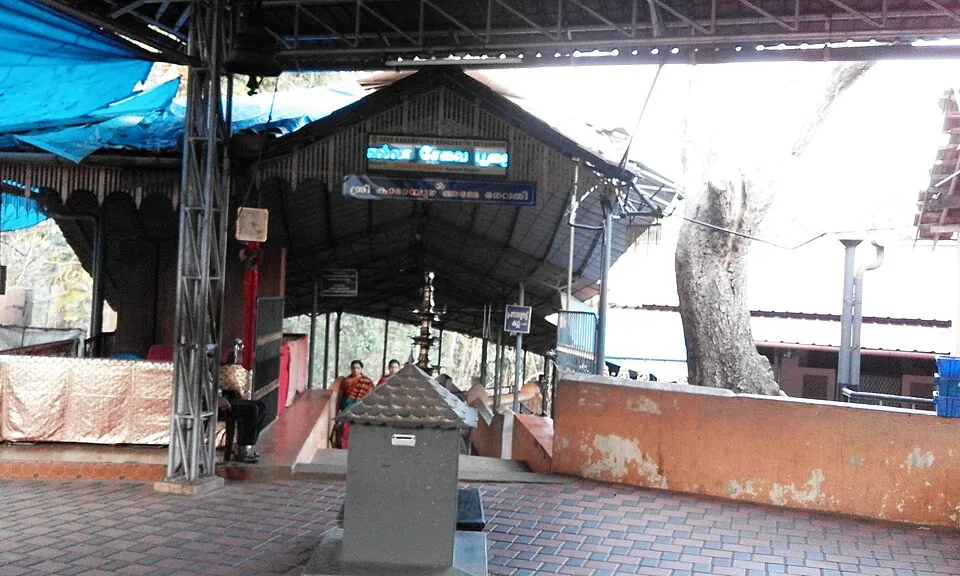
The gilded doors of the Karanayil shrine carry the eye first in most photographs, and the board above them settles what the shrine is: it reads Sree Moolasthanam Karanayil Sivan. Moolasthanam means the original seat — the spot the deity is held to have occupied before the present temple was built round it. A great many Kerala temples have one and very few of them say so on a board.

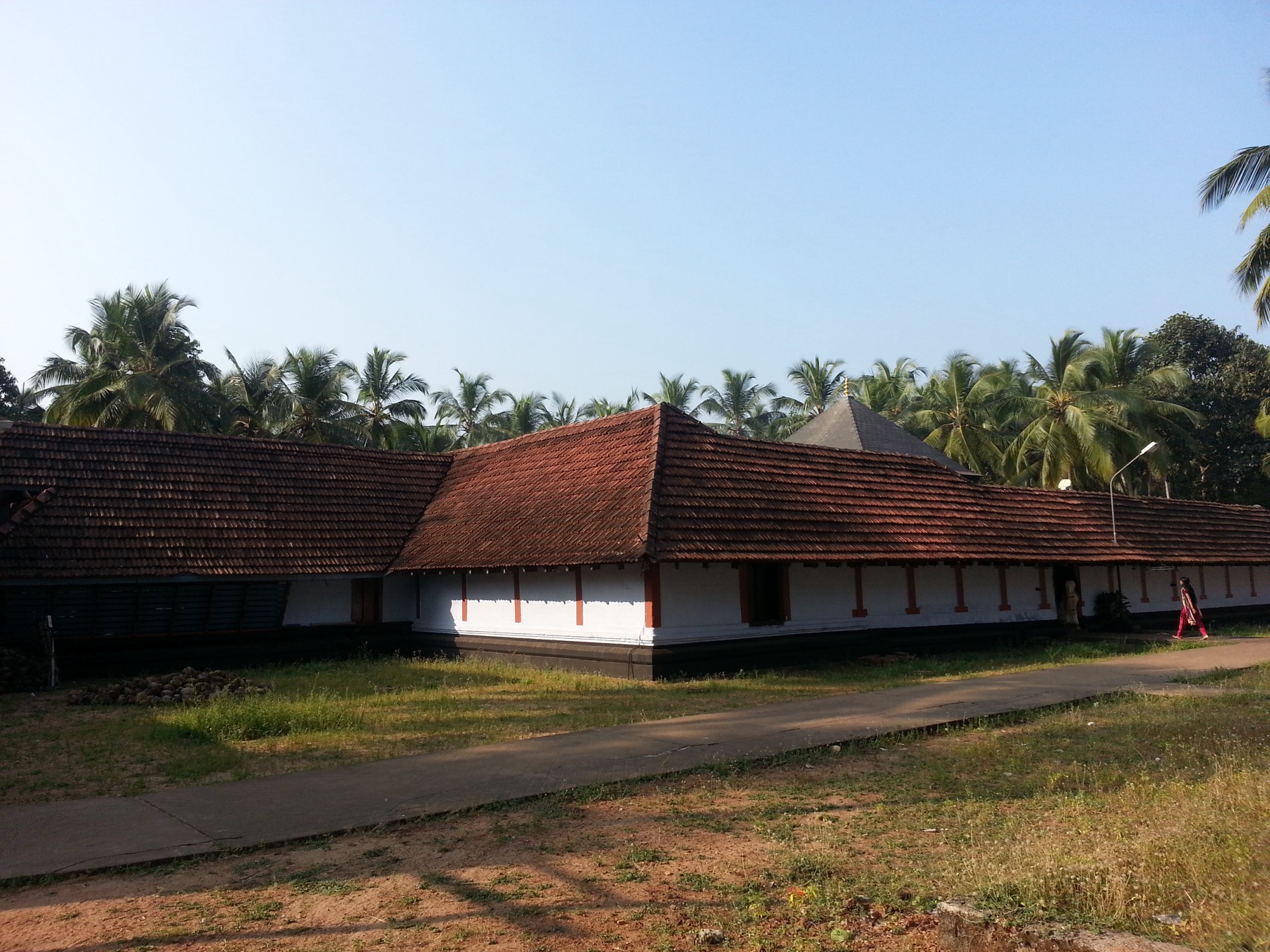
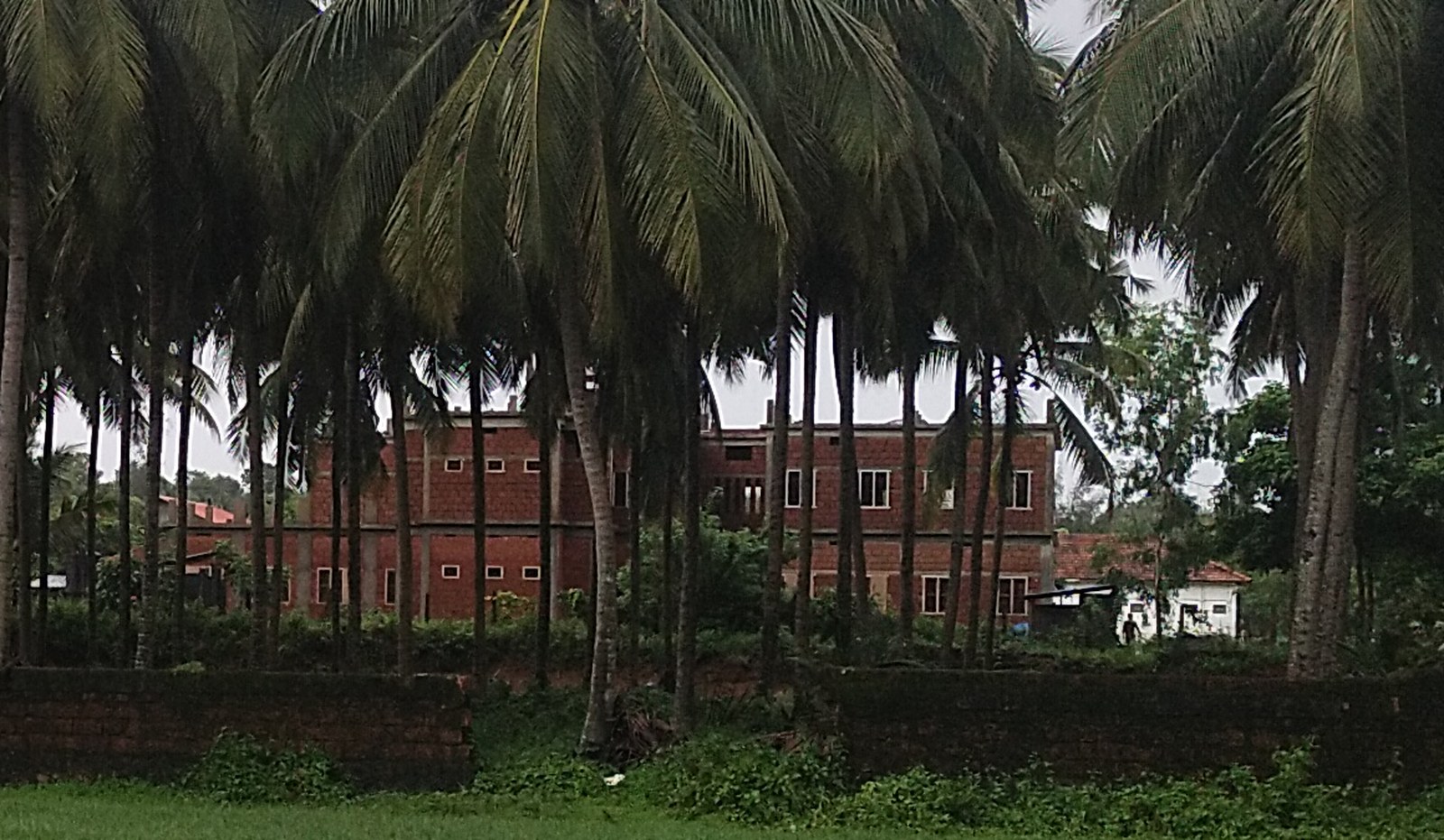
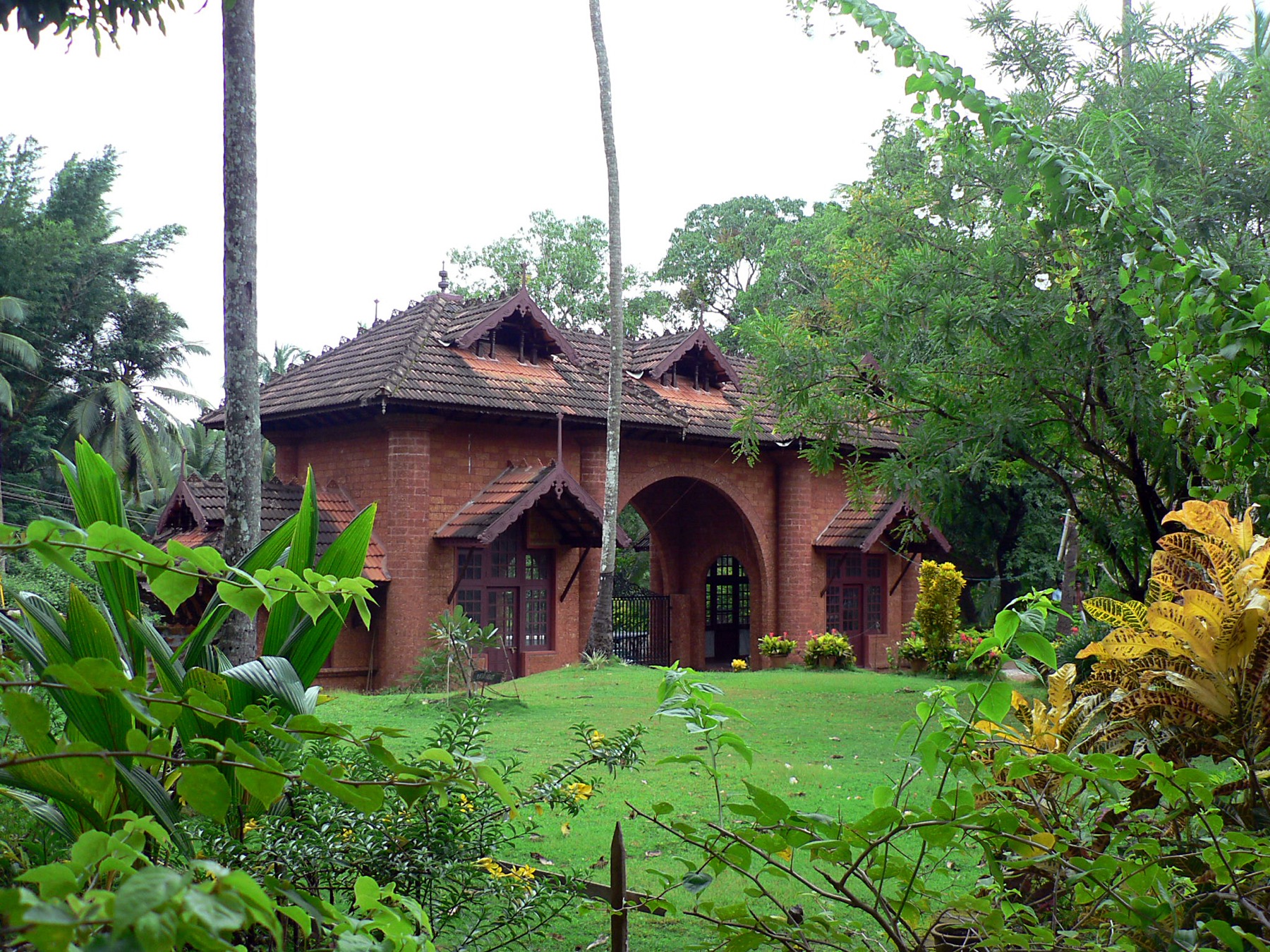
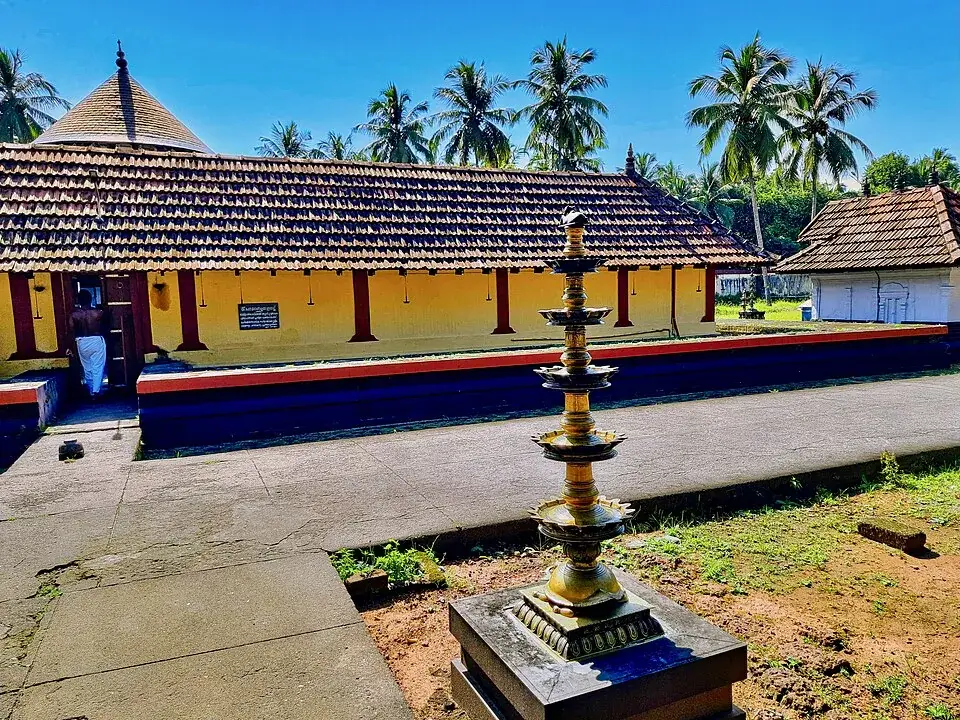
The enclosure is large by Malabar standards, about six acres, and its buildings are arranged as ranges of white-walled shrines under separate tiled roofs rather than as one mass. The effect from the courtyard is of a village of small temples with a brass lamp column standing among them, which is exactly what a nine-shrine complex is.

Triprangode is one of the four villages the standard accounts name as the actual ground of the Kerala school of astronomy. The school is usually described as a Kerala-wide phenomenon; the addresses are four lanes in one taluk, and this is one of them.

Legend & myth

A sage called Mrikandu and his wife Marudvati had no child, and did penance until Shiva offered them a choice: an ordinary son who would live a long and unremarkable life, or an exceptional one who would die at sixteen. They chose the second, and Markandeya was born.

The boy grew up devoted to Shiva and learned the Mahamrityunjaya mantra, the verse addressed to the conqueror of death. On the day he turned sixteen Yama came for him. Markandeya ran to the temple and threw his arms round the linga, and when Yama's noose came down it went round the stone and the boy together.

What happened next is the reason the shrine exists. The linga split open with a roar and Shiva came out of it in a form of fire, and struck Yama down with his trident. That form is Kalasamharamurti — the destroyer of time — and it is the form this temple is named for in the record.

The gods then had to argue him out of it. With Death dead, nothing on earth would end, and the Devas asked for Yama back; Shiva revived him. So the temple commemorates a killing that was undone, which is why it is a place people come to when they are frightened for someone's life rather than a place of triumph.

The Mahamrityunjaya mantra the boy is said to have mastered is not a local text — it is a verse of the Rigveda, addressed to the three-eyed one who nourishes, asking to be released from death as a cucumber is released from its stem. It is recited across India for the sick and the dying, and this temple is one of the places where that recitation has an address. That is the practical link between a legend and a queue of people: the story is the reason the mantra is said here rather than anywhere else.

The choice Mrikandu and Marudvati were offered is the part of the story people argue about, and it is put to them plainly — a dull son who lives, or a brilliant one who dies at sixteen. They chose brilliance and had to live with it, and the temple exists because the bargain was then broken on their behalf. It is an unusually hard-edged founding legend for a place that people come to in hope.

Two details on the ground belong to the same story. A great banyan is said to have stood in the way of the entrance and to have parted into two halves to let Markandeya through. And the pond at the south-western corner is where the trident was washed. The temple faces west, the tradition holds, because that is the direction the god turned.

What people actually come here to do is ask for a life. The temple's business is prayers about illness, danger and long life, and the offerings and homams arranged at the office follow from that rather than from a general calendar of devotion. It gives the place an atmosphere unlike a festival temple: quieter, more purposeful, and busy at times that have nothing to do with the season.

The absence worth noticing is Yama's. Death was killed here and then revived, and there is no shrine to him — the three shrines that mark the steps are to the god who took them, not to the one they were taken against. For a temple whose entire story is a confrontation, only one of the two parties is present in stone.

Read the full history of Triprangode Maha Shiva Temple 519 more words

History

The oldest hard evidence on the site is written on it. Inscriptions of the later Chera ruler Goda Ravi Varma, of the tenth century, have been recovered from this temple, which fixes it as a functioning establishment with royal attention more than a thousand years ago. Descriptions of the fabric place the complex itself in the ninth century.

It was a landmark early enough to be used as one. The Kokila Sandesha, a fifteenth-century Sanskrit messenger-poem by Uddanda Sastrikal, names Triprangode among the major destinations of this region — the sort of casual mention that tells you more about a temple's standing than a dedication would.

The territory around it was Vettathunad, the kingdom of Tanur, whose rajas were vassals of the Zamorin of Calicut; it is the same small principality that held Trikkandiyoor and the same milieu the astronomers of these villages worked in. The eighteenth century arrived here as it did everywhere on this coast, and the damaged Mrityunjaya image is what is left of it.

Vettathunad, the country this temple stood in, was one of the smaller Malabar principalities and its rulers were vassals of the Zamorin of Calicut. The same kingdom held Trikkandiyoor to the north, and the two temples therefore share an administrative history as well as a century. What Vettathunad is best remembered for is not its size but the concentration of learning inside it — the astronomers, the mathematicians and, at Tirur, the poet who settled the alphabet.

The temple's standing can be measured by who mentioned it. A sandesha kavya — a messenger-poem, in which a traveller or a bird is sent across a landscape and the poet describes what it passes — is one of the few genres that records what was worth seeing in medieval Kerala. Uddanda Sastrikal's Kokila Sandesha, written in the fifteenth century, sends its cuckoo past Triprangode. Being on that itinerary five hundred years ago is a firmer statement of importance than any modern listing.

The temple is today one of the more important Hindu pilgrimage centres in northern Kerala, and its draw is specific rather than general: it is where people come with prayers about death and long life, because that is the transaction its founding story records.

Why visit

It is a west-facing Shiva temple, which is rare in Kerala, and the reason given for it is the legend the whole complex is built around.

The two-storeyed apsidal vimana is one of the more complete pieces of ninth-century Kerala temple architecture still in use.

Three of the nine shrines mark the steps Shiva is said to have taken to reach Yama — a legend laid out as a walk rather than told as a story.

Tenth-century inscriptions of the Chera ruler Goda Ravi Varma were recovered here, and a fifteenth-century Sanskrit poem already treats it as a landmark.

The stone Mrityunjaya carries damage from Tipu Sultan's Malabar campaigns, which is the eighteenth century visible on the object itself.

Five ponds surround the temple and each has a job — the priests' bath, the field pond, the public tank, and the one where the trident was washed.
What to expect

Highlights

  • A west-facing Shiva shrine — rare in Kerala — under a two-storeyed apsidal vimana, with the elephant-back curve of the roof visible from directly beneath it.
  • Three shrines marking the steps Shiva is said to have taken to reach Yama: a legend laid out as a walk rather than told as a story.
  • The Karanayil shrine, whose own board names it Sree Moolasthanam Karanayil Sivan — the original seat, before the present temple existed.
  • A carved wooden ceiling in the mandapam, coffered into panels with a rosette in each.
  • Kerala murals on the shrine walls in the ochres, reds and whites of the tradition, and a white stucco frieze of figures under the gables.
  • A stone Mrityunjaya carrying damage from Tipu Sultan’s Malabar campaigns.
  • Five ponds, including the one at the south-western corner where the trident is said to have been washed.
Getting there

How to visit

  • Come from Tirur, 8.8 km by road and about fifteen minutes in an auto. There is no nearer station and the usually published figure of ten kilometres is a little long for the road as it now runs.
  • Walk round to the west front first. Every other Kerala Shiva temple you have been to was entered from the east, and the difference is the point of the place.
  • Look for the three step-shrines and the Karanayil board; between them they carry the legend in a way no signage does.
  • Give it an hour. There is a great deal more to look at here than the size of the site suggests, most of it in the timber and the plaster rather than the stone.
  • Nothing is published about the day’s timings. If you are coming for a particular puja, telephone first rather than drive out on an assumption.

Distance by road

  • Kozhikode49 km
  • Coimbatore133 km
  • Kochi168 km
  • Mysuru192 km
  • Mangaluru277 km

Road km to Malappuram; ghat roads and traffic vary — allow extra.

Timing

Best time

October to March, for the same reasons as anywhere on this coast. Maha Shivaratri, in Kumbham, is the biggest night of the year here. Beyond that the temple has no season in the tourist sense: it is a working pilgrimage centre for prayers about illness and long life, so it can be full on a Tuesday in June and quiet on a festival weekend.

Weather in Triprangode Maha Shiva TempleSeasonal guide

Live forecast loads in your browser.

Today at Triprangode Maha Shiva Temple
Sunrise6:17 am
Sunset6:37 pm
Golden hour best light5:37 pm–6:37 pm
Blue hour after sunset6:37 pm–7:02 pm
Sun sets toward compass bearingW · 279°
Moon tonight🌖 Waning gibbous · 83%
South-west monsoon. June to September is the south-west monsoon in Kerala. Expect heavy showers, mostly in bursts rather than all day — carry rain cover, allow extra time for getting around, and note that ferries and open-air sites are the first things affected.

Sun and moon are calculated for this location and shown in IST. Photography windows are the hour around sunrise and sunset; the sunset bearing is degrees clockwise from true north. Moon phase is accurate to about half a day.

Visitor notes

  • Triprangode is not Trikkandiyoor. The names are confused constantly, the temples are seven kilometres apart, and directions written for one routinely lead to the other.
  • This is a village temple with no visitor facilities at all. Food, cash and transport are back in Tirur.
  • No ticket is charged. Homams and offerings are arranged at the temple office.
  • Dress conservatively and remove footwear; entry to the inner enclosure may be restricted to Hindus.
Safety

Good to know

  • The approach is a two-lane road through paddy with no footway; the last stretch is best done in a vehicle rather than on foot.
  • The ponds are unfenced and their banks are steep in places, which is worth knowing if you have children with you.
Stay · eat · do · rent · see · shop

Stays, food & things to do near Triprangode Maha Shiva Temple

Verified hotels, homestays, restaurants, experiences, sights, shops and rentals around Triprangode Maha Shiva Temple — commission-free, with direct contact. Filter by what you need.

2 places to stay near Triprangode Maha Shiva Temple

Grace Residency Tirur — Direct Tirur city hotel in Tirur
Top pick Verified
Direct Tirur city hotel · Tirur
Grace Residency Tirur

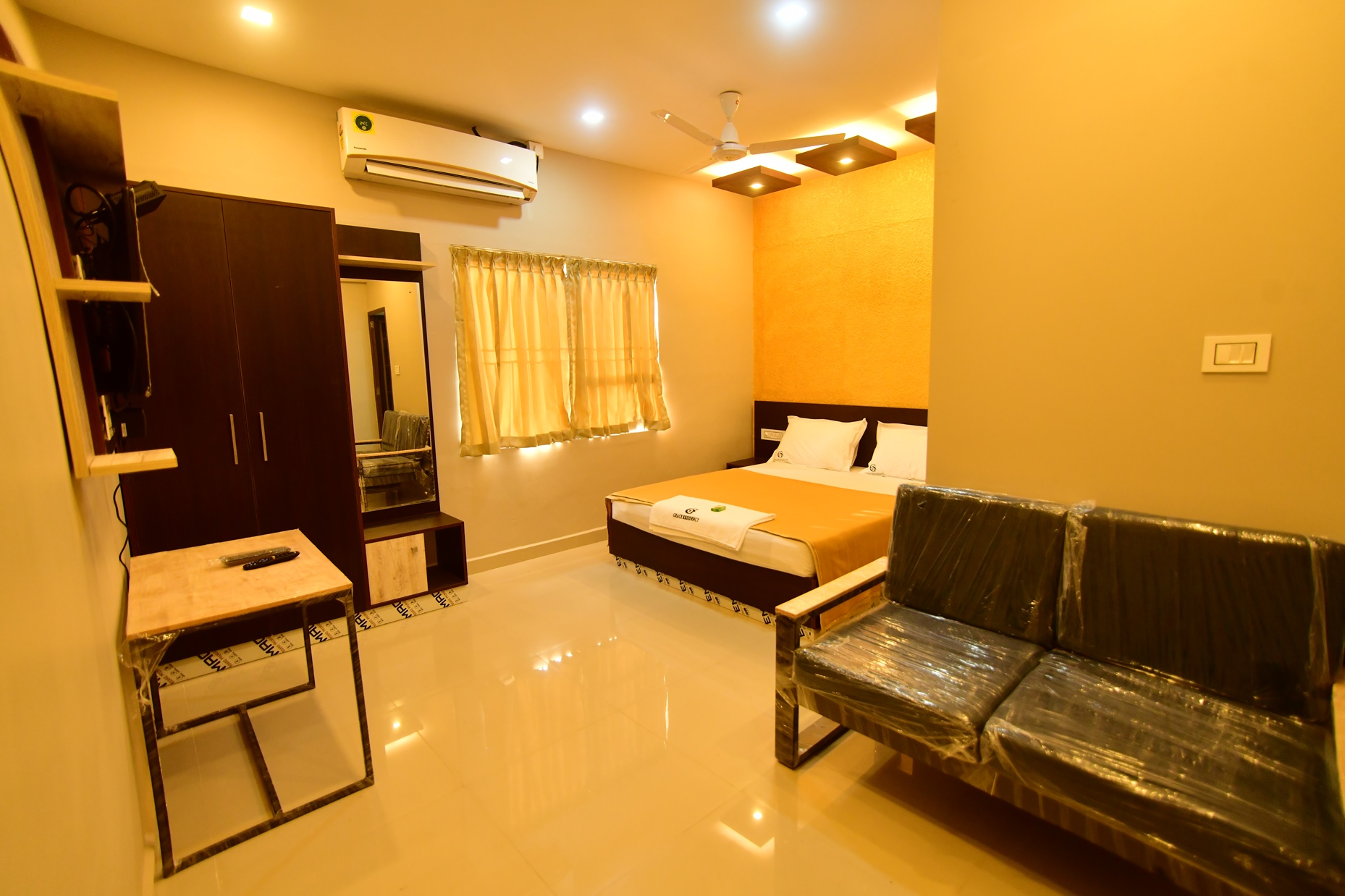
A budget-friendly hotel in the heart of Tirur town with AC suites and deluxe rooms. It sits within walking distance of Thunchan Parambu.

Commission-freeView details
P
Prosland Hotel
Place to stay
Top pick
Hotel · Tirur
Prosland Hotel

A contemporary hotel at B.P Angadi in central Tirur with suites and a party hall. Its kitchen serves regional and global cuisine, plus spa services.

Commission-freeView details

Book with the place itself. India’s cyber-crime coordination centre warned in April 2025 that convincing copies of hotel and pilgrimage booking sites are being pushed through sponsored search and social ads, taking payment for rooms the property never hears about. Every listing here links to the business’s own contact details and its own Google or Bing profile — we take no commission and sit in nobody’s payment path. If a booking page reached you through an ad, check the address bar against the property’s own site before you pay. Fraud can be reported on cybercrime.gov.in or on 1930.

Ranked

The best of Tirur, ranked

Triprangode Maha Shiva Temple sits in Tirur, and these rank everything verified across the town rather than this one spot — built from the same listings shown above, ordered by the strength of the source evidence behind each entry rather than by anyone's star score. Every card shows how many places are really on it. Nobody pays to appear.

Across the whole of Tirur

Ranked guides

Top experiences around Tirur

6 more places around Tirur, each worth a day of its own.

templeThirunavaya Nava Mukunda Temple

5.7 km · ~14 min by auto

An ancient Vishnu temple on the Bharathapuzha at Thirunavaya, near the historic Mamankam fair-ground and a major venue for ancestral (bali/shraddha) rites.

templeAlathiyur Hanuman Temple

2.0 km · 26 min walk

The Alathiyur Perumthrikkovil near Tirur, where the sanctum holds Sri Rama alone and the Hanuman carved outside it — leaning, caught in the act of listening to his orders — is the figure the crowds come for.

templeTrikkandiyoor Mahadeva Temple

6.1 km · ~15 min by auto

One of the hundred and eight Shiva temples of Kerala, a kilometre from Thunchan Parambu — an apsidal ninth-century shrine that opens at half past two in the morning because the god here was installed at dusk.

heritageWagon Tragedy Memorial

7.2 km · ~18 min by auto

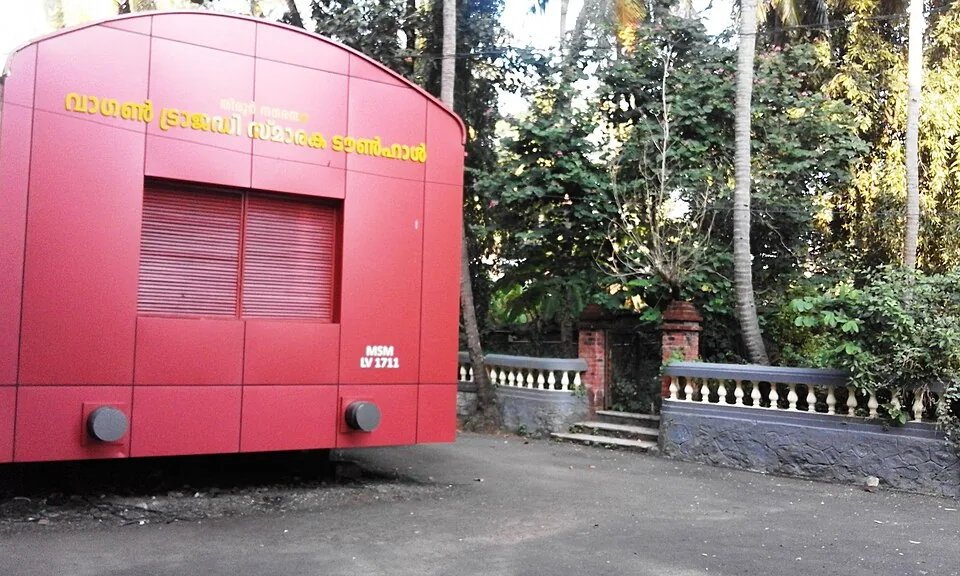
Tirur's town hall, built as a full-size railway goods wagon in signal red and lettered MSM LV 1711 — the memorial to the hundred prisoners shut into wagon 1711 at the station down the road on 19 November 1921.

heritageThunchath Ezhuthachan Malayalam University

6.5 km · ~16 min by auto

The state university at Vakkad, four kilometres west of Thunchan Parambu, founded in 2012 to teach the humanities and social sciences through Malayalam rather than English.

heritageThunchan Parambu

6.8 km · ~17 min by auto

At Tirur, the ground of Thunchath Ezhuthachan, the “father of the Malayalam language” — a working literary institution with a museum, a manuscript library and the Vidyarambham first-letters tradition at Vijayadashami.

Roampedia is commission-free — own or know a stay, eatery, guide or shop near Triprangode Maha Shiva Temple? List it and it appears here once verified.

Add a nearby business
Before you go

Triprangode Maha Shiva Temple — at a glance

TimingsNo fixed schedule is published for this temple. It follows the ordinary Kerala pattern of an early-morning session, a midday close and an evening one, and the hours are worth confirming locally before travelling out from Tirur for a particular puja.

Entry: No ticket is charged for entry. Homams and offerings are arranged at the temple office.

Photography: The best frames are the west front with the two-storeyed vimana behind it, the namaskara mandapam with Nandi in it, and the large public pond on the north-eastern side. Ask before photographing within the enclosure.

Parking: Vehicles are left on the road outside. There is no dedicated car park.

Getting here

How to reach Triprangode Maha Shiva Temple

  • ✈︎ By air Calicut International Airport at Karipur is about 45 km by road.
  • 🚆︎ By train Tirur station, 8.8 km by road, about fifteen minutes by auto. There is no closer station.
  • 🚗︎ By road South from Tirur on the Alathiyur–Codacal road. Thunchan Parambu is 8.0 km away and Trikkandiyoor 7.0 km; the usually published figure of ten kilometres from Tirur is a little long for the road as it now runs.
  • 🚌︎ By bus Local buses from Tirur bus stand run down this road; an auto from Tirur is the simpler option for a single trip.
Getting back

Work out your return before you settle in for the sunset. Public transport here thins out sharply in the evening, and Triprangode Maha Shiva Temple is easier to reach than to leave. We do not publish departure times: there is no official live feed we are permitted to republish, and a wrong time here would strand you. Check the operator directly on the day.

Ask at the bus stand for the time of the last service back, not the next one. If you miss it, an auto or app cab is the fallback — agree the fare before you get in.

Do

Things to do

  • Walk round to the west front first — the direction the shrine faces is the whole point of the place.
  • Find the three shrines that mark the steps taken to reach Yama; they turn the legend into something you walk rather than read.
  • Look for the stone Mrityunjaya and the damage it carries from the eighteenth century.
  • Take in the two-storeyed apsidal vimana from the outside, which is the best-preserved thing on the site.
  • Find as many of the five ponds as you can; each has a use rather than a view.
Plan

Good to know

  • This is a village temple with no visitor facilities. Food, cash and transport are back in Tirur.
  • Triprangode is not Trikkandiyoor. The two names are confused constantly and the temples are seven kilometres apart.
  • It is a working pilgrimage centre for prayers about illness and long life, so it can be busy at times that have nothing to do with the tourist calendar.
  • Dress conservatively and remove footwear; entry to the inner enclosure may be restricted to Hindus.
  • Do not plan a specific puja without confirming the day's timings by telephone first — nothing is published.
Getting around Triprangode Maha Shiva Temple

We have not assessed physical access at this place yet. Across India, step-free routes, handrails and accessible toilets are the exception rather than the rule, and pavements are often interrupted — if step-free access matters to you, contact the site or a local operator before committing to the trip.

If you need help at Triprangode Maha Shiva Temple
112All emergencies (police · fire · medical)The single number to call in any emergency (ERSS).

Emergency numbers are verified against official government and state tourism sources. 112 works anywhere in India.

Nearby

What’s near Triprangode Maha Shiva Temple

templeAlathiyur Hanuman Temple 2.0 km · 26 min walk · straight line
templeThirunavaya Nava Mukunda Temple 5.7 km · ~14 min by auto · straight line
templeTrikkandiyoor Mahadeva Temple 6.1 km · ~15 min by auto · straight line
heritageThunchath Ezhuthachan Malayalam University 6.5 km · ~16 min by auto · straight line
heritageThunchan Parambu 6.8 km · ~17 min by auto · straight line
heritageWagon Tragedy Memorial 7.2 km · ~18 min by auto · straight line
backwaterBiyyam Kayal 8.2 km · ~14 min by cab · straight line
beachPadinjarekara Beach 8.2 km · ~14 min by cab · straight line
backwaterBharathapuzha estuary 8.6 km · ~14 min by cab · straight line
mosquePonnani Juma Masjid 8.9 km · ~15 min by cab · straight line
heritagePonnani 10.9 km · ~18 min by cab · straight line
templeKadampuzha Devi Temple 14.3 km · ~24 min by cab · straight line

All 7 places to visit in Tirur →

On the map

Where Triprangode Maha Shiva Temple is

Good to know

Triprangode Maha Shiva Temple — frequently asked

Why does the Triprangode temple face west?

Kerala Shiva temples are usually entered from the east. Tradition here holds that the god turned west to meet Yama when Death came for the boy Markandeya, and the shrine was built facing the direction he turned.

What is Kalasamharamurti?

The form Shiva is said to have taken when he came out of the linga in fire and struck down Yama — literally the destroyer of time. The Commons photographic record of this temple is filed under that name, and it is the form the temple's own legend turns on.

Did Yama stay dead?

No. The gods pointed out that with Death gone nothing on earth would ever end, and Shiva revived him. The temple therefore commemorates a killing that was reversed, which is why people come here with prayers about illness and long life.

How old is the temple?

The fabric is described as ninth-century, and inscriptions of the later Chera ruler Goda Ravi Varma, of the tenth century, have been recovered from the site. A fifteenth-century Sanskrit poem, the Kokila Sandesha, already names it as one of the region's major destinations.

How many shrines are there?

Nine. The main west-facing Shiva shrine with Parvati beside it, four further Shiva shrines including the Karanayil temple described as the original seat, and three marking the steps taken to reach Yama — with Vishnu, Ganesha, Ayyappa, Krishna, Vettakkorumakan, Bhadrakali, the serpent deities and a Brahmarakshas around the enclosure.

How far is Triprangode from Tirur?

8.8 km by road from Tirur railway station and 8.0 km from Thunchan Parambu, on the Alathiyur–Codacal road. The figure usually published is ten kilometres, which is a little long for the road as it now runs. There is no nearer station, and an auto or a local bus from Tirur is the normal way in.

Is Triprangode the same as Trikkandiyoor?

No. They are two separate ninth-century Shiva temples about eight kilometres apart and the names are confused constantly. Trikkandiyoor is east-facing, belongs to the Parasurama circuit and opens at half past two in the morning; Triprangode is west-facing and belongs to the Markandeya story.

What are the five ponds?

Santhikkulam, where the priests bathe; Vellottukulam out by the fields; the pond at the south-western corner where the trident is said to have been washed; one in front of the Karanayil shrine; and the large public pond on the north-eastern side.

Is there an entry fee?

No ticket is charged for entry. Normal Kerala temple observances apply, and specific offerings and homams are arranged at the temple office.

When is the best time to visit Triprangode Maha Shiva Temple?

October to March, for the same reasons as anywhere on this coast. Maha Shivaratri, in Kumbham, is the biggest night of the year here. Beyond that the temple has no season in the tourist sense: it is a working pilgrimage centre for prayers about illness and long life, so it can be full on a Tuesday in June and quiet on a festival weekend.

What are the entry fee and timings at Triprangode Maha Shiva Temple?

Entry: No ticket is charged for entry. Homams and offerings are arranged at the temple office.. Timings: No fixed schedule is published for this temple. It follows the ordinary Kerala pattern of an early-morning session, a midday close and an evening one, and the hours are worth confirming locally before travelling out from Tirur for a particular puja.

How do I reach Triprangode Maha Shiva Temple?

Come from Tirur, 8.8 km by road and about fifteen minutes in an auto. There is no nearer station and the usually published figure of ten kilometres is a little long for the road as it now runs. Walk round to the west front first. Every other Kerala Shiva temple you have been to was entered from the east, and the difference is the point of the place. Look for the three step-shrines and the Karanayil board; between them they carry the legend in a way no signage does. Give it an hour. There is a great deal more to look at here than the size of the site suggests, most of it in the timber and the plaster rather than the stone. Nothing is published about the day’s timings. If you are coming for a particular puja, telephone first rather than drive out on an assumption.

How much time do I need for Triprangode Maha Shiva Temple?

About an hour for the enclosure and the ponds. Half a day if you are coming out from Tirur and pairing it with Alathiyur, two kilometres north.

What else is near Triprangode Maha Shiva Temple?

Nearby you can pair Alathiyur Hanuman Temple (2.0 km), Thirunavaya Nava Mukunda Temple (5.7 km), Trikkandiyoor Mahadeva Temple (6.1 km), Thunchath Ezhuthachan Malayalam University (6.5 km).

What should I know before visiting Triprangode Maha Shiva Temple?

The approach is a two-lane road through paddy with no footway; the last stretch is best done in a vehicle rather than on foot. The ponds are unfenced and their banks are steep in places, which is worth knowing if you have children with you.

Read before you go

Triprangode Maha Shiva Temple guides, stories & itineraries

Stories & history of Triprangode Maha Shiva Temple

Written about Triprangode Maha Shiva Temple itself — its history, its legends and the arguments about them.

Around Tirur

Triprangode Maha Shiva Temple sits in Tirur, so these cover the streets, buildings and surroundings around it.

In-depth guides to Tirur

Written about Tirur as a whole rather than about Triprangode Maha Shiva Temple — its history, its streets, and how to spend a day in it.

Kerala-wide guides & itineraries

Route-level itineraries and practical guides for the rest of Kerala.

See all 27 Malappuram guides & stories →

Photographs: Ms Sarah Welch (CC0), RajeshUnuppally (Public domain). Wikimedia Commons.

Image credits