Kalpetta is the town where Wayanad is administered rather than the one where it is photographed. It sits at about 780 metres on NH 766, the Kozhikode–Kollegal highway, roughly 71 kilometres up the ghat from Kozhikode, and it holds the Civil Station, the district tourism office, the taluk headquarters and the buses that reach everywhere else. It became district headquarters on 1 November 1980, while it was still only a village panchayat, and did not become a municipality until 1 April 1990; the 2011 census counted 31,580 people. Older than any of that is its Jain past — Malayalam sources describe Kalpetta plainly as a former stronghold of Jainism, and a handful of Kerala’s oldest Jain shrines stand within a few kilometres. What the town carries now is harder: coffee prices, elephants and a highway that closes at night.
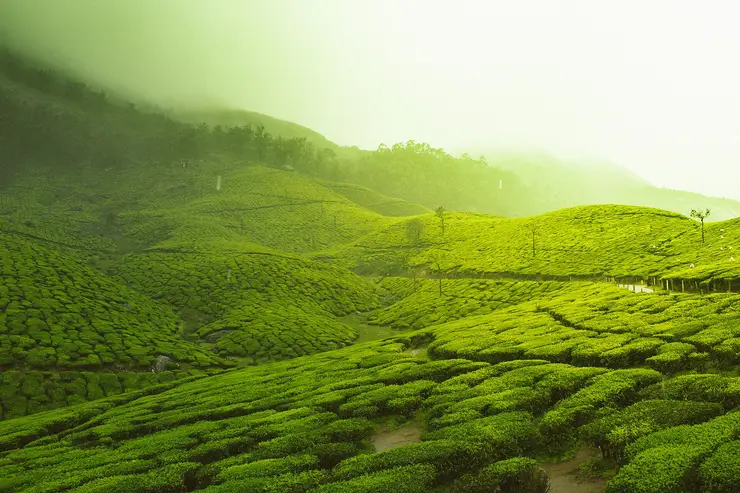
Almost everyone who writes about Wayanad writes about somewhere else — Chembra, Edakkal, Banasura, the ghat. Kalpetta is where the district is actually run. The Civil Station complex, whose gate arch simply reads Civil Station Wayanad in Malayalam, houses the collectorate and the departmental offices; Kainatty, on the edge of town, is the administrative suburb. Vythiri taluk is administered from here, the District Tourism Promotion Council keeps its office here, and the trekking permits for half the district are issued or refused on paperwork that passes through this town. It is a working hill town of about 31,580 people (2011 census), strung along the highway between coffee slopes, with two bus stands, a bypass and a great deal of traffic.
The strangest thing about Kalpetta is written on its own ward list. The municipality has thirty wards, and among the expected Malayalam names — Puliyarmala, Puthoorvayal, Madiyoorkuni, Chathothu Vayal, Gramathu Vayal — sit Emily, Adelaide and Turkey. These are plantation names. When the British opened the Wayanad plateau to coffee and tea in the nineteenth century, estates were christened after English and Australian towns and after the planters’ wives, and when the panchayat and then the municipality drew its ward boundaries it simply used the names already on the ground. A voter in Kalpetta today casts a ballot in a ward called Adelaide because someone once cleared a hillside and named it that. Nothing else in the town states its plantation history so bluntly.
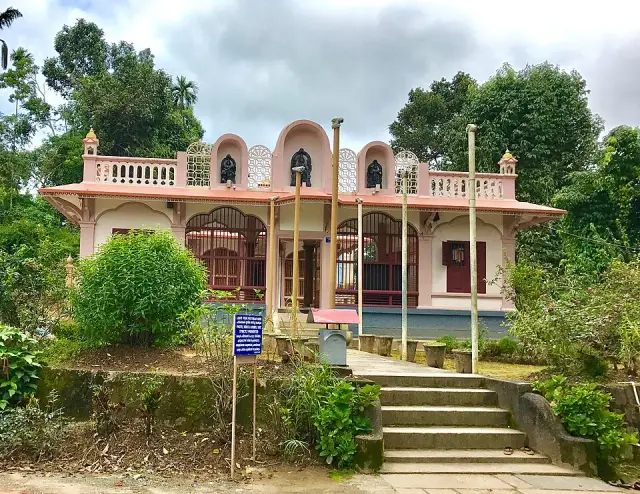
Before the planters there were the Jains, and Kalpetta was one of their centres. The Malayalam Wikipedia article on the town puts it flatly: Kalpetta was once a stronghold of Jainism, and several of the oldest Jain temples in Kerala stand close to it. The community that built them came down from the Karnataka country — Digambara Jains, merchants and settlers moving south along trade routes that tied this plateau to Mysore and the Deccan rather than to the Malabar coast. Their descendants are still here: the 2011 census recorded roughly 4,500 Jains in the whole of Kerala, and they are concentrated in two districts, Wayanad and Ernakulam. It is a very small number for a faith that once shaped a landscape.
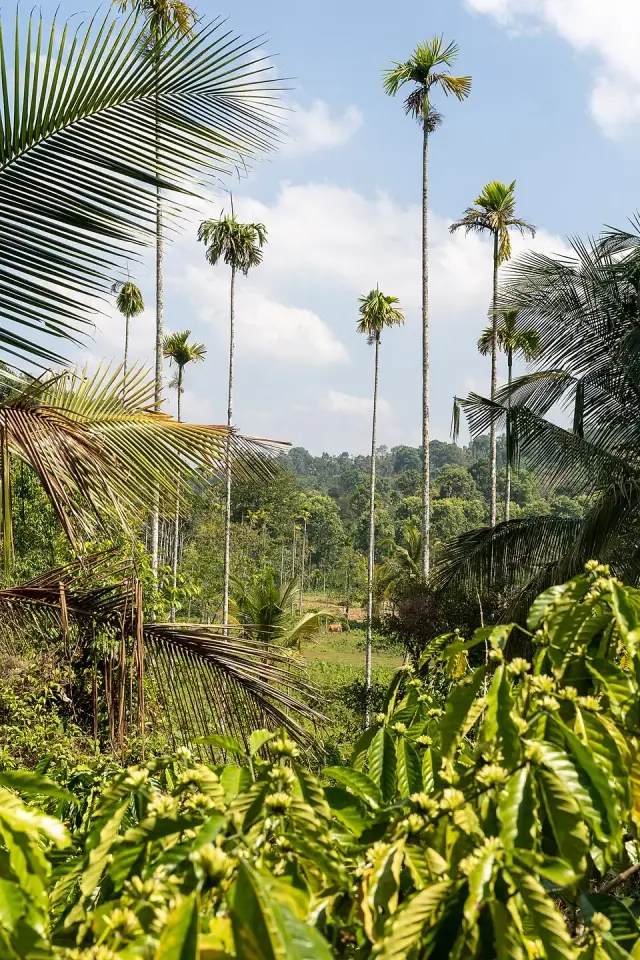
The crop that replaced the old trade was coffee, and Kalpetta is where coffee is studied. The Regional Coffee Research Station at Chundale, inside the municipal limits, runs to about 116 hectares under the Coffee Board of India and works chiefly on robusta — the hardy, low-grown, high-caffeine species that most of Wayanad actually plants, as against the arabica of the Karnataka hills. Robusta is the district’s economic spine. It is also the reason the district became a national byword for agrarian distress, because a crop that pays for a family’s year is a crop whose price collapse takes the year with it.
That distress is documented, and it should be reported plainly rather than dramatised. A psychological autopsy study published in the Industrial Psychiatry Journal in 2024 by P. N. Suresh Kumar and Rohith Suresh took the 180 suicides recorded in Wayanad district by the District Crime Records Bureau over the first six months of 2020 and traced 166 of them to a household. Most of the dead were marginal or landless cultivators working leased land. A hundred and eleven carried liabilities, much of it owed to private moneylenders and to individuals rather than to banks. Alcohol dependence appeared in about a third of the cases against 14.4 per cent of controls, and depression in 28 per cent against 8.4 per cent. Debt, crop and mind are not competing explanations here; they are the same story told three ways.
There is a serious argument about the category itself. The anthropologist Daniel Münster, who did his fieldwork in Wayanad, argued in Contributions to Indian Sociology in 2012 that a ‘farmer’s suicide’ is not a self-evident kind of rural death but something the state makes visible by counting it — enumerated, then reported, then attached to an equally constructed ‘agrarian crisis’, and then answered with relief packages. That does not make the deaths less real. It is a caution against reading a district off a headline number, and Kalpetta, as the place where the counting is done, is exactly where the caution belongs.
The town also holds one of the more hopeful answers. About three kilometres out at Puthoorvayal is the Community Agrobiodiversity Centre of the M. S. Swaminathan Research Foundation — the institution Swaminathan founded in 1988 with the money from his World Food Prize — which works on conserving traditional crop varieties, tribal knowledge and the seed diversity of a district that had bet very heavily on two or three cash crops. Its grounds carry a botanical and butterfly garden. It is not a tourist attraction so much as the intellectual opposite of a monoculture, sited deliberately in the district that needed the argument most.
What dominates Wayanad politics now is not price but elephants. A study in the Indian Journal of Science and Technology (2025) counted 9,989 human–elephant conflict incidents in Wayanad from January 2018 to November 2023, of which 94.69 per cent were crop raids and 3.16 per cent property damage, with about ₹690 lakh paid out in compensation and the South Wayanad division accounting for 43.5 per cent of the total. A follow-up study covering 2020–21 to 2023–24 logged 7,155 incidents across the three forest divisions and mapped 295 conflict hotspots, 134 of them high-priority, clustered along the eastern and southern forest–farm edges facing Bandipur, Mudumalai and Nagarhole. Solar fencing, elephant-proof trenches and rapid response teams are what the district argues about at election time.
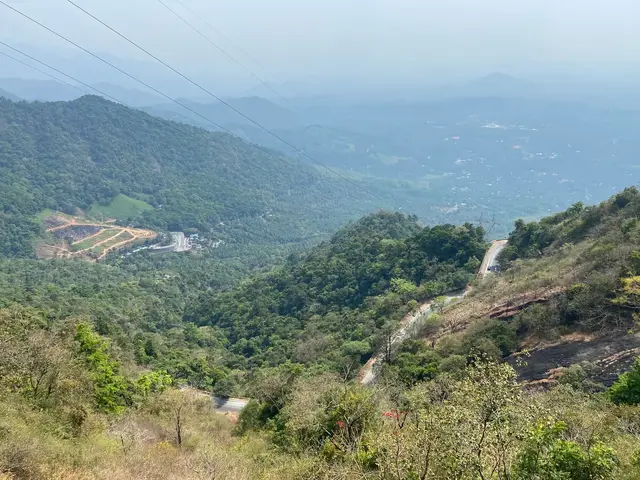
Finally, the road. Kalpetta sits on NH 766, and beyond Muthanga that highway runs 19.7 kilometres through Bandipur, where Karnataka has banned night traffic since 2009 — no vehicles between 9 pm and 6 am, and no two-wheelers from 6 pm. The night detour to Mysuru runs via Mananthavady, Kutta, Gonikoppal and Hunsur, about 352 kilometres against roughly 132 by the direct road. On the Kozhikode side, the nine hairpins of the Thamarassery ghat are being bypassed by the 8.1-kilometre twin-tube Anakkampoyil–Kalladi–Meppadi tunnel, begun on 31 August 2025 on a four-year programme; a mudslide at the Kalladi site on 7 July 2026 killed six workers and construction was suspended pending inquiry. Anyone planning a Wayanad trip should check both the tunnel works and the Bandipur timings before setting an arrival hour.
Legend & myth
Kalpetta’s legends are not the ones sold at the roadside, and it is worth saying at the start which stories are not its own. The chained ficus and the murdered Adivasi guide Karinthandan belong to Lakkidi, at the head of the ghat. The thousand-armed asura Banasura, his daughter Usha and her stolen night with Krishna’s grandson Aniruddha belong to the Banasura hills and the reservoir beneath them. Sita’s forest exile and the shrine of her twins belong to Pulpally, on the far eastern side of the district. The granite temple that became Tipu Sultan’s ammunition store, and gave a town its name, belongs to Sulthan Bathery. Borrowing any of them onto Kalpetta would be easy and would be false. What Kalpetta has instead is older, quieter and genuinely local: a Jain imagination that reached this plateau from the north and never entirely left it.
The figure at the centre of it is Anantanatha, the fourteenth of the twenty-four Tirthankaras, to whom the Jain shrines around Kalpetta are dedicated. A Tirthankara is not a god in the sense the surrounding Hindu landscape would recognise. The word means ford-maker: one who has found a crossing over the river of rebirth and left the ford marked for others. Jain myth counts twenty-four of them in the present cosmic age, each born a prince, each renouncing everything, each attaining omniscience and then teaching a path whose first principle is ahimsa — not merely not killing, but not injuring, extended so far that a Digambara monk sweeps the ground before he sits on it. The men who raised these shrines were merchants who lived by that discipline in a hill country full of hunters, and that tension is the real strangeness of Jain Wayanad.
How they arrived is itself a story told as much as documented. The tradition holds that in the years after Chandragupta Maurya, in the third century BCE, the Jain teacher Bhadrabahu led a migration south to escape a long famine, settling at Shravanabelagola in the Karnataka country; from there disciples went looking for quieter places to meditate and drifted further south into Kerala and the Tamil country. By the first centuries of the common era Jainism was well established on this coast, and the Tamil epic Silappadikaram is attributed to Ilango Adigal, a Jain of the Chera line. From the eighth century the great Shaiva and Vaishnava devotional movements pushed it back, and by the sixteenth it had all but vanished from Kerala. The Wayanad shrines are what the tide left behind on the way out.
The most interesting Kerala legends about Jainism are absorption legends — stories in which a faith is not destroyed but swallowed. The Koodalmanikyam temple at Irinjalakuda is widely believed to have begun as a Jain shrine to Bharateshwara before it became a Hindu one. The Kallil temple near Perumbavoor, a rock shrine, is held by tradition to have been dedicated to Parshvanatha, Padmavati and Mahavira, and is now a Devi temple where Jains still come to pray. Behind both is the same folk intuition: that the old deity did not leave, only changed clothes. In Wayanad, where a Jain basadi and a Bhagavathi kavu can stand within the same few kilometres, that intuition is not hard to understand.
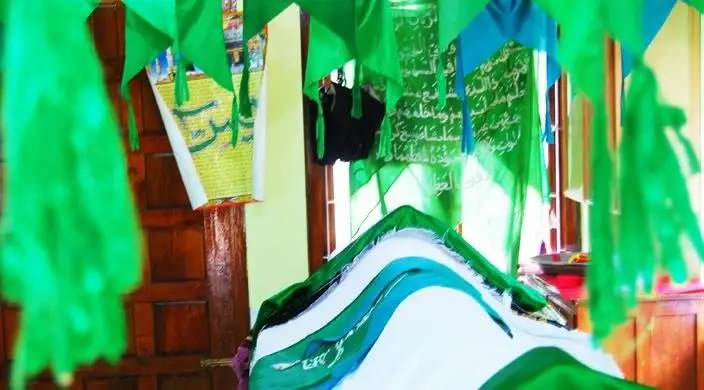
Twenty kilometres from Kalpetta stands the strangest survival of all, the shrine Malayalam sources call simply the Kannadi Kshetram, the mirror temple, dedicated to Parshvanatha and famous because its walls are lined with mirrors that multiply the images inside into thousands. Parshvanatha is the twenty-third Tirthankara, always shown with the hood of a many-headed serpent raised above him — in the legend the naga Dharanendra and his consort Padmavati shelter the meditating ascetic from a storm sent to break his concentration, and he does not open his eyes. A hall of mirrors around such a figure is not decoration. It is a Jain argument in glass: that the same truth, reflected without end, is still one truth.
There is a naming legend too, from Puthangadi near Kayakkunnu on the northern side of the district, where an ancient kallampalam — a stone temple — stands ruined. The old people there say the place was once a pearl market, muthangadi, and that muthangadi wore down over generations into puthangadi; they also say the stone temple was broken during Tipu Sultan’s campaigns through Wayanad. Both halves are tradition rather than record, and the pearl story in a landlocked hill district should be read as a memory of trade rather than of pearls. But it preserves something true about the Jain centuries here: this plateau was a market that faced Karnataka, and the shrines were built by people who dealt in goods that travelled.
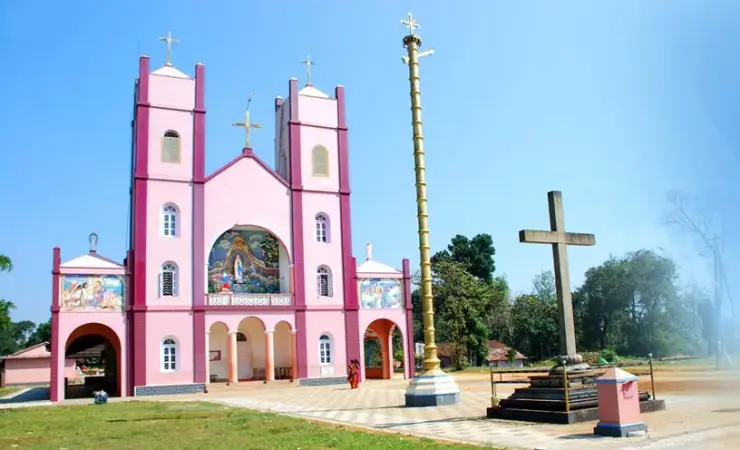
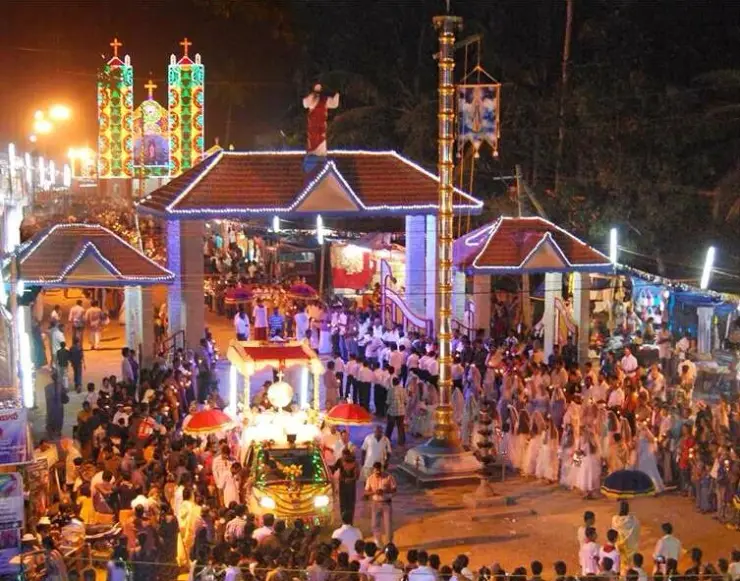
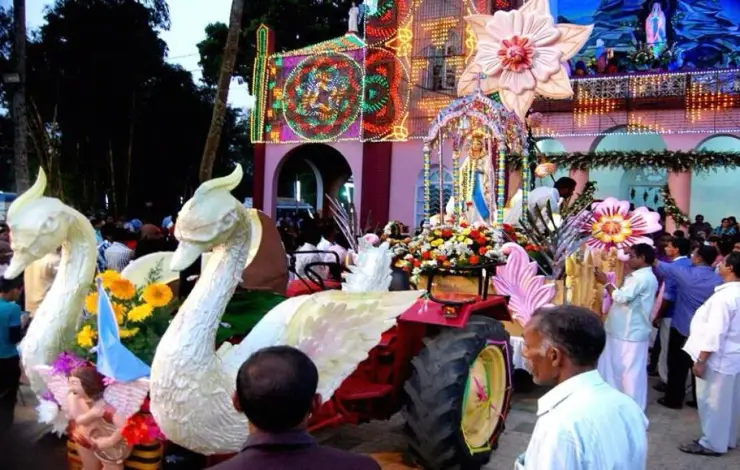
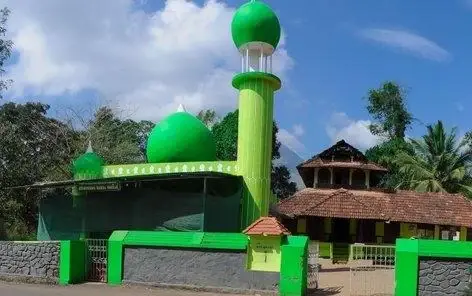
It would be dishonest to claim that Kalpetta town itself is thick with folk legend. Searching in Malayalam — കൽപറ്റ, ക്ഷേത്രം, ഐതിഹ്യം, ജൈനക്ഷേത്രം — and reading a level up, at the Vengappally and Muttil panchayat articles and the Kalpetta municipality entry, turns up worship rather than myth: the Thekkumthara Bhagavathi temple about five kilometres out, the Madiyoor Mahavishnu temple inside town, a Chelode makham, and two shrines with dates instead of stories. The Varambetta mosque, about twenty-four kilometres away by road, is called the oldest in Wayanad, though its age is given as roughly 300 years in one source and about 400 years, around AD 1600, in another, and the Malayalam article flags its own figure as uncited. The Lourdes church at Pallikkunnu, twelve kilometres off, was built by a French priest, Fr Jefreno, in 1908 and keeps a February feast. That is a real answer, not an empty one: Kalpetta is a town whose deep story is a religion that left, and whose surface is a century of arrivals.
More about Kalpetta
History
Wayanad’s recorded history begins late and abruptly. The plateau was held by chieftains — the district administration’s own account names rajas of the Veda tribe and later the Pazhassi rajas of Kottayam — before Hyder Ali’s invasion, after which Tipu Sultan is said to have restored it to the Kottayam line. The Treaty of Srirangapatnam handed Malabar to the British, and the resistance led by Kerala Varma Pazhassi Raja, who organised the Kurichiya into a hill militia, ended with his death in these forests in 1805. What followed was the opening of the plateau to coffee, tea, pepper and cardamom, and the roads to Mysore and Ooty that brought settlers in from every part of Kerala. Nearly everything in Kalpetta today rests on that nineteenth-century clearance.
The nationalist century began, in Wayanad, in this town. The first political conference in the district was held at Kalpetta in 1921 under the leadership of Dharmaraja Iyer, attended by K. P. Kesava Menon and by A. K. Gopalan, and the local Congress committee was formed at about the same time. Mahatma Gandhi came to Kalpetta on 14 January 1934, during the tour he made across the south against untouchability. The boarding house at Puliyarmala where he rested, roughly four kilometres from the town centre, is kept as a Gandhi museum with a small library — a modest building doing the work of a much grander monument.
Administratively Kalpetta is a young capital. Wayanad was carved out of Kozhikode and Kannur districts and came into being on 1 November 1980 as Kerala’s twelfth district, with Kalpetta as its headquarters — at which point Kalpetta was still a village panchayat. Municipal status followed only on 1 April 1990. It is today a Grade 2 municipality of thirty wards and, by the Malayalam municipality entry, about 40.74 square kilometres; the English Wikipedia infobox gives 50.74 square kilometres for the town, and the two figures disagree. The municipality is bounded by the Kottathara and Muttil panchayats to the north, Vythiri to the south and west, and Meppadi and Muttil to the east.
Kalpetta is also the name of an assembly constituency and sits inside the Wayanad Lok Sabha seat, which has had an unusually high national profile: it was held by Rahul Gandhi from 2019 until he vacated it in 2024, and then by Priyanka Gandhi Vadra. For a district of under a million people whose main political questions are crop prices, forest boundaries and elephants, that is a peculiar amount of attention, and locals will tell you so.
The most recent chapter is the one nobody wanted. After the landslides that destroyed Chooralmala and Mundakkai on 30 July 2024, the state took 64.4 hectares at Elstone Estate near Kalpetta for a rehabilitation township; the first phase was handed over on 1 March 2026. That programme is told properly on our Wayanad landslide pages, and it is mentioned here only because it explains why the district headquarters has spent two years being a construction and compensation office as much as a town.
Two long-running literary and political figures come from here. Kalpatta Narayanan, the poet and novelist, takes his pen-name from the town, and M. P. Veerendra Kumar — writer, parliamentarian and for decades the presiding figure at Mathrubhumi — was a Wayanad man. The town also produced a run of contemporary Malayalam film names, which is how most of India now hears of it at all.
Why visit
It is the most practical base in Wayanad: everything in the district is within about an hour, and you sleep on a highway rather than up a jeep track.
The Civil Station, the DTPC office and the forest offices are here, so permits, trek status and road advisories are checked in person rather than guessed at.
Myladippara, the bare granite dome east of the Civil Station with a small pavilion on its crown, gives a short, unfussy climb and a view over the whole town.
The Gandhi museum at Puliyarmala, in the boarding house where he stayed on 14 January 1934, is four kilometres out and takes twenty minutes.
The Wayanad Flower Show fills Kalpetta with dahlias, celosia and potted petunias each December–January, and is the one time the town itself is the attraction.
The M. S. Swaminathan Research Foundation’s agrobiodiversity centre at Puthoorvayal makes sense of the district’s farming in a way no viewpoint can.