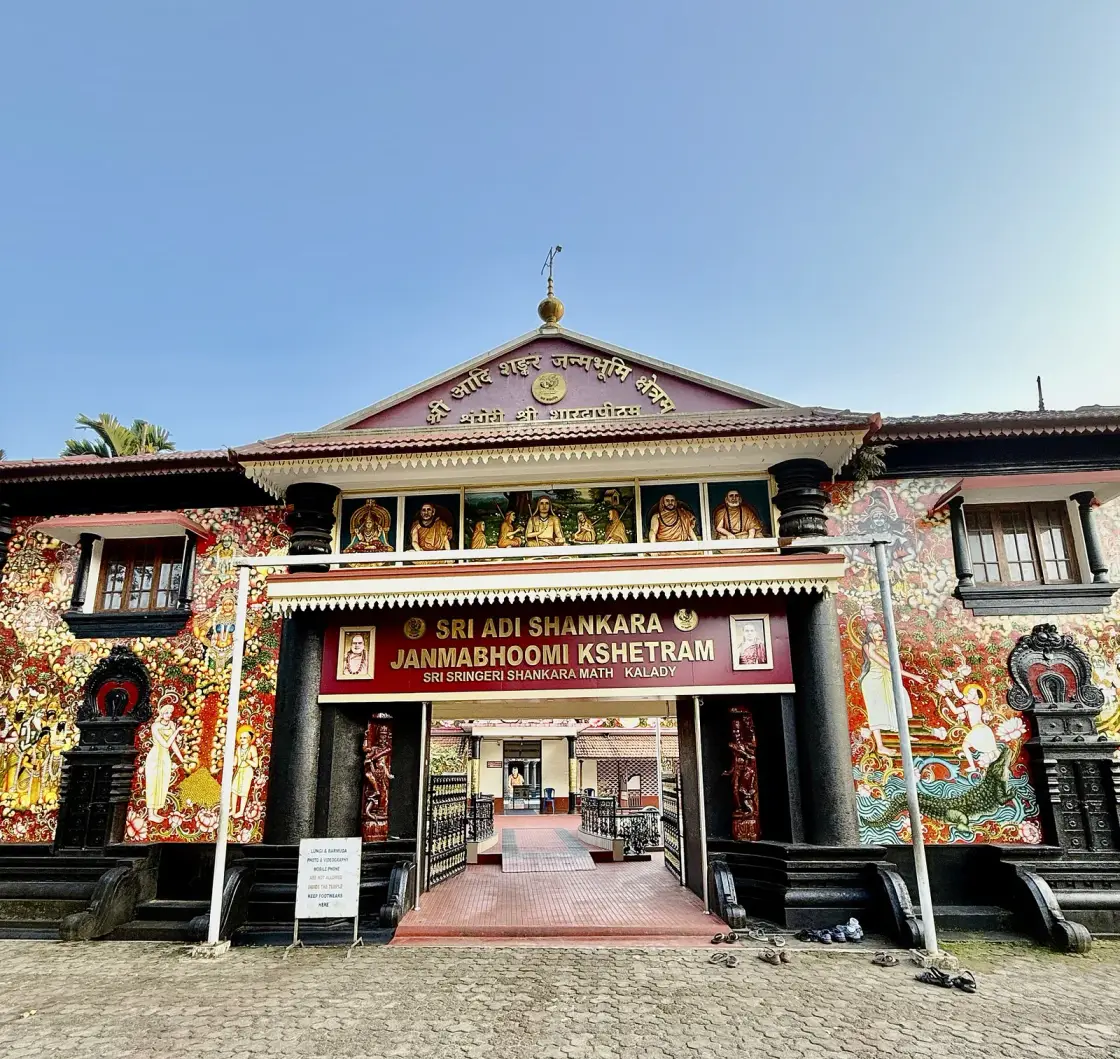
Kalady is a rice town, a university town and an airport town that happens to be the traditional birthplace of Adi Shankara, and almost everything written about it stops at the last clause. The pilgrimage complexes on the Periyar are real and they are the reason coaches come, but they occupy a few hundred metres of a panchayat of 16.44 sq km that mills a very large share of Kerala’s rice, teaches Sanskrit to a student body that is overwhelmingly female and overwhelmingly from communities historically kept out of it, and sits about ten minutes from Cochin International Airport. This record is about that town: the bridge that made it, the mills at Mattoor, the university founded in 1993, and the monk who spent twenty-five years arguing against caste at the birthplace of the tradition most associated with it.
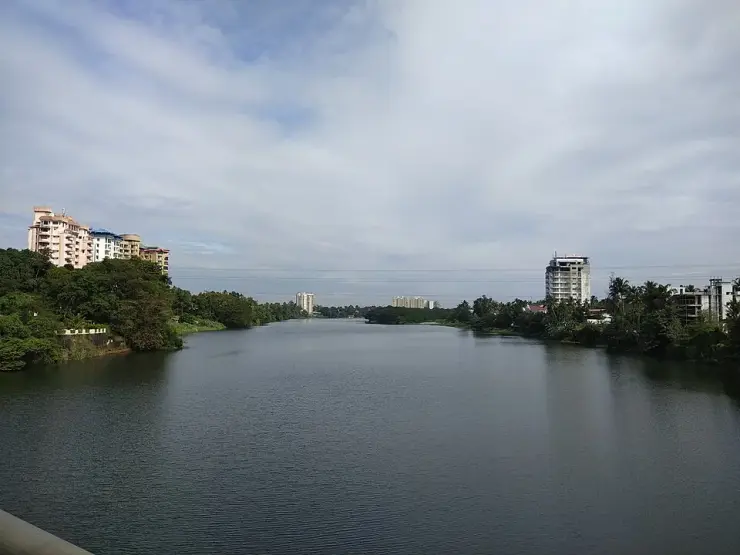
Start with the bridge, because Kalady is a town the river used to divide. The Sankara Bridge across the Periyar was built in 1965, after a long campaign by Swami Agamananda of the Ramakrishna Advaita Ashrama here, who took the case as far as the President of India. Before it, the ghats were crossings as much as bathing places. After it, the MC Road corridor through Kalady became a working through-route between Angamaly and Perumbavoor, and the town on the far bank could industrialise. Nearly everything else on this page dates from after that bridge.
The first thing to understand about modern Kalady is that it mills rice — a great deal of it. The cluster goes back to about 1940 as a scatter of small conventional mills, modernised heavily through the 1990s into mechanised parboiling and milling plants, and it is now described by the Kerala industries department and by the millers themselves as the largest rice-processing cluster in the state. The Kalady Rice Millers Consortium, registered at Mattoor with the Kalady postcode 683574, gives the cluster an annual capacity of about six lakh tonnes of rice and a daily output of around 2,000 tonnes of parboiled rice, plus roughly 100 tonnes of bran and 300 tonnes of husk a day.
The reason the mills are here rather than somewhere else is the Periyar. Parboiling rice — soaking, steaming and drying the paddy in the husk, which is what makes Kerala’s red matta what it is — takes very large volumes of clean fresh water, and this reach of the river supplies it. That is the plain industrial explanation for why a village on a river became a milling centre, and it is the same river the pilgrimage is about. Malayalam Wikipedia puts it at roughly eighty of Kerala’s two hundred and fifty rice mills; the consortium’s own account counts over fifty units and forty-one members. The figures are counted differently and we give both rather than choosing.
You cannot tour a rice mill, and we are not suggesting you try. What the mills mean for a visitor is the texture of the place: lorries on the MC Road, a stretch of the town given over to godowns and weighbridges, and the sacks of matta, kuruva and other Kerala varieties in every shop. Mattoor, a couple of kilometres west of the temple complex, is the industrial half of Kalady, and the consortium’s common facility centre — built to extract oil from rice bran that the mills had previously been selling cheap and out of state — sits there rather than anywhere scenic.
The second modern institution is Sree Sankaracharya University of Sanskrit, whose headquarters campus is on the Periyar bank at Kalady. The enabling law is the Sree Sankaracharya University of Sanskrit Act, 1994, which the university dates to its coming into force on 25 November 1993; UGC recognition under section 2(f) followed in 1993 and 12(B) in 2005. It runs twenty-four academic departments across ten faculties, with regional campuses spread deliberately into rural Kerala — Thiruvananthapuram, Panmana, Ettumanoor, Tirur, Koyilandy and Payyannur among them. In 2021 it took an A+ grade from NAAC, the first Sanskrit university in India to do so.
The statistic that ought to be on the signboard is not the grade. The university states that more than ninety per cent of its students and research scholars come from economically and socially backward communities, and that more than seventy per cent are women. Set that against what Sanskrit learning was for most of its history in Kerala — restricted by birth and by sex — and the campus is doing something considerably more interesting than commemorating a philosopher. It is worth saying clearly that this is a Kerala state university, with the Governor as Chancellor. The English Wikipedia article on Kalady describes it as run by the Sringeri Mutt in the mutt’s grounds, and that is simply wrong.
Education at Kalady did not start with the state, though. It started in 1936, when local people offered Swami Agamananda — a disciple of Swami Brahmananda, the Ramakrishna Order’s first president — land and an old building, and the Sri Ramakrishna Advaita Ashrama opened on Sankara Jayanti day, 26 April 1936. It was affiliated to Belur Math in 1941. The Brahmanandodayam Sanskrit School followed in May 1937, its building opened by C. P. Ramaswami Iyer, then Dewan of Travancore, on 4 February 1938; a high school division came in 1947 and a primary section in 1950, and an Ayurvedic dispensary in 1951. Sree Sankara College, now affiliated to Mahatma Gandhi University, was founded by Agamananda in 1954. Malayalam Wikipedia dates the college to 1964; the college and English Wikipedia both give 1954, and we follow those.
So Kalady has an unusually dense stack of institutions for a panchayat of its size: a state university, an arts and science college, an engineering college in the Adi Sankara Institute of Engineering and Technology, an ashrama running schools from nursery to higher secondary, and two monastic establishments — Sringeri at the birthplace complex, Kanchi Kamakoti at the memorial tower — that do not answer to each other. Add the district’s rice mills and it is a town that employs, teaches and processes rather than one that merely receives pilgrims.
Practically, it is one of the easiest places in Kerala to reach and one of the easiest to underrate. Angamaly is the nearest railway station at roughly ten kilometres, buses run constantly from Angamaly, Aluva and Perumbavoor, and the airport is very close — English and Malayalam Wikipedia give six and seven kilometres respectively, which is a straight-line figure; by road, and on our own place pages, it is nearer ten. Either way it is a genuine first or last stop on a Kerala trip rather than a detour, and half a day covers the shrines with time left for the town.
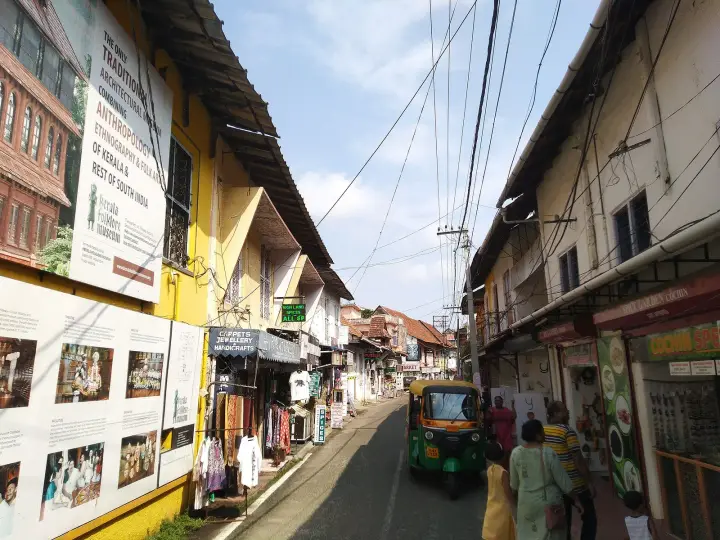
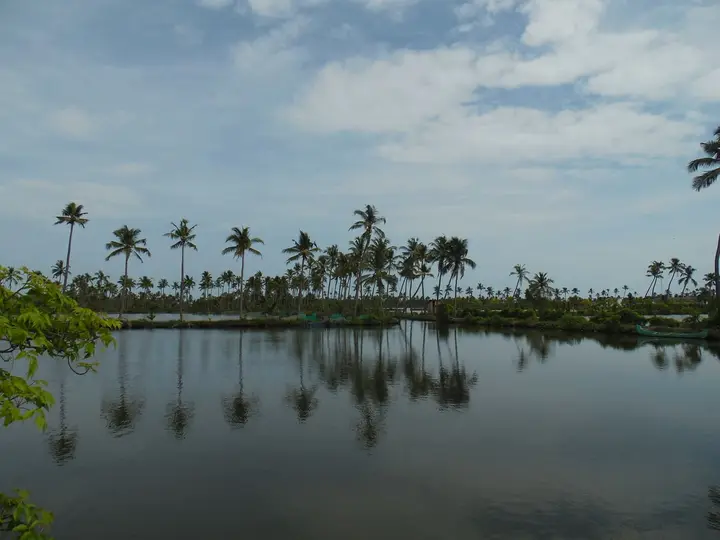
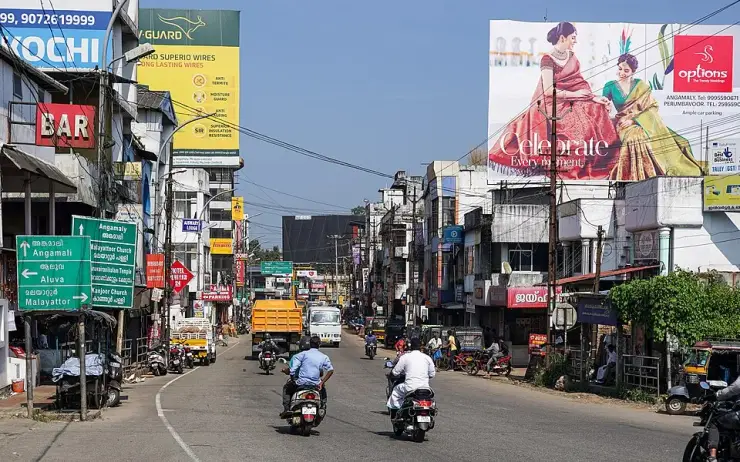
One honest caution about expectations. Kalady is not picturesque in the way Fort Kochi or Alappuzha are. It is a busy junction town on a state highway, with hoardings, lorries and a bus stand, and the sacred ground is embedded in it rather than set apart from it. That is exactly what makes it worth an hour more than most people give it — but if you arrive expecting a hushed riverside village you will be briefly disappointed before you adjust.
Legend & myth
The town’s name is its first legend, and the legend has a competitor almost nobody mentions. Both English and Malayalam accounts record that the settlement was called Sasalam before it was called Kalady, and that the change is credited to the story of the boy Shankara and his mother — kal-adi, the foot-mark, from the tradition that the Purna moved to follow the track his feet had traced. That story belongs to the river and we tell it at the Periyar rather than here. What belongs here is what the name change implies: a place that had a perfectly good older name and lost it to a biography.
The competitor is recorded on Malayalam Wikipedia and it is a Buddhist reading. On this account the area was a Buddhist centre before it was anything else, and the footprints that gave the place its name were footprints of the Buddha carved or venerated on stone — the buddhapada, a form of aniconic worship found across the Buddhist world and once present in Kerala. If that is right, the name predates Shankara and was later re-explained around him. We are in no position to adjudicate it, and we are not going to: it is a claim recorded in one encyclopaedia in one language, without an inscription behind it, and it is not the reading you will hear at Kalady. But the shape of it is familiar to anyone who has followed Kerala’s religious history, where Buddhist and Jain sites were absorbed rather than erased, and it deserves to be written down rather than quietly dropped because it is inconvenient.
There is a third foundation story that is older than either and is told about the settlement rather than about the saint. In it, a chieftain named Rajasekara founded the place, built a Shiva temple and settled Brahmin families around it. That is the standard shape of a Kerala settlement legend — a ruler, a shrine, an invited priesthood — and its interest is that it makes Kalady an ordinary planted village with an ordinary origin, into which the extraordinary birth is later inserted. It is recorded on English Wikipedia and we have not found it corroborated in a document. Treat it as tradition.
The best story in Kalady’s repertoire is one it does not own, and the honest thing is to say so. The Kanakadhara Stotram — the hymn to Lakshmi that tradition names as Shankara’s first composition, made when he was about eight — is set at the door of a house so poor that the woman inside had nothing to give a begging boy but a single dried gooseberry. The tradition holds that he was so moved by a gift that cost her everything she had that he sang twenty-one or twenty-two verses to Lakshmi on the spot, and that the goddess answered by raining golden gooseberries into the hut. It is the loveliest of the Shankara legends because the miracle is a response to generosity rather than to austerity, and because the person it rewards is a woman nobody names.
Kalady tells that story and marks it liturgically: a Kanakadhara Yajnam is performed here in the Sankara Jayanti season, and a golden-gooseberry abhisheka on Akshaya Tritiya. But the incident itself is not sited at Kalady. It is sited at Swarnathu Mana — the golden house — at Punnorkode, some twenty-three kilometres away in the same district, where a Kanakadhara Mahalakshmi temple was consecrated on the ground in 2013. So the birthplace performs a rite for something that, by the tradition’s own geography, happened elsewhere. That is not a scandal; it is how a pilgrimage centre works, gathering the whole life to the one place a visitor can stand. It is only worth knowing so that you do not go looking at Kalady for a house that is not there.
The riverbank itself is organised by story rather than by geography, and the ordering is the point. Three ghats are named in sequence along the Periyar: the Kalady or Aarattu Kadavu, where the river is said to have turned; the Muthala Kadavu, the crocodile ghat, where the boy is held to have taken sannyasa; and the ghat associated with his mother’s cremation and the funeral rites he is said to have performed against the rules of his own order. Those three episodes are told in full on our river and temple pages. What matters at town level is that they run west to east along the bank in the order the life runs, so that walking the riverside at Kalady is walking a biography. Whether that sequence was found or arranged, nobody can now say.
The institutions carry their own claims, and they are claims. The Thekke Madam here, founded from Thrissur, is described as having been granted special archana rights in 825 and rights of kingship over Kalady in 1730. Those are precise-sounding dates attached to a Kerala monastic property, reported in reference accounts without a cited grant, and we pass them on as the madam’s tradition rather than as record. The same caution applies more famously to the man himself: his dates are argued over by centuries, and the monastic institutions founded in his own name do not agree with each other about them. We follow the mainstream 788–820 CE dating on our pages and we set out the full disagreement in our story on the birthplace.
A last thing about the sacred geography, which is easy to miss when you are standing in it. The Sringeri Sharada Peetham identified this ground and consecrated shrines here in February 1910 — one of them to Sharadamba, beside the spot local memory gave as the place Shankara’s mother was cremated. Before that the site was not a maintained pilgrimage centre. So Kalady’s legends are ancient and Kalady’s marked places are a little over a century old, and the two facts sit side by side without cancelling each other. The Travancore government’s acquisition of the Kappilly properties, recorded in a 1906 gazette proceeding, is the paperwork of a village becoming a shrine. It is one of the few moments in this story with a date you can look up.
More about Kalady
History
Kalady is a grama panchayat in Angamaly block, Ernakulam district, formed in 1956, covering 16.44 sq km. The 2001 census recorded 24,707 people, a density of about 1,503 per sq km — figures now a quarter of a century old, and the town has plainly grown since, but they are the ones on the record. The postcode is 683574 and vehicles here carry KL-40 or KL-63 plates, registered at Perumbavoor and Angamaly respectively, which tells you which two towns Kalady administratively leans on.
Politically the ground has changed hands more than once. The area lay historically within the Kochi kingdom and later came under Travancore, which is why the 1906 acquisition of the Kappilly properties associated with Shankara’s paternal family was carried out by proceedings of the Travancore government rather than by Cochin. The centenary of that modern refounding was marked in May 2010.
The twentieth century did three things to Kalady in sequence, and they are the reason the town looks as it does. First the shrines: Sringeri identified the site under Sri Sacchidananda Shivabhinava Nrisimha Bharati, who headed that matha from 1879 to 1912, and consecrated the birthplace shrines in February 1910. Then the institutions: the Ramakrishna Advaita Ashrama in 1936, its Sanskrit school in 1937, the high school in 1947, Sree Sankara College in 1954. Then the infrastructure: the Sankara Bridge over the Periyar in 1965, a community centre at Mattoor in 1971, and the Kanchi Kamakoti Peetham’s memorial tower dedicated in 1978.
Swami Agamananda deserves more space than he usually gets in accounts of this town. He ran the ashrama here for a quarter of a century as an explicitly reformist project, working against caste discrimination in a village whose entire fame rested on a Brahmin household, and he built schooling rather than only shrines. The Travancore Dewan gave the ashrama more than a hundred acres of forest land, of which about 32 acres were actually used. The bridge that carries traffic across the Periyar at Kalady exists because he pressed for it. A visitor who leaves knowing only about the eighth century has missed the twentieth.
The rice industry’s dates run alongside all of that. Small conventional mills from around 1940; heavy modernisation into mechanised parboiling through the 1990s; the Ernakulam rice-mill cluster identified by the Kerala industries department under the national cluster development programme; and in October 2003 the formation of the Kalady Rice Millers Consortium. Accounts of how many mills founded it differ — thirty-three in the cluster’s own project proposal, thirty-nine in later summaries — and we give both. At the time of that proposal the district held about 70 modern and 55 small conventional mills in the small-scale sector, with rice milling in Ernakulam estimated to employ some 3,000 people directly and 1,500 indirectly.
The last date is the university. The Sree Sankaracharya University of Sanskrit was established at Kalady in 1993, under an Act of the Kerala legislature of 1994 which the university dates to its commencement on 25 November 1993. It is the single largest change to what Kalady is for: a place that had been a destination became, for several thousand people, somewhere they go to work and study. Sources differ on whether it has seven campuses or eight; the university’s own site says eight regional campuses besides the Kalady headquarters, and English Wikipedia counts seven in total.
Why visit
It is about ten minutes from Cochin International Airport, which makes it the most practical first or last stop in Kerala for anyone flying in or out.
The Adi Shankara birthplace complex, the Periyar ghats and the eight-storey memorial tower are all within a short walk of each other, so half a day covers the pilgrimage properly.
Sree Sankaracharya University of Sanskrit gives the town a large, genuinely modern campus on the riverbank — a state Sanskrit university whose students are mostly women and mostly from communities long excluded from Sanskrit learning.
It is the biggest rice-milling cluster in Kerala, and knowing that changes what the lorries, godowns and sacks of matta on the MC Road actually mean.
The Ramakrishna Advaita Ashrama, its schools and Sree Sankara College are a twentieth-century reform story sitting inside an eighth-century one.
Malayattoor, the St Thomas pilgrimage hill, is close enough to pair with Kalady in a single day out from Kochi.