Kozhikode Beach

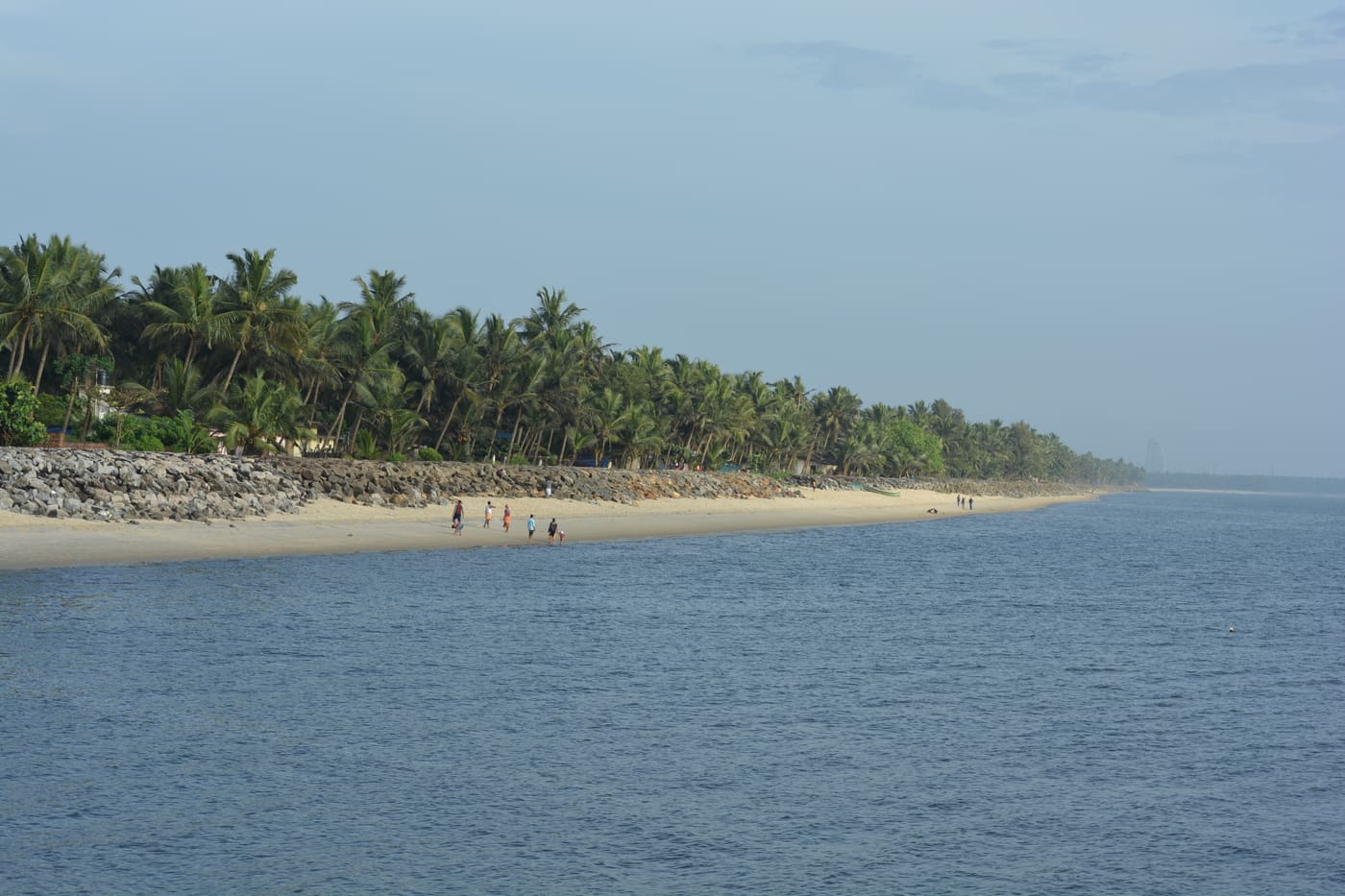
Kozhikode Beach is the city's main seafront, known for sunset crowds, old pier remains, food stalls, nearby heritage streets and easy access from the Malabar food capital. It is a city-beach experience, not a secluded resort beach.

Kozhikode Beach, Kozhikode city
Practical guide

Plan Kozhikode Beach

Who's going?Tailor Kozhikode Beach to your trip
Typebeach
Nearest baseKozhikode city
DistrictKozhikode
Best timeNovember to February is the most…
Time needed1 to 2 hours for a beach walk
EntryFree
Places to visit7Listed businesses51

The best of it is how it combines with the rest of Kozhikode: the beach road, SM Street, Mananchira, Kuttichira, the seafood and halwa stops and an evening walk. Choose food, a stay and transport close to the beach — and treat a promised sea view as something to confirm rather than assume.

The story

Kozhikode Beach — long known as Calicut Beach — is the seafront heart of a city that was once the greatest spice port on the Malabar Coast. Two crumbling iron piers reach out into the Arabian Sea, a lighthouse and Lions Park sit along the shore, and every evening the sand fills with families, walkers and street-food carts gathered to watch the sun drop into the water.

The story of Kozhikode Beach

The beach runs as a broad, straight ribbon of dark sand along the western edge of Kozhikode city, edged by a paved promenade that has become the town's favourite gathering place. It is not a swimming beach so much as a social one — people come to walk, to sit on the sea wall, to let children run, and above all to watch the sun sink into the Arabian Sea. On weekends and holidays the crowds swell into the thousands, and the whole shoreline takes on the feel of an open-air fair.

Its most distinctive features are the two old piers that jut out toward the middle of the sea, both more than a century old and now weathered into skeletal ruins. Once used to load and unload cargo and passengers when Calicut was a busy working port, they have long since fallen out of use, their ironwork rusted and their decks broken. Today they survive as brooding silhouettes against the sunset — a favourite subject for photographers and a reminder that this quiet shore was once a place of ships and commerce.

As dusk approaches the beach comes alive with food. Carts and stalls line the promenade selling Kozhikode's beloved snacks — spicy fried fish and squid, unnakkaya, pazham pori (banana fritters), bhajjis, cut fruit, roasted peanuts, kadala, and the sweet, milky local tea. The street-food culture here is part of the draw in a city famous for its cuisine, and the smell of frying and grilling drifts along the shore as families settle onto the sand with paper plates.

Beside the beach stands Lions Park, a small children's amusement park set up next to the lighthouse, with rides, play equipment and green space that make the seafront especially popular with families. The lighthouse itself, the marine aquarium and the park together turn a simple stretch of sand into an evening outing where children can play, parents can relax, and everyone can catch the same golden sunset.

The beach carries the atmosphere of an old port city rather than a resort. Behind the promenade lie the streets of a historic trading town — the SM Street market, spice warehouses, and old mosques and temples — and the shore has always been the point where that city meets the sea. There is a lived-in, everyday quality to Kozhikode Beach: fishermen, joggers, couples, hawkers and holidaymakers all sharing the same sand, with none of the polish of a manicured tourist strand.

For most visitors the beach is best treated as a leisurely evening destination — a place to stroll the promenade, sample the street food, photograph the ruined piers against the sky, and sit out the sunset. The nearby beach of Kappad, a short drive north of the city, adds a layer of history that few Indian shores can match, giving the whole coastline around Kozhikode a sense of standing at one of the great crossroads of world trade.

There is a particular pleasure in walking out along the surviving pier structure as far as access allows and turning back to face the city. From the sand, Kozhikode Beach reads as a promenade with a town behind it. From out over the water it reads as what it actually is — a shoreline settlement that has been facing the sea and doing business with it for something over a thousand years, with the lighthouse, the old warehouses and the modern city stacked up behind the sea wall in rough chronological order. It is the one vantage point that makes the beach legible as a working coast rather than an evening amenity.

Legend & myth

Almost everyone reads the two piers wrongly, and the correct reading is far more interesting than the romantic one. They are not the remains of a harbour. Calicut never had a harbour. For the whole of its career as the greatest pepper port on the Malabar coast — through the Zamorins, through the Arabs, through Vasco da Gama and the Portuguese — ships did not tie up anywhere. They anchored out in the open roadstead, exposed to the sea, and everything that came ashore or went aboard was carried between ship and beach by small boats. The wealth that made Calicut famous across three continents crossed this sand in armfuls.

That is the context for the piers, and the northern one is a genuinely notable piece of Victorian engineering. It was built in 1871, ran about 400 feet out into the water and ended in a T, and it was an iron screw-pile structure. Screw-pile is not a decorative term. It describes a technique in which each cast-iron leg ends in a broad helical blade and is literally screwed down into the seabed rather than driven, which allows a pier to be founded in soft sand where no conventional pile will hold. The method was developed in the 1830s and used across the world wherever engineers had to build out over an unhelpful seabed. It is also why the ruins are still standing: those legs are wound deep into the sand rather than merely resting in it.

For a few decades the arrangement worked hard. Cranes on the piers loaded spices and produce for ships bound for Aden, Genoa, Oslo, London, Bremen, Hamburg and New York, and the beach you now walk for the sunset was the loading floor of a global export business. But a pier is a poor substitute for shelter. It gives you a crane and a walkway; it does not give a ship anywhere safe to lie, and it is useless in weather.

What finished it was not decline but competition, and specifically a decision taken down the coast. From 1928 the harbour at Cochin was dredged into a genuine deep-water port under the engineer Robert Bristow, and the spoil from that dredging was used to raise Willingdon Island, completed in 1936. Kerala now had somewhere that ocean-going ships could actually enter and berth. Cargo follows shelter, and the roadstead-and-lighter arrangement at Calicut could not compete with a harbour a ship could sail into (indicative — the shift had several causes and unfolded over decades).

So the piers are not the wreckage of a port that failed. They are the last upgrade of a port that had always improvised, made obsolete by the arrival of the real thing seventy miles south. Standing at the water with fried fish in your hand, that is the thing worth knowing: this beach was the front door of the medieval spice trade precisely because there was no door — just sand, open water, and boats going back and forth.

It is worth holding on to what that actually required in labour, because the romantic version of the spice trade quietly deletes it. A roadstead port runs on boatmen. Every sack of pepper, every bale, every crate landed at Calicut for centuries was rowed out through surf to a ship standing off the beach, lifted aboard by hand, and the process reversed for everything coming in — in a climate where the south-west monsoon shuts the open coast down for months at a stretch. The Zamorins’ wealth, the Arab merchants’ fortunes and the cargoes that drew the Portuguese here all passed across this sand on somebody’s shoulders. The piers, when they came in the 1870s, were the first serious attempt in the port’s entire history to spare anyone that work.

Read the full history of Kozhikode Beach 497 more words

History

Kozhikode — Calicut to the wider world — was for centuries the pre-eminent port of the Malabar Coast and the seat of the Zamorin (Samoothiri), the ruling dynasty of the region. Under the Zamorins the city grew into a cosmopolitan trading hub where Arab, Persian, Chinese, Jewish and Indian merchants met to deal in pepper, spices and cloth, and it was this seafront and its roadstead that made the city's fortune.

It was on this stretch of the Malabar Coast that the Portuguese navigator Vasco da Gama made landfall on 20 May 1498, completing the first direct sea voyage from Europe to India around the Cape of Good Hope. His arrival opened a maritime spice route that would reshape global trade and history. He was received by the Zamorin of Calicut, though the meeting soon soured as the city's established Arab traders saw the Portuguese as rivals.

The landing itself is generally placed not at the city beach but at Kappad (Kappakadavu), a short distance north of Kozhikode, where the Kerala Department of Archaeology has erected a stone monument whose plaque records that "Vasco da Gama landed here, Kappakadavu, in the year 1498." (The exact spot remains debated among historians, some of whom argue he actually came ashore at the nearby port of Panthalayani Kollam — indicative; confirm locally.)

As Calicut continued as a working port into the colonial and early modern periods, iron piers were built out into the sea to handle cargo and passengers where there was no natural harbour. Records point to a screw-pile iron pier on the northern part of the beach dating to the 1870s, several hundred feet long with a T-shaped end (indicative — confirm locally). With the decline of the old port trade and the rise of modern harbours these piers fell into disuse and were left to rust.

In more recent decades the seafront has been developed as a public recreation space rather than a commercial port — with a promenade, sea wall, lighthouse, marine aquarium and Lions Park added along the shore. The old piers have been retained as heritage landmarks, and Kozhikode Beach has settled into its present role as the city's civic gathering place and one of its best-loved evening destinations.

Why visit

One of Kerala's most atmospheric sunset spots, with the sky over the Arabian Sea turning shades of orange and pink each evening.

The two historic, more-than-a-century-old iron piers reaching into the sea — evocative ruins that make for striking photographs.

A superb street-food scene: fried fish and squid, pazham pori, unnakkaya, bhajjis, cut fruit and Kozhikode's famous snacks along the promenade.

Family-friendly, with Lions Park amusement park, a lighthouse and a marine aquarium right beside the sand.

A window into the history of Calicut as the great Zamorin spice port and the coast where Vasco da Gama reached India in 1498.

An easy, central city beach — a relaxed place to walk the promenade, sit on the sea wall and soak up everyday Kozhikode life.

What to expect

Highlights

  • Central Kozhikode seafront with sunsets, food stalls and old pier remains.
  • Pairs well with SM Street, Mananchira, Kuttichira, Valiyangadi and Malabar food walks.
  • Expect to be booking hotels, restaurants, bakeries, halwa shops, taxis and evening stops.
Getting there

How to visit

  • Base in Kozhikode city and plan the beach for late afternoon or evening.
  • Combine the beach with old-city food and shopping rather than treating it as a full-day beach resort.
  • Confirm exact hotel location because many city stays use "beach" loosely in descriptions.

Distance by road

  • Coimbatore180 km
  • Kochi182 km
  • Mysuru209 km
  • Mangaluru233 km
  • Bengaluru349 km

Road km to Kozhikode; ghat roads and traffic vary — allow extra.

Timing

Best time

November to February is the most comfortable season. Monsoon seas can be dramatic but swimming and promenade plans depend on warnings.

Weather in Kozhikode BeachSeasonal guide

Live forecast loads in your browser.

Today at Kozhikode Beach
Sunrise6:17 am
Sunset6:40 pm
Golden hour best light5:40 pm–6:40 pm
Blue hour after sunset6:40 pm–7:05 pm
Sun sets toward compass bearingW · 281°
Moon tonight🌔 Waxing gibbous · 99%
South-west monsoon. June to September is monsoon season: the sea gets rough, swimming is often unsafe and boat services can be suspended. Follow lifeguard and local warnings, and expect changeable conditions.

Check the official alert before you travel. Kerala’s beaches, waterfalls and trekking routes close at short notice during heavy rain, and district alert levels change day to day. We do not publish an alert level of our own — read it from the state authority: Kerala State Disaster Management Authority, or the district control room on 1077.

Sun and moon are calculated for this location and shown in IST. Photography windows are the hour around sunrise and sunset; the sunset bearing is degrees clockwise from true north. Moon phase is accurate to about half a day.

Visitor notes

  • Expect crowds in the evening and on holidays.
  • Swimming suitability changes by sea condition and local warnings.
  • Street food and famous shops should be checked for current opening hours before itinerary promises.
Safety

Good to know

  • Follow sea warnings and avoid rough-water swimming.
  • Keep valuables secure in crowded evening areas.
  • Use known transport for late returns from beach road or food streets.
Stay · eat · do · rent · see · shop

Stays, food & things to do near Kozhikode Beach

Verified hotels, homestays, restaurants, experiences, sights, shops and rentals around Kozhikode Beach — commission-free, with direct contact. Filter by what you need.

15 places to eat near Kozhikode Beach

Paragon Restaurant Calicut — Restaurant in Kozhikode city
Verified
Restaurant · Kozhikode city
Paragon Restaurant Calicut
650 m · 8 min walk

Calicut Paragon restaurant with direct official contact and address evidence. Kannur Road, near CH Overbridge, Kozhikode, Kerala 673001 · Contact direct · Paragon, Kozhikode food, Malabar cuisine.

Directions Commission-freeView details
S
Sofi's Kitchen
Where to eat
Top pick
Restaurant · Kozhikode city
Sofi's Kitchen
2.1 km · 26 min walk Closed now indian, regional

Restaurant (indian, regional) on Wayanad Rd, in Kozhikode City.

Directions Commission-freeView details
K
Kadalas Cafe
Where to eat
Top pick
Café · Kozhikode city
Kadalas Cafe
1.0 km · 12 min walk Closed now

Café on South Beach Road, Kuttichira, Kozhikode, Kerala, 573001 in Kozhikode City.

Directions Commission-freeView details
C
Calicut grills
Where to eat
Top pick
Café · Kozhikode city
Calicut grills
790 m · 10 min walk Closed now kebab, tikka, chicken grill, rolls

Café (kebab, tikka, chicken grill, rolls) on P T Usha Road. in Kozhikode City.

Directions Commission-freeView details
P
Paragon Restaurant
Where to eat
Top pick
Restaurant · Kozhikode city
Paragon Restaurant
1.0 km · 13 min walk Malabar / Seafood

Iconic Malabar restaurant on Kannur Road, established in 1939. It is renowned for Kozhikode biryani, seafood and fish curries.

Directions Commission-freeView details
S
Salkara Restaurant
Where to eat
Restaurant · Kozhikode city
Salkara Restaurant
2.1 km · 26 min walk Malabar

Malabar restaurant by the Paragon group, serving nostalgic 1970s-80s Calicut recipes. Its West Nadakkavu outlet is one of several branches across the city.

Directions Commission-freeView details
T
Topform Restaurant
Where to eat
Restaurant · Kozhikode city
Topform Restaurant
1.4 km · 18 min walk Malabar / Biryani

Heritage Malabar eatery founded in 1975, near KSRTC on Mavoor Road. It is known for chicken biryani, tea and snacks across five Kozhikode outlets.

Directions Commission-freeView details
B
Bombay Restaurant
Where to eat
Restaurant · Kozhikode city
Bombay Restaurant
670 m · 8 min walk Malabar

One of Kozhikode's oldest eateries, serving Malabari fare near the city beach since 1949. It is known for biryani, traditional Malabar snacks and Arabic dishes.

Directions Commission-freeView details
R
Rajasthan Bhojanalaya
Where to eat
Restaurant · Kozhikode city
Rajasthan Bhojanalaya
1.9 km · 24 min walk Closed now indian

Restaurant in Kozhikode city.

Directions Commission-freeView details
S
Sri Venkatesh Lunch Home
Where to eat
Restaurant · Kozhikode city
Sri Venkatesh Lunch Home
360 m · 5 min walk regional

Restaurant (regional) on Empress Hotel Road in Kozhikode City.

Directions Commission-freeView details
K
KFC
Where to eat
Street food · Kozhikode city
KFC
2.1 km · 26 min walk chicken

Street food in Kozhikode city.

Directions Commission-freeView details
M
Malabar Hotel
Where to eat
Restaurant · Kozhikode city
Malabar Hotel
4.4 km · ~11 min by auto regional, chicken

Restaurant (regional, chicken) on Mini Byepass Road in Kozhikode City.

Directions Commission-freeView details
R
Rahmath Family Restaurant Calicut
Where to eat
Verified
Restaurant · Kozhikode city
Rahmath Family Restaurant Calicut
1.2 km · 15 min walk

Calicut biryani restaurant with direct social contact evidence. P. T. Usha Road / Aravind Ghosh Road, Mananchira side, Kozhikode, Kerala 673001 · Contact direct · Rahmath, Kozhikode biryani, Malabar food.

Directions Commission-freeView details
S
Sagar Restaurant Calicut
Where to eat
Verified
Restaurant · Kozhikode city
Sagar Restaurant Calicut
2.2 km · 28 min walk

Mavoor Road Calicut restaurant with direct social/contact evidence. Contact direct · Sagar Restaurant, Mavoor Road, Kozhikode food.

Directions Commission-freeView details
B
Bombay Hotel Calicut
Where to eat
Verified
Restaurant · Kozhikode city
Bombay Hotel Calicut
670 m · 8 min walk

Old Calicut restaurant on Silk Street with direct contact evidence. Contact direct · Bombay Hotel, Silk Street, Kozhikode food.

Directions Commission-freeView details

Book with the place itself. India’s cyber-crime coordination centre warned in April 2025 that convincing copies of hotel and pilgrimage booking sites are being pushed through sponsored search and social ads, taking payment for rooms the property never hears about. Every listing here links to the business’s own contact details and its own Google or Bing profile — we take no commission and sit in nobody’s payment path. If a booking page reached you through an ad, check the address bar against the property’s own site before you pay. Fraud can be reported on cybercrime.gov.in or on 1930.

Roampedia is commission-free — own or know a stay, eatery, guide or shop near Kozhikode Beach? List it and it appears here once verified.

Add a nearby business
Before you go

Kozhikode Beach — at a glance

TimingsOpen public beach and promenade, accessible through the day; evenings around sunset are by far the liveliest (indicative — confirm locally).
Best timeOctober to March for pleasant, dry weather; visit in the late afternoon for the sunset. June–September is monsoon, with a rough sea (indicative — confirm locally).

Entry: Free to enter the beach and promenade; adjacent attractions such as Lion’s Park may charge their own small admission (indicative — confirm locally).

Photography: Free to shoot; the old piers, lighthouse and sunset over the Arabian Sea are the standout frames — golden hour gives the best light (indicative — confirm locally).

Getting here

How to reach Kozhikode Beach

  • ✈︎ By air Calicut International (Karipur) ~25 km (indicative — confirm locally)
  • 🚆︎ By train Kozhikode ~2–3 km (indicative — confirm locally)
  • 🚗︎ By road autos/taxis from the city centre (indicative — confirm locally)
  • 🚌︎ By bus city buses to the beach/Kozhikode stand (indicative — confirm locally)
Getting back

Work out your return before you settle in for the sunset. Public transport here thins out sharply in the evening, and Kozhikode Beach is easier to reach than to leave. We do not publish departure times: there is no official live feed we are permitted to republish, and a wrong time here would strand you. Check the operator directly on the day.

Ask at the bus stand for the time of the last service back, not the next one. If you miss it, an auto or app cab is the fallback — agree the fare before you get in.

Do

Things to do

  • Walk the promenade at sunset and watch the sky turn orange over the sea
  • Photograph the two century-old sea-crumbled piers and the old lighthouse
  • Snack on kallummakkaya (spiced mussels), fresh fruit and tea from the beachside vendors
  • Take the children to Lion’s Park and the marine aquarium beside the lighthouse
  • Head inland to SM Street (Mittai Theruvu) for Calicut halwa, banana chips and bazaar shopping
  • Rise early for a chance to spot dolphins offshore at Dolphin’s Point
Getting around Kozhikode Beach

We have not assessed physical access at this place yet. Across India, step-free routes, handrails and accessible toilets are the exception rather than the rule, and pavements are often interrupted — if step-free access matters to you, contact the site or a local operator before committing to the trip.

Practical things near Kozhikode Beach
What the cash actually costs
  • Withdrawing from a bank that is not your own is free for a set number of times a month, then costs up to ₹23 plus GST — about ₹27 a withdrawal. This is not one of the RBI’s six metro centres, so the allowance here is the higher one: at least five free other-bank withdrawals a month, and at least five at your own bank.
  • That free allowance belongs to Indian bank accounts. On a card issued abroad your own bank’s international withdrawal and exchange charges apply instead. If the machine offers to bill you in your home currency, choose rupees — the conversion rate on that offer is set by the machine, not by your bank.
  • Given a choice, use an ATM inside or attached to a branch: it sits in view of staff and cameras, and there is someone to ask if the machine keeps your card. A machine standing alone on a tourist street is the one to be wary of. Banks are listed here alongside the ATMs, but the map data does not record which ATMs sit inside a branch — check when you get there.

Charge cap and free-transaction limits: Reserve Bank of India, in force since 1 May 2025.

Mapped within about 1.2 km of Kozhikode Beach, with real walking routes rather than straight-line distances. Community-mapped data: opening hours are shown only where they are recorded, and this is not a complete list — something unmapped may well be closer. Please confirm on the ground.

Nearby

What’s near Kozhikode Beach

heritageMananchira Square 1.2 km · 15 min walk · straight line
mosqueMishkal Mosque 1.4 km · 17 min walk · straight line
heritageSM Street / Mittayi Theruvu 1.7 km · 21 min walk · straight line
mosqueMuchundi Mosque 1.8 km · 22 min walk · straight line
museumRegional Science Centre and Planetarium 2.0 km · 25 min walk · straight line
templeThali Temple 2.1 km · 26 min walk · straight line
wildlifeSarovaram Bio Park 3.0 km · ~7 min by auto · straight line
museumPazhassi Raja Museum 4.2 km · ~10 min by auto · straight line
heritageBeypore 9.6 km · ~16 min by cab · straight line
heritageChaliyam 11.6 km · ~19 min by cab · straight line
beachKappad Beach 15.4 km · ~26 min by cab · straight line
heritageKoyilandy 21.6 km · ~36 min by cab · straight line

All 7 places to visit in Kozhikode city →

Nearby toilets, pharmacies, ATMs, seating and vets are community-mapped and may be incomplete or out of date. Map data © OpenStreetMap contributors | Walking times © openrouteservice.org by HeiGIT

On the map

Where Kozhikode Beach is

Good to know

Kozhikode Beach — frequently asked

What are the old iron piers at Kozhikode Beach?

They are the remains of cargo piers from the period when Calicut was a working export port. The northern one was built in 1871, extended roughly 400 feet into the sea and ended in a T, and was an iron screw-pile structure — each cast-iron leg ends in a helical blade that was screwed down into the sand, a Victorian technique for founding piers on soft seabeds. Cranes on the piers loaded spices and produce for ships bound for ports including Aden, Genoa, London, Bremen, Hamburg and New York (indicative — confirm locally).

Why did the piers fall out of use?

Because Calicut had no natural harbour — ships anchored offshore in the open roadstead and cargo was ferried out by small boats, with the piers serving as loading structures rather than berths. From 1928 the harbour at Cochin was dredged into a deep-water port under the engineer Robert Bristow, with the spoil used to create Willingdon Island by 1936, giving Kerala a harbour ocean-going ships could enter directly. Shipping moved to shelter, and the piers became obsolete (indicative — the shift had several causes over several decades).

What is Kozhikode Beach best known for?

Its sunsets, its two old crumbling iron piers, its street food, and its history as the seafront of Calicut — the great Zamorin spice port where Vasco da Gama reached India in 1498. It is a lively, family-friendly city beach rather than a swimming or resort beach.

Is Kozhikode Beach the same as Calicut Beach?

Yes. Kozhikode was long known internationally as Calicut, so Kozhikode Beach and Calicut Beach are two names for the same seafront in the heart of the city.

Did Vasco da Gama land at Kozhikode Beach?

Vasco da Gama reached the Kozhikode (Calicut) coast in 1498, but his landfall is generally commemorated at Kappad (Kappakadavu), a short drive north of the city, where an archaeology-department monument marks the spot. Some historians argue the actual landing was at nearby Panthalayani Kollam (indicative — confirm locally).

What is the best time to visit Kozhikode Beach?

Late afternoon into the evening is ideal, timed for the sunset and the street-food stalls; the beach is busiest and liveliest then. The cooler, drier months are the most comfortable for coastal Kerala, while the monsoon brings heavy rain and rough seas (indicative — confirm locally).

Can you swim at Kozhikode Beach?

It is mainly a promenade-and-sunset beach for walking, sitting and eating rather than a swimming beach; sea conditions can be rough. Enjoy the water from the shore and follow any local safety advice (indicative — confirm locally).

What is there to do near Kozhikode Beach?

Beside the beach are Lions Park, a lighthouse and a marine aquarium. Nearby lie the city's historic market streets and SM Street, while a short drive north brings you to Kappad Beach with its Vasco da Gama monument (indicative — confirm locally).

When is the best time to visit Kozhikode Beach?

November to February is the most comfortable season. Monsoon seas can be dramatic but swimming and promenade plans depend on warnings.

What are the entry fee and timings at Kozhikode Beach?

Entry: Free to enter the beach and promenade; adjacent attractions such as Lion’s Park may charge their own small admission (indicative — confirm locally).. Timings: Open public beach and promenade, accessible through the day; evenings around sunset are by far the liveliest (indicative — confirm locally).. Fees and timings are indicative — confirm on site before you travel.

How do I reach Kozhikode Beach?

Base in Kozhikode city and plan the beach for late afternoon or evening. Combine the beach with old-city food and shopping rather than treating it as a full-day beach resort. Confirm exact hotel location because many city stays use "beach" loosely in descriptions.

How much time do I need for Kozhikode Beach?

1 to 2 hours for a beach walk; half a day with food, SM Street and old-city stops.

What else is near Kozhikode Beach?

Nearby you can pair Mananchira Square (1.2 km), Mishkal Mosque (1.4 km), SM Street / Mittayi Theruvu (1.7 km), Muchundi Mosque (1.8 km).

What should I know before visiting Kozhikode Beach?

Follow sea warnings and avoid rough-water swimming. Keep valuables secure in crowded evening areas. Use known transport for late returns from beach road or food streets.

Image credits
  • Kozhikode Beach:Gannu03 · CC BY-SA 4.0