At the entrance, teak stops looking like a plank. An exposed network of roots spreads through the portico, its polished branching forms rising against the trees outside. Before the museum explains any timber trade or planting method, it makes the visitor look at the part of a tree that a forest walk usually conceals.
The story of Nilambur Teak Museum
That opening sets the character of the museum. It takes an apparently familiar material and restores the stages that are easy to overlook: a seed that must germinate, a growing tree that needs years of tending, a trunk with different uses at different sizes, and an object made after harvesting. The galleries connect those stages instead of presenting teak only as expensive wood.
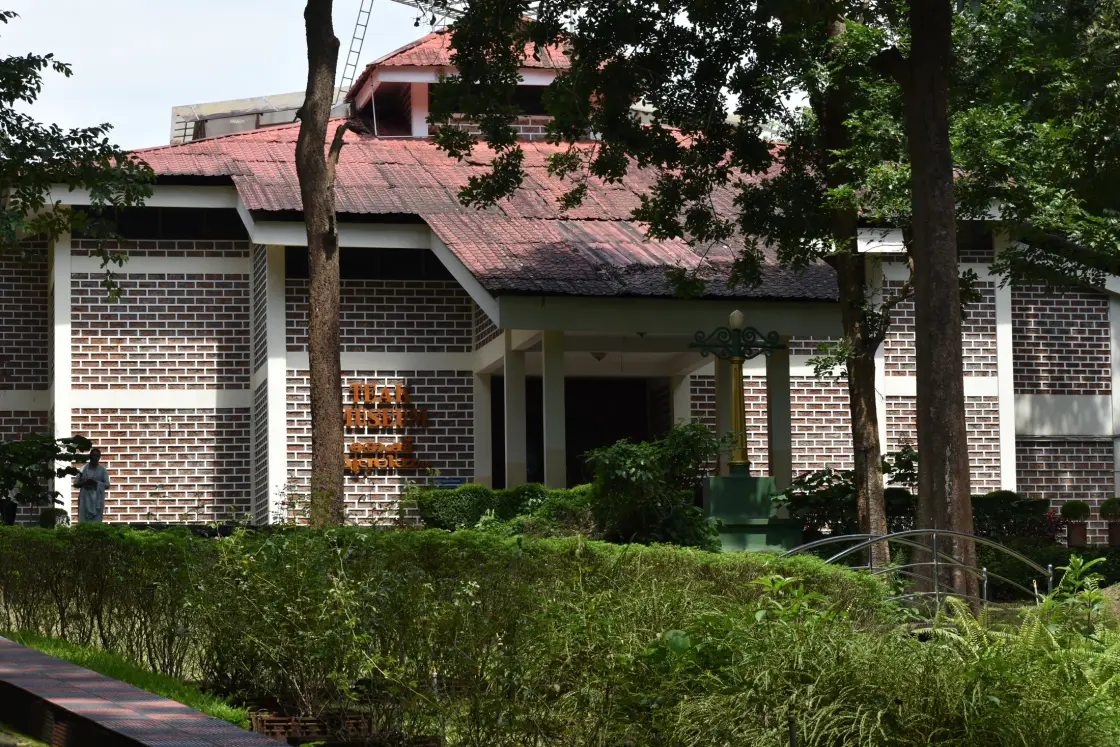
The building itself provides an immediate example of that material language. Its entrance has a deeply carved wooden surround, with scrolling foliage and tree forms on the door panels. The lettering on the laterite-patterned facade announces the subject in English and Malayalam. These details make wood both the topic of the exhibition and part of the way a visitor enters it.
On the ground floor, the historical and artistic displays explore what people made from teak. KFRI identifies a granary, an uru model and timber sections associated with different stages of plantation management. The objects offer different questions: how wood is joined, why a particular shape is useful, and how the dimensions of an available trunk influence its eventual purpose.
Large-tree exhibits introduce another way of looking. The museum includes an image of Kannimara teak at Parambikulam and a replica based on a large tree from Malayattoor. Their value is comparative. A visitor can understand the scale of trees in different forest settings while remaining clear about which exhibits are representations and which are physical specimens.
Upstairs, the emphasis moves from finished material to the growing organism. Displays cover flowering and seed production, seed treatment, regeneration and propagation. The tissue-culture section uses photographs of plant material in vessels to explain a method quite different from simply sowing a seed. A tree that appears solid and singular outside becomes a subject of repeated experiments and carefully controlled growing conditions.
The collection also recognises the difficulties of raising a timber crop. KFRI describes exhibits about insects and diseases, alongside tools and photographs of forestry operations. These belong with the displays of growth and timber use: a plantation is a managed living system, exposed to damage and dependent on decisions made long before harvest.
The nature park outside expands that scientific curiosity beyond teak. A visitor can move between collections arranged by plant relationships and others grouped by adaptations or habitat. Ferns, palms, orchids and water plants invite different kinds of observation. Leaves may have contrasting forms; a shaded collection feels different from a rock garden; the labels help explain why.
The best connection between indoors and outdoors is to carry one question into the garden. After a seed display, look for fruit or seedlings without collecting them. After seeing the root specimen, notice how a standing tree meets the ground. After the botanical exhibits, read a family label rather than trying to memorise every plant name. The museum makes a garden walk more attentive, and the garden gives the exhibits a living context.
The poles displayed from plantation thinning explain a stage between planting and final harvest. Thinning removes selected trees while others remain to grow, so the resulting poles vary in size and quality. KFRI presents them alongside a classification system. The display makes an otherwise abstract forestry operation visible: a plantation produces material at more than one point in its life, and not every harvested stem is the massive log that visitors associate with an old teak tree.
The scientific floor also introduces ‘plus trees’, selected for features that are better developed than those of surrounding trees. KFRI places this beside seed grading and pre-sowing treatment. These displays ask how the qualities of a future stand are influenced before a seedling reaches the plantation. They also distinguish several processes that are easily collapsed into the word ‘planting’: choosing a source, preparing seed, raising young material and establishing it outside.
Seasonal photographs bring movement into a museum full of durable wood. They show changes in the tree’s foliage, flowering and fruiting across the year. The timber in a granary or vessel has reached one stage of use, but the living species follows recurring cycles. Comparing the seasonal displays with the bark, fruit and leaf exhibits is a good way to finish the scientific section before returning to the outdoor collections.
A large stump from Nagarampara adds a cross-section to the museum’s account of old trees. KFRI describes it as coming from a 480-year-old specimen in the Kottayam Forest Division. It is a physical stump with a stated provenance, unlike the life-size representation of the Malayattoor tree or the illuminated photograph of Kannimara. Keeping specimen, replica and photograph distinct makes the ground-floor comparisons much more informative.
The wood samples reward a slower look than their modest size might suggest. KFRI's museum guide describes billets cut across the trunk and in two different lengthwise planes. These cuts reveal different patterns within the same material. Look first at the direction of the grain, then compare the colours and texture between samples. The exercise connects a finished wooden object downstairs with the structure of the tree from which it came, rather than treating every polished surface as interchangeable brown timber.
In the insect displays, the names teak defoliator and teak skeletonizer point to two different kinds of leaf damage. KFRI identifies the leaf-feeding caterpillars alongside a shoot-borer display. This makes the collection more than a cabinet of insects: it connects an animal's activity to a particular part of a growing tree. Compare the affected leaf or shoot with the healthy plant material represented elsewhere in the gallery. The aim is to understand a relationship within a plantation, not to conclude that every insect encountered outside harms teak.
The nature park's aquatic collection extends this attention to plant structure. KFRI groups plants that float, remain submerged, emerge above the water or root below it while carrying floating leaves. From a permitted path, these forms can be compared without touching the water or moving a specimen. Notice where the visible leaf sits in relation to the surface and read the label for the rest of the plant's arrangement. A small planted water feature can thus become a lesson in several different ways of occupying one environment.
The butterfly garden is organised around more than flowers for adult butterflies. KFRI explains that host plants support the caterpillar stage as well. That changes what counts as an interesting sight: a leaf with feeding marks, an egg or a pupa may tell as much about the garden as a brightly coloured adult. Which stages are present varies, so inspect a few plants attentively from the path instead of expecting a fixed display of flying insects. Leave leaves attached and let staff handle any identification that would require disturbing them.
The park also contains an archaeological layer. KFRI reports megalithic burials within the campus and gives an estimated age range of about 1,800–2,300 years. Ask staff where the admitted viewing area is if this is part of your interest. These remains introduce a human timescale far earlier than the museum's nineteenth-century plantation story. They deserve attention as archaeological features, with the surrounding ground left undisturbed, rather than as another piece of garden furniture or a place to climb for a photograph.