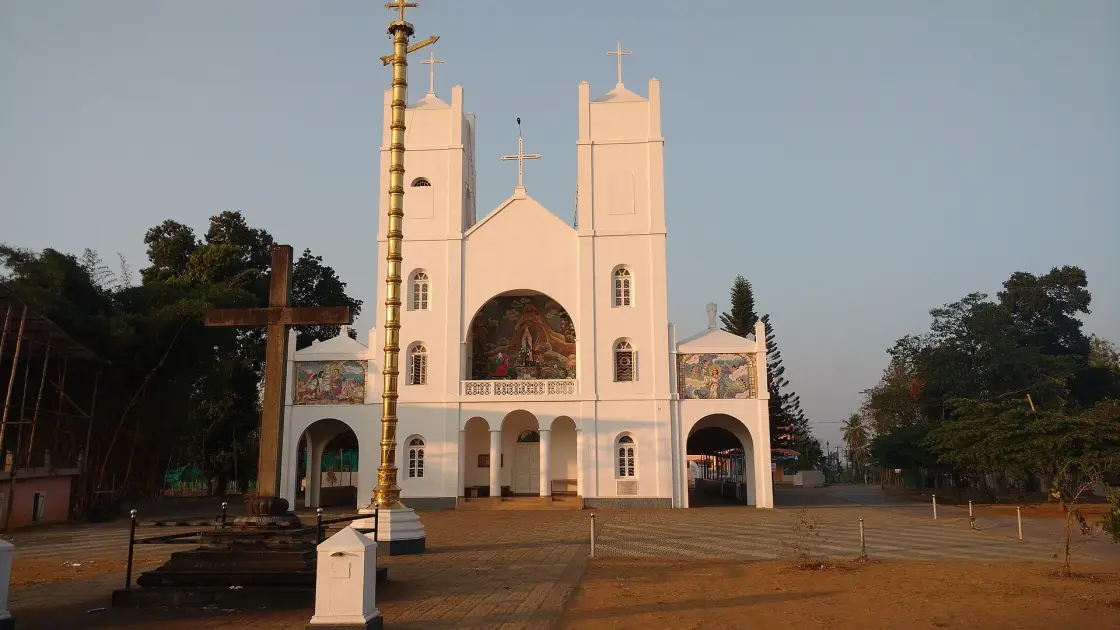
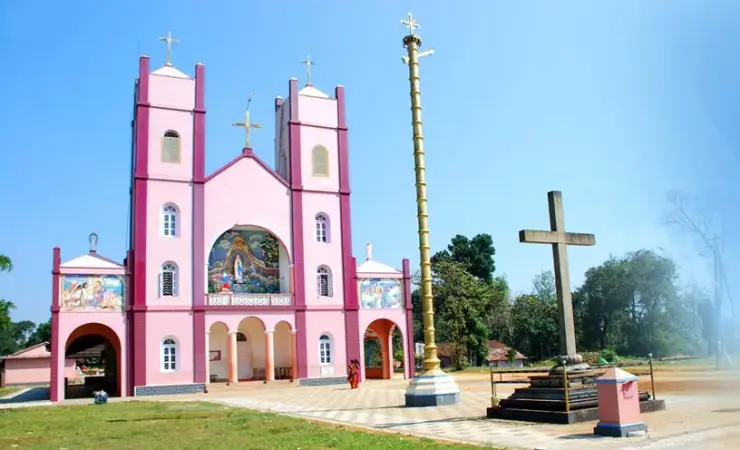
The approach brings several vertical forms into one view: the two white towers, the slender flagstaff and the darker stone cross. Between them, the Marian image gives the facade its devotional centre. At feast time, light and procession make those same grounds feel very different.
The story of Pallikkunnu Church
Lourdu Matha Church, Pallikunnu, North Wayanad is the archdiocesan name of the shrine also known as Our Lady of Lourdes and Pallikkunnu Church. Include Wayanad when arranging the journey. St George’s CSI Church at Pallikkunnu in Idukki is a separate church, with a different denomination and history.
The facade can be read from the forecourt without treating the building as an empty monument. Two square towers flank the central gable. Narrow windows repeat vertically within them, while broader arches open at ground level. The central Marian image occupies a large arched field, with smaller religious scenes towards the outer sides. The composition remains clear even when the visitor stays back to leave the approach open.
The freestanding stone cross and golden flagstaff introduce another layer before the church doors. They are separate objects with their own bases, rather than decorative lines on the facade. A frontal photograph can make them overlap; an oblique view separates them and reveals how the forecourt is organised. Keeping a little distance is useful both for understanding that arrangement and for avoiding the movement of worshippers.
The church has appeared in both pink and white. In the archival pink views, the central Marian image and paired towers already give the facade its familiar outline. The later white finish brings the dark window openings and coloured central image into sharper contrast. Looking between the two appearances reveals how much of the church’s recognisable shape lies in its composition rather than its paint.
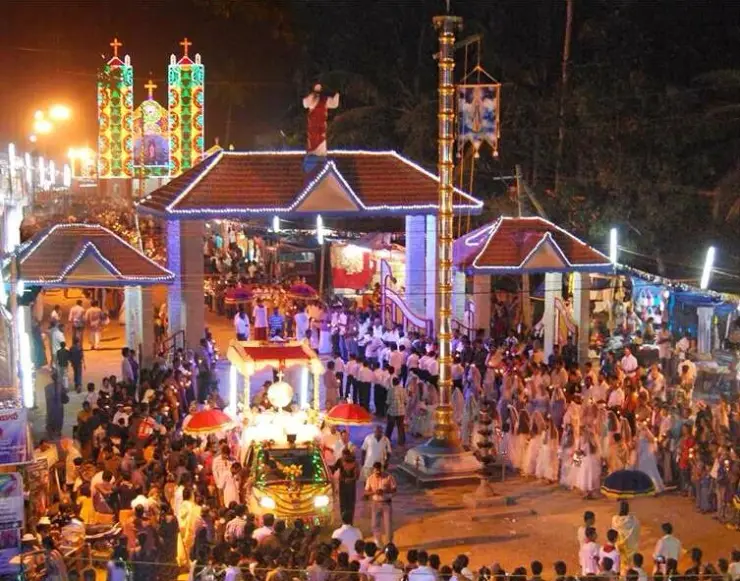
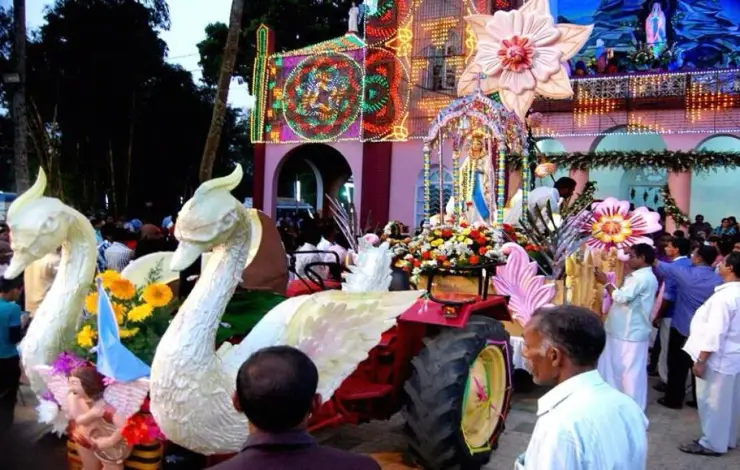
The February feast changes the use of the grounds. Kerala Tourism’s festival archive shows an outdoor Mass with the church visible behind the congregation, as well as illuminated processional scenes. Those are different spatial experiences from standing quietly before the doors: worship may extend into the open area, and a route through the compound becomes part of a gathering.
The archive also names Nerchabhakshanam, the shared feast meal. Its account describes rice and curry and a custom of clearing the leaves or plates used by others. This is a specific practice associated with the celebration, not evidence that the shrine runs a daily restaurant. A visitor attending the feast should follow the organisers’ arrangements rather than treating the religious meal as a travel amenity.
Other customs in the festival record include carrying stones, carrying a crown and shayanapradakshinam. They belong to devotional practice and should be approached through the shrine’s explanation and current rules. Describing them does not require a tourist to perform them, and watching a participant does not make that person part of a staged cultural demonstration.
The church’s published Mass and novena times show that the shrine has a life beyond the annual feast. A traveller who wants to pray can choose a service deliberately; someone interested in the architecture can avoid interrupting it. Both visits are legitimate, but their timing and behaviour differ. The building is easiest to appreciate when its current use remains part of the experience.
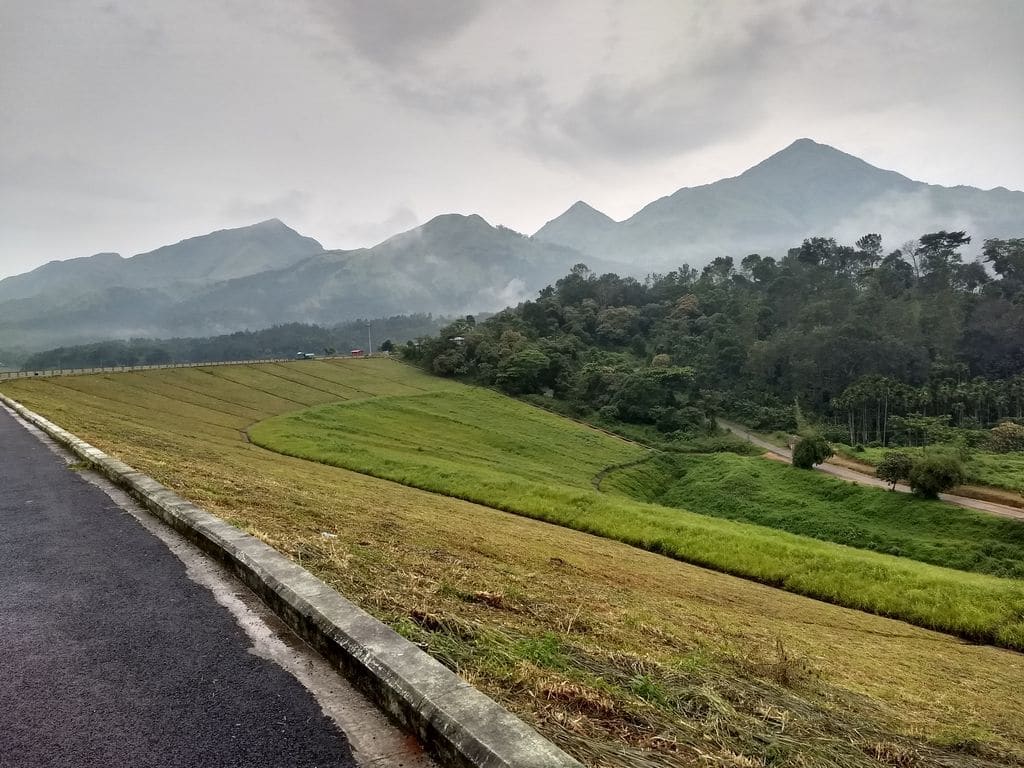
The wider road landscape is also worth keeping clear. The state heritage inventory places the church in Anjukunnu village and Panamaram local-body territory beside the Kambalakkad–Vilambukandam road. Kalpetta is the familiar larger base used in travel descriptions. A loose reference to Kalpetta or Meenangadi should not replace the actual shrine address when arranging the last approach.
A considered visit therefore has three parts: knowing which Pallikkunnu church is meant, recognising the physical arrangement of the forecourt and facade, and choosing a time that respects worship. That is more useful than reducing the shrine to a single foundation date or a general account of Christianity in Kerala.
Read the full history of Pallikkunnu Church 272 more words
History
Public accounts place the shrine’s beginnings in the early twentieth century and associate them with the French missionary whose name appears as Fr Jeffrine, Jeffrino or Jefreno. The Wayanad district administration and census account give 1905, while Kerala Tourism’s destination description gives 1908. The available accounts do not establish that these were separate foundation and consecration events.
The tourism festival archive tells of the missionary working through Kaniyambetta and preserves an account of a cross erected on Kurumbala hill and the beginnings of a local Christian community. Its devotional language belongs to the shrine’s religious memory. It should not be expanded into an independently verified route or used to promise access to a hill site.
A photograph made in February 2008 records Malayalam centenary lettering across the church front. Below it, the forecourt forms a gathering space in front of the paired towers. The anniversary display adds a dated record of parish celebration alongside the written accounts of the shrine’s beginnings.
The current archdiocesan directory continues to identify the church and publish its worship schedule. That living diocesan relationship is the strongest guide to today’s parish identity, while the festival archive and older photographs illuminate how the shrine has been remembered and used.
Why visit
Visit for the clear relationship between twin towers, Marian image, flagstaff and stone cross in the church’s forecourt.
The shrine offers a specific Wayanad example of Latin Catholic pilgrimage and local devotional practice.
The February feast has documented liturgical, processional and shared-meal dimensions beyond decorative lighting alone.
The contrast between archival pink and later white facades gives a useful way to read continuity and change in a familiar building.