What to expect
Highlights
- Heritage experience at Punnapra Vayalar Memorial
- Architecture, local stories and old trade/cultural routes
- Good fit for guided walks and nearby cafes/shops
Martyrs’ memorial (Rakthasakshi Mandapam) to the 1946 Punnapra–Vayalar uprising, on the coastal belt north of Punnapra on the Alappuzha side.
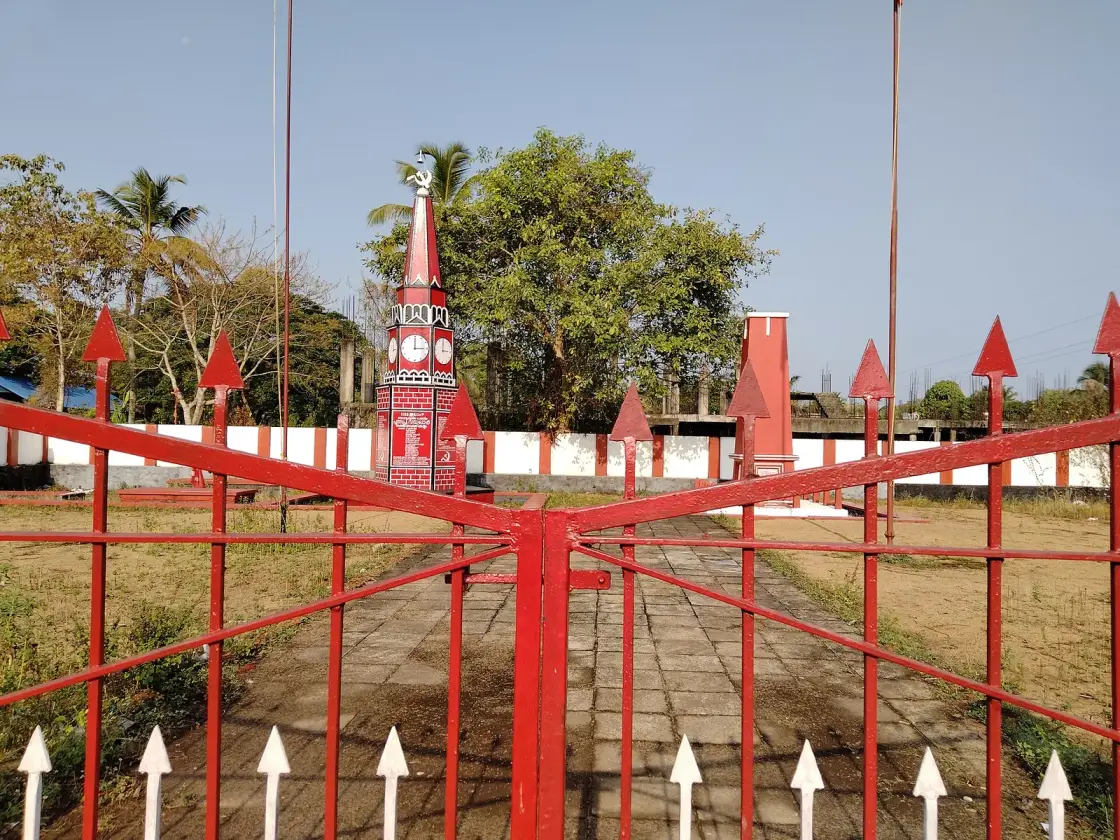
Four kilometres south of Alappuzha town, set back from the coast road behind a low red-and-white wall, stands a red obelisk with a clock face on it and a hammer and sickle below. It marks the ground where, in October 1946, a rising by the coir workers of this coast was put down by the army of the princely state of Travancore. How many people died has never been settled, and the memorial does not pretend otherwise.
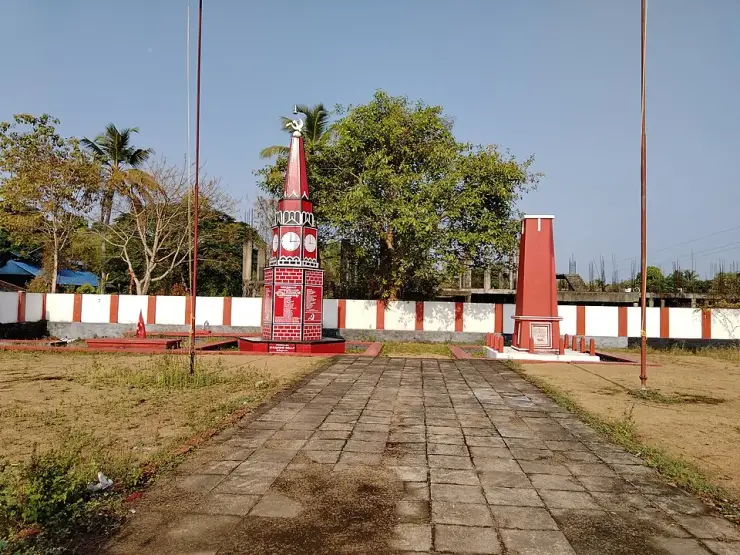
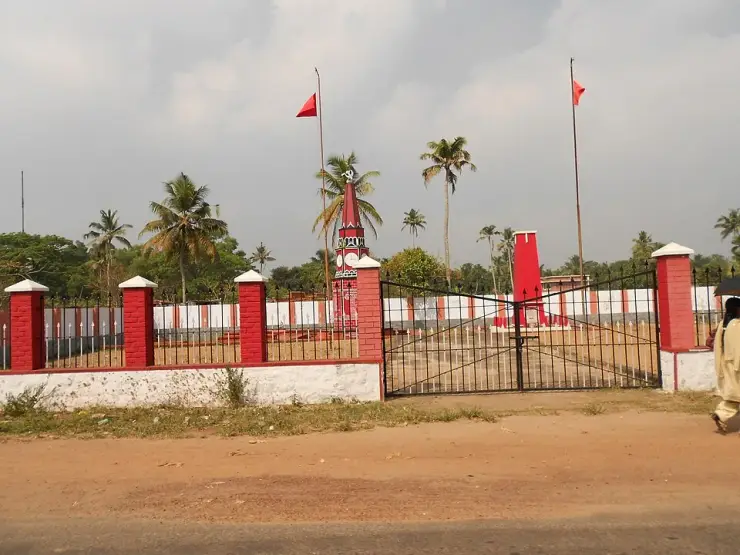
The Punnapra Vayalar Rakthasakshi Mandapam sits at Vattappally, on the Eravukad road off the national highway, in Ambalappuzha taluk about four to five kilometres south of Alappuzha town. It is a walled open-air enclosure rather than a building: a boundary wall banded in red and white, a pair of iron gates, a paved walk, two flagstaffs usually flying red flags, and at the centre a tapering red column carrying a clock face, a hammer-and-sickle finial and an inscribed panel of names. A second, squarer red pylon stands to one side with a plaque set into its base. There is no ticket office, no museum and no English interpretation board. What the site offers is the ground itself and the names on the stone.
To understand why a memorial of this kind stands on this particular stretch of sand, it helps to know what Alappuzha was in 1946. This was the coir town — a working port and factory belt where rope and matting were spun, woven and shipped, and where a dense industrial workforce had organised itself unusually early. The Travancore Coir Factory Workers' Union was among the strongest labour bodies in the princely state. The immediate backdrop to October 1946 was a general strike, a food-rationing crisis and a long-running dispute over wages and conditions in those factories. The workers had set up camps in the coastal villages, and it was from these camps that the events of that month unfolded.
On 24 October 1946, by the date most commonly published, an armed body of workers attacked the police camp at Punnapra. Sub-inspector Velayudhan Nadar and three policemen were killed — most accounts say the sub-inspector had moved forward to talk before he was attacked — and the police opened fire, killing twenty-seven. That gives twenty-eight dead at Punnapra including the four policemen, and it is the one part of the whole episode where the figures are relatively firm.
What followed was of a different order. Martial law was declared in Alleppey on 25 October. On 27 October the Travancore army moved on Vayalar, some twenty-five kilometres north in what is now Cherthala taluk — a place surrounded by water on three sides, with the state navy used to close off the water and prevent escape. Accounts of that day describe a pincer movement against an encircled and far more lightly armed crowd. The commonly published estimate is that at least a hundred and fifty people were killed on the spot and many more died later of their injuries.
Then the counting stops being possible. There is no independent enumeration of the Vayalar dead, and the figures in print vary by more than an order of magnitude. D. Sugathan, a former Congress MLA, put the number at a hundred and three from burial records. English Wikipedia's own article states, in different places, that at least a hundred and thirty were killed in army firings at different places and that over four hundred and seventy communists were killed, and its infobox says more than a thousand. The historian A. Sreedhara Menon wrote of thousands. Local accounts and contemporary press reported that bodies were disposed of by the army, which is precisely the circumstance that makes an honest count impossible. We give the range rather than choose from it, because the range is the historical fact.
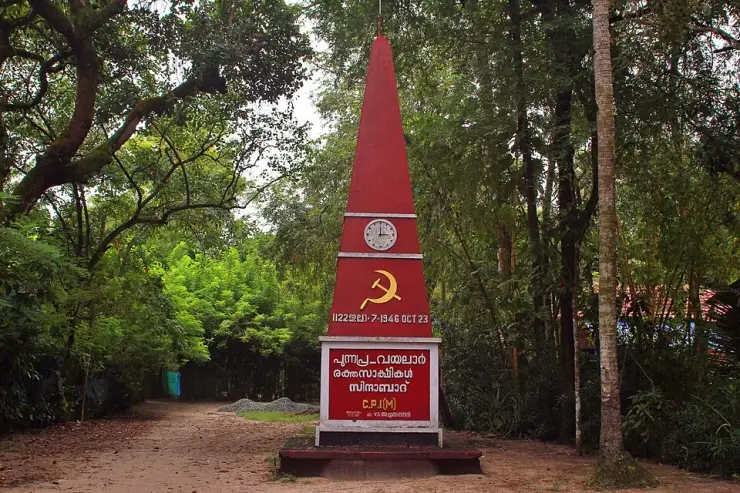
One practical thing to know before you set out: there is more than one memorial, and they are not in the same place. The enclosure described here, at Punnapra, is the one this page is about. There is a separate and older-feeling roadside obelisk at Punnapra South, and at least one more in a shaded lane nearby, both raised by the CPI(M). And there is an entirely distinct Vayalar Rakthasakshi Mandapam at Vayalar itself, twenty-five kilometres north up the coast in Cherthala — a different site commemorating the second and bloodier day. Photographs online conflate all of them freely. If you are navigating to a particular one, check the coordinates rather than the name.
Punnapra is a great deal older than the events it is now known for, and the village has its own goddess. About four and a half kilometres south of the memorial, at Aravukad, stands the Aravukad Sreedevi Temple, where the deity is Bhadrakali in her chakravarthini form — the sovereign aspect, the goddess as empress rather than as consort or as child. Locally she is Aravukadamma, and the Malayalam sources do not describe her merely as the temple's deity: she is named as the desa daivam, the deity of the desam, the god of the people of Punnapra as a place.
The legend told of her is the reason she is here. A rakshasa had been tormenting the poor and the blameless, and the goddess killed him and then stayed, as their protector. Kerala's English-language listing sites will tell you the demon was Daruka; the Malayalam accounts of this temple do not name him at all, and we follow them rather than the tidier version. What makes the story specific to this village is what happens next: having killed him she washed the blood from her pallival, the sacred sword, and the pond she washed it in still exists inside the temple and is kept sacred. That is the detail worth travelling for. A legend with a physical trace you can stand in front of is a different order of thing from one that floats free of any location.
The temple's year turns on the Pooram Mahotsavam in the Malayalam month of Meenam, across March and April: the festival flag goes up on Bharani and the celebration closes on Pooram day with the arattu, the ceremonial bathing of the deity. It is described in Malayalam as the principal celebration of the people of Punnapra village, and its best-known observance is the thiripiduttham, a wick-vow that draws people in from neighbouring desams. There is a separate Saraswati shrine in the compound where hundreds of children are brought for Vidyarambham, the initiation into letters, and the temple also keeps the Makaram pongala, Navaratri, Thrikarthika and Deepavali. Almost none of this appears in the English-language travel web, which is worth stating plainly: the silence in English is a fact about search engines, not about Punnapra.
The village's own name has a folk explanation too, and it is told by the pazhamakkar, the old people, rather than by any official history. Punna — the Alexandrian laurel — grew in groves along this coast, and gatherers came from other districts for its oil. The story goes that a para, the standard grain measure, was once carved from punna wood and held eight changazhi, and that it was presented to the king of Chembakassery; the man who made it was known as the Punnappara-karan, the punna-measure man, and Punnappara became Punnapra. Like most name-origin tales it cannot be verified, and like most of them it tells you what the place thought was worth remembering about itself.
That older layer sits underneath the one everybody comes for, and the two are not really in conversation with each other — but the village map records both. The wards of Punnapra South panchayat include one called Aravukad, named for the goddess, and one called Samarabhumi, the ground of the struggle, named for what happened in 1946. A village that names its wards after both its deity and its dead is telling you something about itself that no monument does.
The newer layer is not legend — nobody is claiming anything supernatural happened in 1946 — but it would be wrong to call it merely commemoration either, because in practice it behaves a great deal like veneration. The Communist newspaper Janayugom, whose framing is partisan and should be read as such, describes the burial ground at Valiyachudukad as a theerthadana kendram, a pilgrimage centre, and writes that the smell of the martyrs' raw flesh still hangs over the ground. The raising of the flag has been an inherited office rather than a rota, passed from one surviving fighter to the next — C. K. Kesavan, then N. Raghavan, then N. K. Gopalan, who survived the firing by a hair, then the singer P. K. Medini. At Vayalar the bodies are said to have been tipped into a pond over which the mandapam now stands, and a coconut stump pierced by bullets is kept as a relic. Sacred ground, an inherited custodianship, a relic and an annual pilgrimage: whatever one calls that, it is not a plaque on a wall.
So begin with the stone, because the memorial's own inscription does not say what the books say. On the CPI(M) obelisk in the lane at Punnapra the date is cast in raised letters: the Malayalam-era year 1122, a month, the day 7, and then, in Latin script beside it, 1946 OCT 23. The standard published date for the attack on the Punnapra police camp is the twenty-fourth. English Wikipedia, meanwhile, dates the start of the revolt to the twenty-fifth, the Maharaja's birthday, which is also the day martial law was declared. Three dates, on a single week, for an event within living memory — and the one carved in concrete and maintained by the party that raised it is the earliest of them. We looked closely at the Malayalam month name at full resolution and could not read it with confidence, so we do not print it; the Latin date on the same stone is unambiguous and is what we quote.
The word on the memorials is Rakthasakshi — blood-witness, the Malayalam term for martyr. It is not a neutral word and it is not meant to be. These are party monuments as much as public ones: the red flags are maintained, the obelisks are repainted, and the memorial at Punnapra South was unveiled by V. S. Achuthanandan, who was himself a young organiser in Alappuzha in that period and later Chief Minister of Kerala. A visitor who arrives expecting the studied neutrality of a state war memorial will find something different — a site of continuing political devotion, tended by people for whom this is not settled history.
The commemorative week runs from the twenty-third to the twenty-seventh of October, and 27 October is observed as Punnapra-Vayalar Martyrs' Day. If you come then you will find gatherings, flags and speeches rather than a quiet enclosure. There is also a substantial body of song and verse — the singer P. K. Medini's revolutionary songs among the best known — and the uprising has a long afterlife in Malayalam poetry, film and party iconography. That afterlife is genuinely part of what the place is; it simply is not legend, and we will not present it as one.
The clock face on the obelisks is the detail visitors most often ask about, and we have not found a sourced explanation of it. It appears on more than one of the Punnapra monuments, which suggests a shared design convention rather than an accident of one builder. We would rather record the question than invent an answer to it: if you know the reason, the temptation to guess is exactly what has filled the internet with confident nonsense about this site. The same goes for the several accounts online that give this memorial a founding anecdote, a named architect or a precise unveiling date. We could not source any of them, and where a claim about a place cannot be traced to anything better than another travel page repeating it, the honest thing is to leave the space empty.
So a visitor who asks what the legend of Punnapra is has two answers, and they belong to different centuries. The older one is Aravukadamma, the asura and the pool the sword was washed in — a story of the kind this coast has in abundance, attached to a place you can go and stand in. The newer one is not a legend at all, and we will not turn it into one: it is a documented, disputed and still-argued account of a week in October 1946, attached to people whose grandchildren live within walking distance of the enclosure. Most old places offer you the first kind. What is unusual about Punnapra is that it offers both at once, and that you can see the seams in how the second is still being recorded.
The political setting was the princely state of Travancore under its Diwan, Sir C. P. Ramaswami Iyer. In 1946 he had proposed a constitutional reform for Travancore modelled, in the language of the time, on the American system — an executive president outside the legislature. English Wikipedia states the American Model was scheduled for implementation on 25 October 1946, the same date it gives for the start of the revolt. The communist slogan of the period, American Model Arabikkadalil — throw the American Model into the Arabian Sea — belongs to this argument.
A separate and later event is frequently folded into the same sentence, and should not be. On 2 June 1947, weeks before Indian independence, the Diwan announced with the royal family's backing that Travancore would become an independent state. That is eight months after the events at Punnapra and Vayalar. Our own article on the making of Kerala already carries that date. Anyone telling you the uprising of October 1946 was a response to the declaration of independence has the chronology the wrong way round, and this page does not make that claim.
The uprising itself is contested in print, and the disagreement is not merely academic. The Communist account holds it as an armed resistance by coir and agricultural workers against exploitative conditions and against the Diwan's constitutional plans — a strand of the wider freedom struggle. In a 2022 book, P. S. Sreedharan Pillai argued the opposite on two grounds: that it cannot be counted a freedom struggle because the transfer of power was already effectively guaranteed by September 1946, months before October; and that it had nothing to do with the independence declaration, which came only in June 1947. He also charged the Communist leadership with indifference to the workers who died. A CPM figure replied that the party's 1946 memorandum to the Cabinet Mission had been tactical, intended to block British plans to preserve the princely states as vassals. Both positions are in print. We set them out and take neither.
The names usually associated with the organising are K. Kelappan Nair, T. V. Thomas, R. Sugathan, S. Kumaran and P. T. Punnoose. On the state side, the officer commanding, V. N. Parameswaran Pillai, is reported to have resigned afterwards. The suppression did not end the movement it was meant to end: within a few years Travancore had acceded to India, the Diwan had left office after an attempt on his life in July 1947, and the political forces organised in these coir factories went on to form the government of the state.
The memorials came later and were built by the movement rather than by the state, which is why they look as they do — party obelisks with flagstaffs rather than a national monument with an interpretive centre. The enclosure at Punnapra, the roadside obelisk at Punnapra South and the mandapam at Vayalar were raised at different times and are maintained separately. That distributed, unofficial quality is itself part of the history: this is a memory that was kept by a political movement first and acknowledged more widely afterwards.
Stand on the actual ground of one of the defining episodes of twentieth-century Kerala — a rising by organised coir workers that was put down by the army of a princely state, and that shaped the politics of the state that followed.
Read the stone for yourself. The inscribed date on the CPI(M) obelisk is 1946 OCT 23, while the books say the twenty-fourth and Wikipedia says the twenty-fifth. It is a rare case where the monument and the histories openly disagree, and you can see it with your own eyes.
See a memorial that has not been smoothed over for visitors. There is no ticket, no gift shop and no interpretation panel — just a walled enclosure, two flagstaffs and a list of names, still tended by the movement that raised it.
Come during the commemorative week of 23 to 27 October, or on Martyrs' Day itself on the twenty-seventh, if you want to see the site as a living observance rather than an empty enclosure.
Pair it with Alappuzha's coir history, which is not a separate subject but the cause of what happened here — the factories, the unions and the 1946 strike are the reason there was a rising on this coast at all.
It is four to five kilometres from Alappuzha town on the coastal belt, so it fits easily into a Kuttanad or Ambalappuzha day without a detour of any consequence.
Road km to Alappuzha; ghat roads and traffic vary — allow extra.
November to February and early mornings are best for walking; avoid midday heat where possible.
Live forecast loads in your browser.
Sun and moon are calculated for this location and shown in IST. Photography windows are the hour around sunrise and sunset; the sunset bearing is degrees clockwise from true north. Moon phase is accurate to about half a day.
Browse listed stays, food, activities, sights, shops and rentals around Punnapra Vayalar Memorial. Check each listing’s locality and contact the business directly for current arrangements.
Restaurant at Hotel Coral Heights near Sree Krishna Temple Road in Ambalappuzha. Hotel restaurant, Hotel Coral Heights Restaurant.
Book with the place itself. India’s cyber-crime coordination centre warned in April 2025 that convincing copies of hotel and pilgrimage booking sites are being pushed through sponsored search and social ads, taking payment for rooms the property never hears about. Use the contact and source details on each profile to confirm the exact business and booking channel. A directory entry or map pin alone does not establish an operator’s identity or current availability. Roampedia takes no commission and does not collect booking payments. If a booking page reached you through an ad, check the address bar against the property’s own site before you pay. Fraud can be reported on cybercrime.gov.in or on 1930.
Find food, accommodation and activities across Ambalappuzha. Browse the guides for places to eat, stay and explore along your route.
3 more places around Ambalappuzha. Open a guide to plan the visit and onward journey.
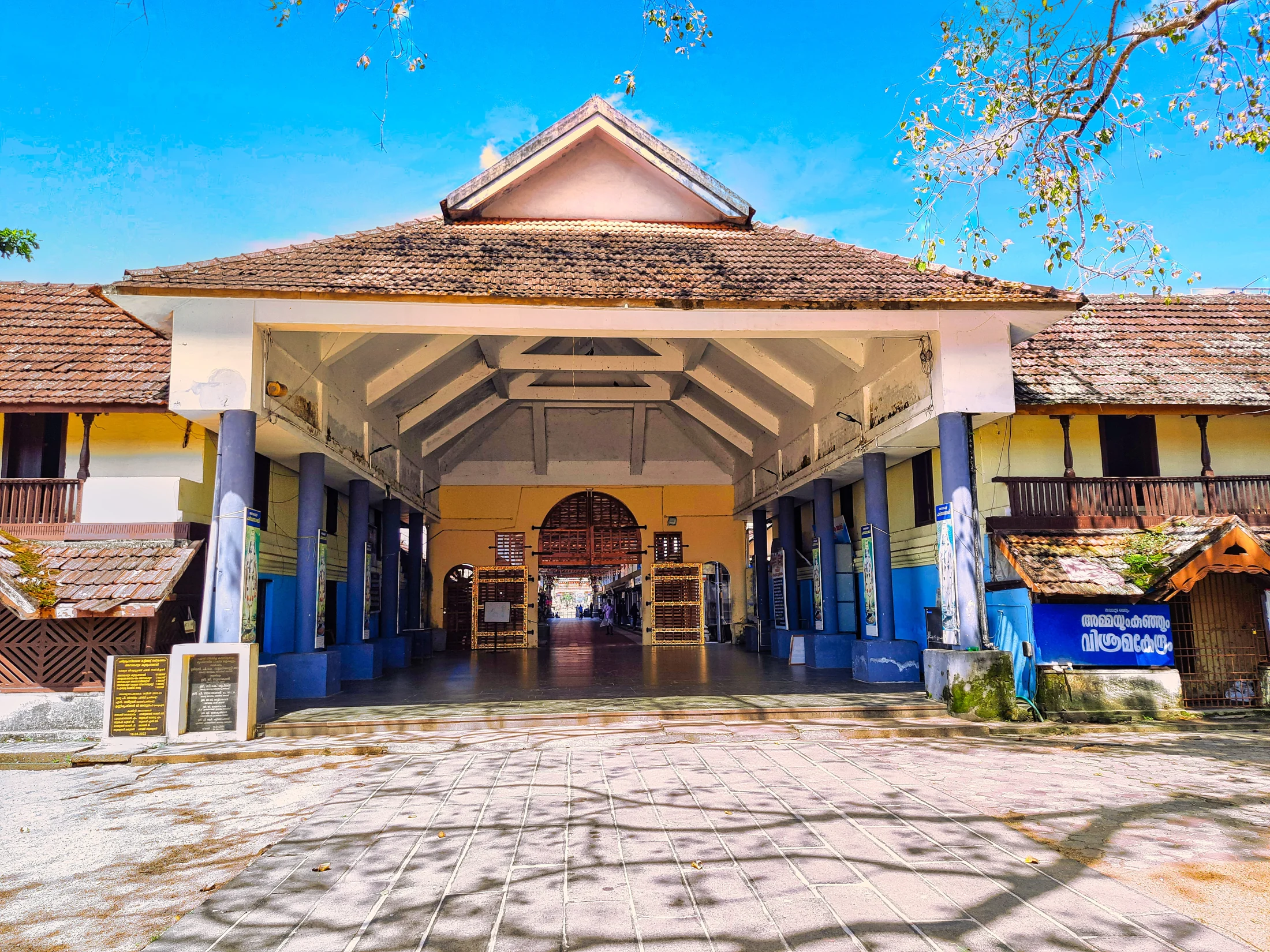
10.8 km · straight line
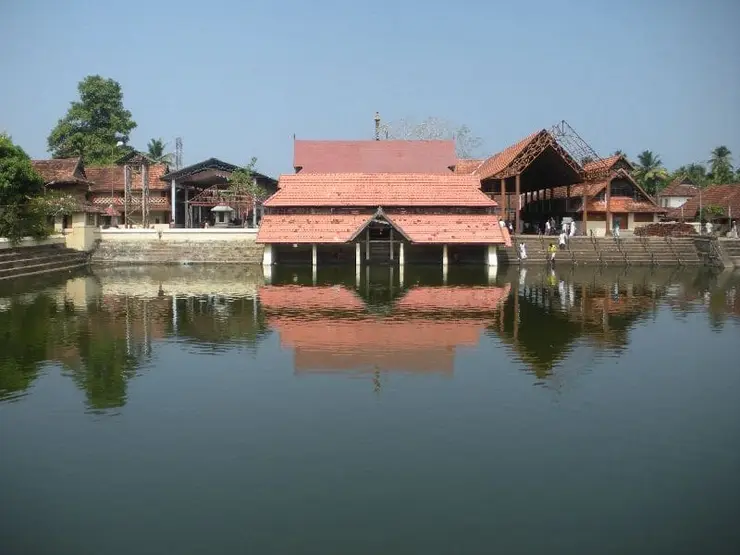
Ambalappuzha Sree Krishna Temple is an active temple in Ambalappuzha town, south of Alappuzha, administered by the Travancore Devaswom Board. Krishna is worshipped here as Parthasarathy, Arjuna’s charioteer. The temple combines a broad tank, tiled courtyards and painted ritual spaces with two enduring cultural associations: Palpayasam offered to the deity, and Kunchan Nambiar’s creation of Thullal. A visit works best when darshan, the permitted exterior spaces and any offering collection are planned around the temple’s morning or evening opening.
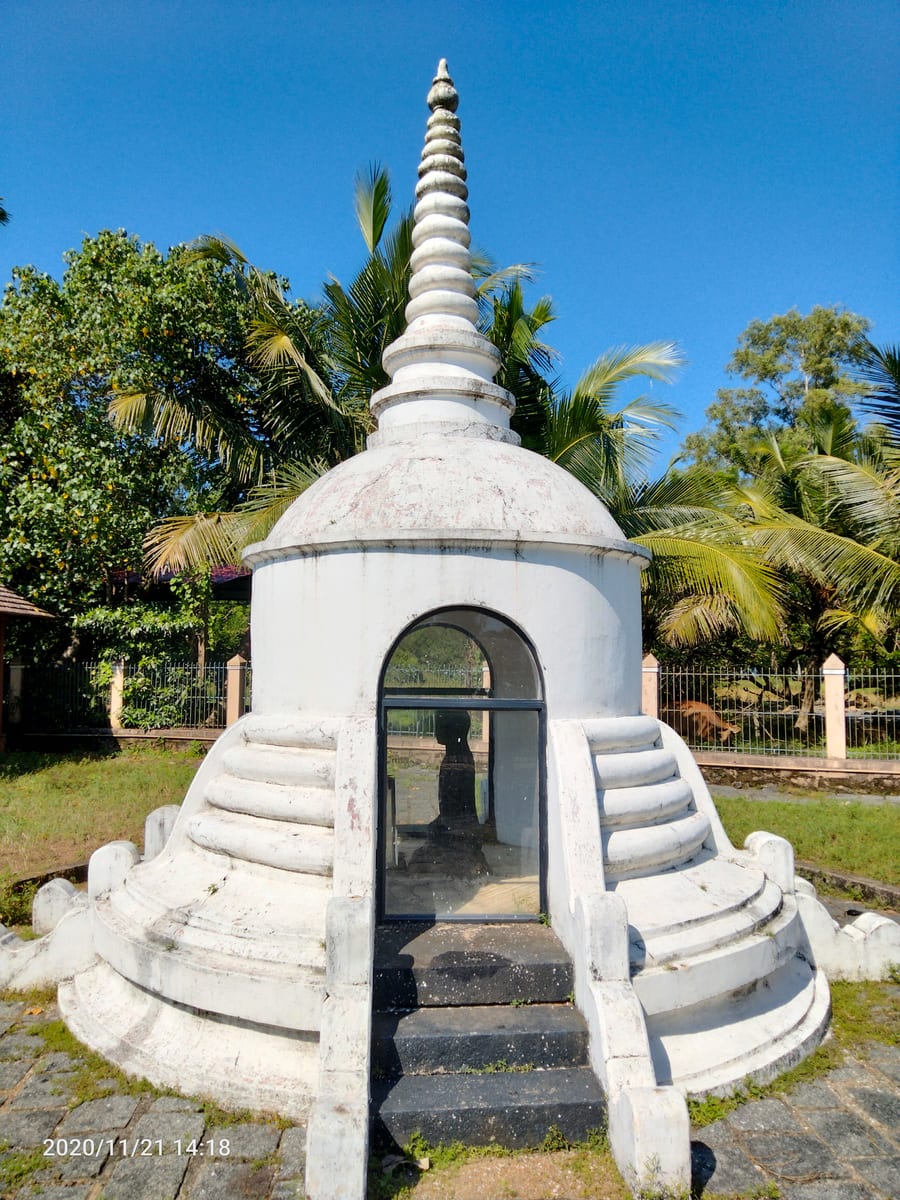
12.0 km · straight line
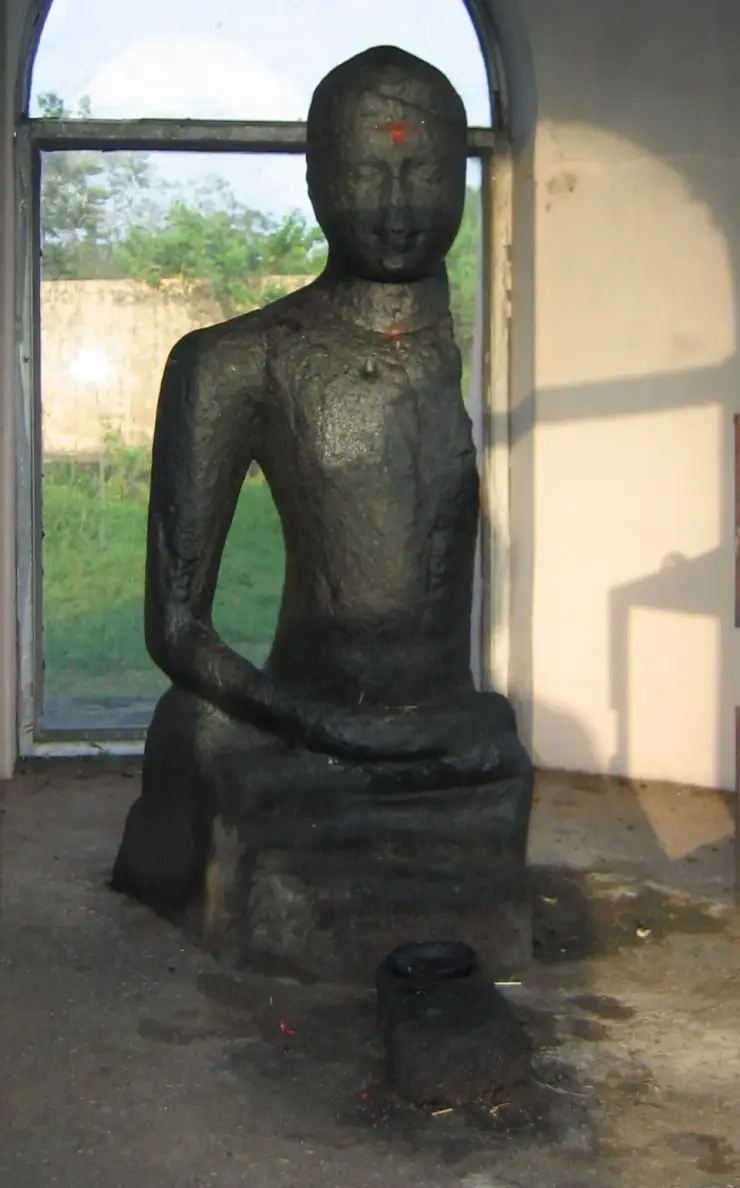
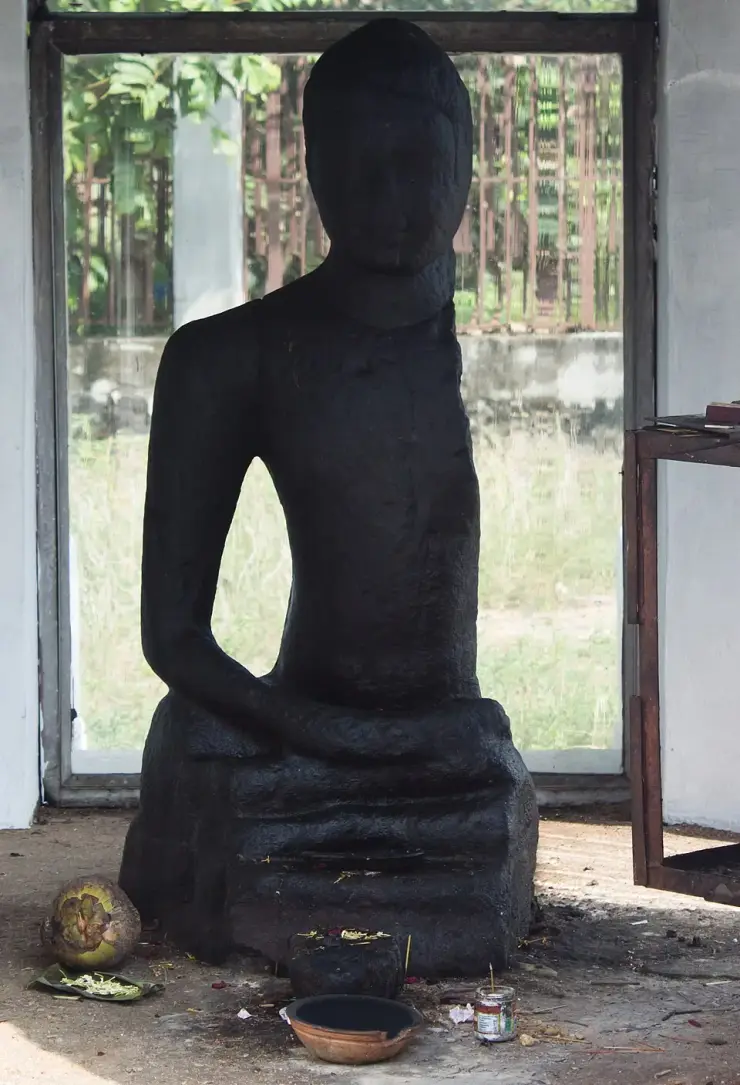
Ancient black-granite Buddha statue at Karumadi near Ambalappuzha, a relic of Kerala’s Buddhist past.
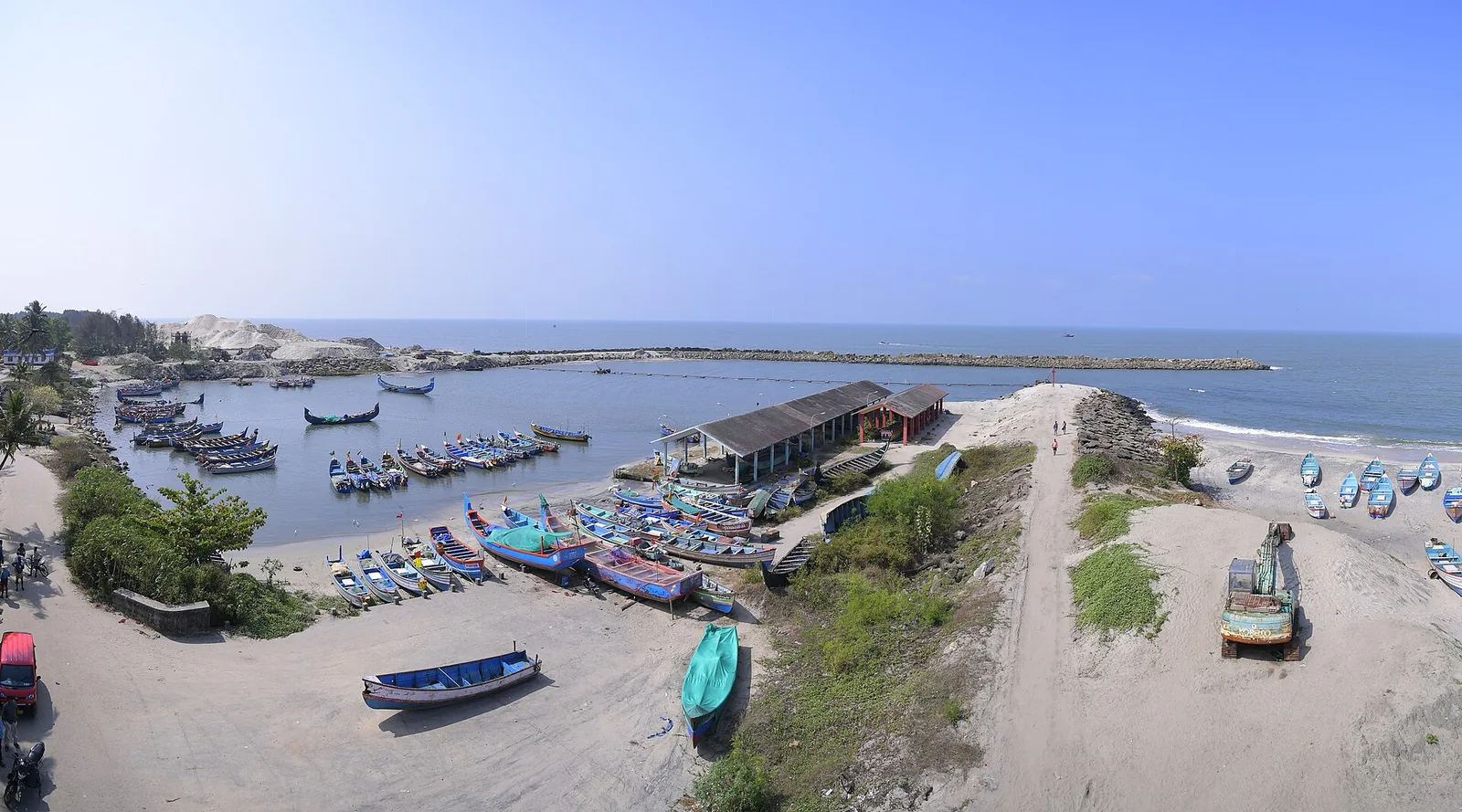
Working fishing harbour and 1955 flood spillway where the Thottappally leading channel meets the sea, south of Ambalappuzha — a painted fleet, two breakwaters and heaps of titanium-bearing black sand, rather than a quiet beach.
Roampedia is commission-free — own or know a stay, eatery, guide or shop near Punnapra Vayalar Memorial? Submit public business details for review.
Add a nearby businessEntry: Free. There is no ticket office, and no charge has ever been reported.
Photography: Open-air public memorial; photography is not restricted. During commemorations this is an active political gathering — ask before photographing people.
If you are travelling by bus or ferry, check the return service with the operator before setting out. Leave time to reach the stop or jetty after your visit.
Ask at the bus stand for the time of the last service back, not the next one. If you miss it, an auto or app cab is the fallback — agree the fare before you get in.
If you need step-free access, contact the site before travelling. Ask about a level entrance, steps along the route, the nearest drop-off point, seating and accessible toilets.
These services are listed within about 1.2 km of Punnapra Vayalar Memorial. Walking distances follow mapped routes; access and opening hours can change. Other services may be closer but are not included here.
Published emergency and visitor-assistance contacts. For an immediate emergency, call 112. Shared Kerala contact sources checked 4 October 2026; publication does not establish a tested live response.
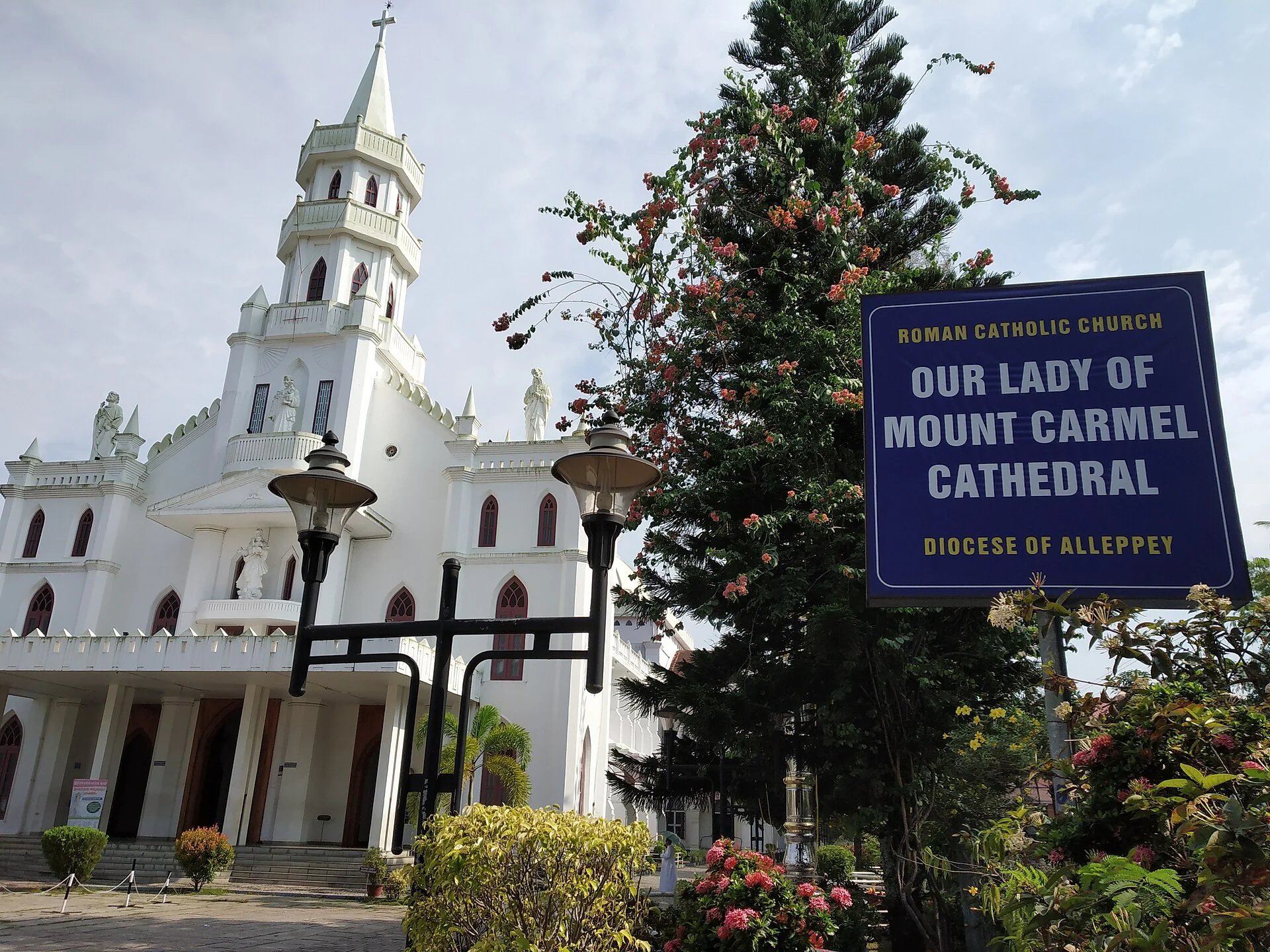
Landmark 19th-century cathedral of the Alappuzha diocese near the town centre.
2.4 km · straight line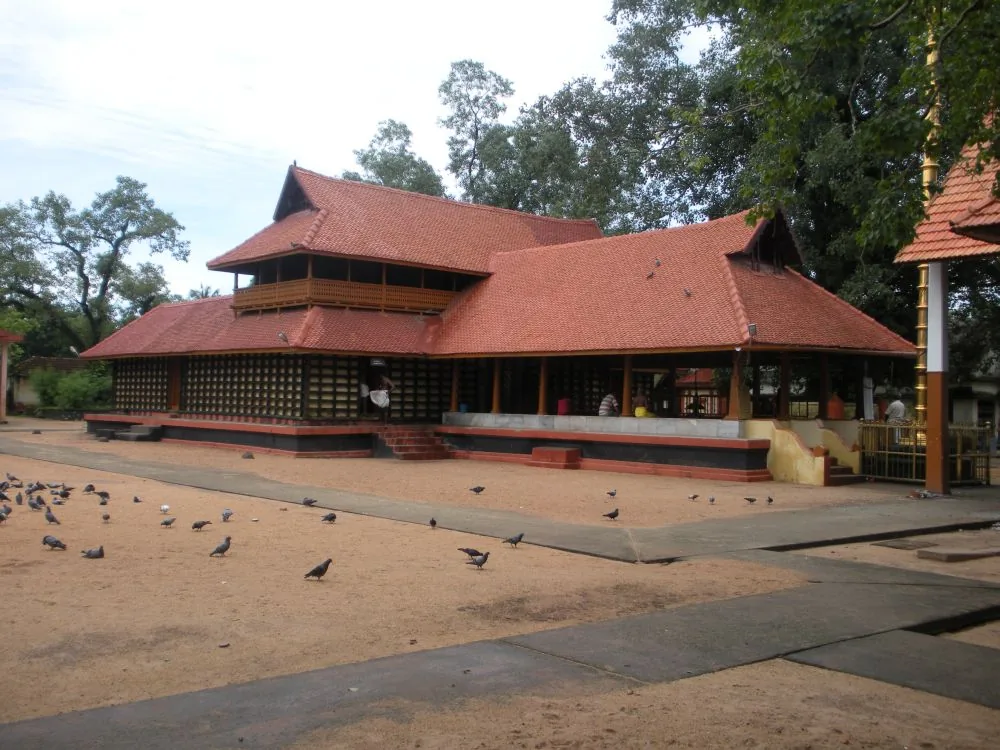
Central Alappuzha town temple (Mullakkal Rajarajeswari) famous for the annual Mullackal Chirappu festival.
2.4 km · straight line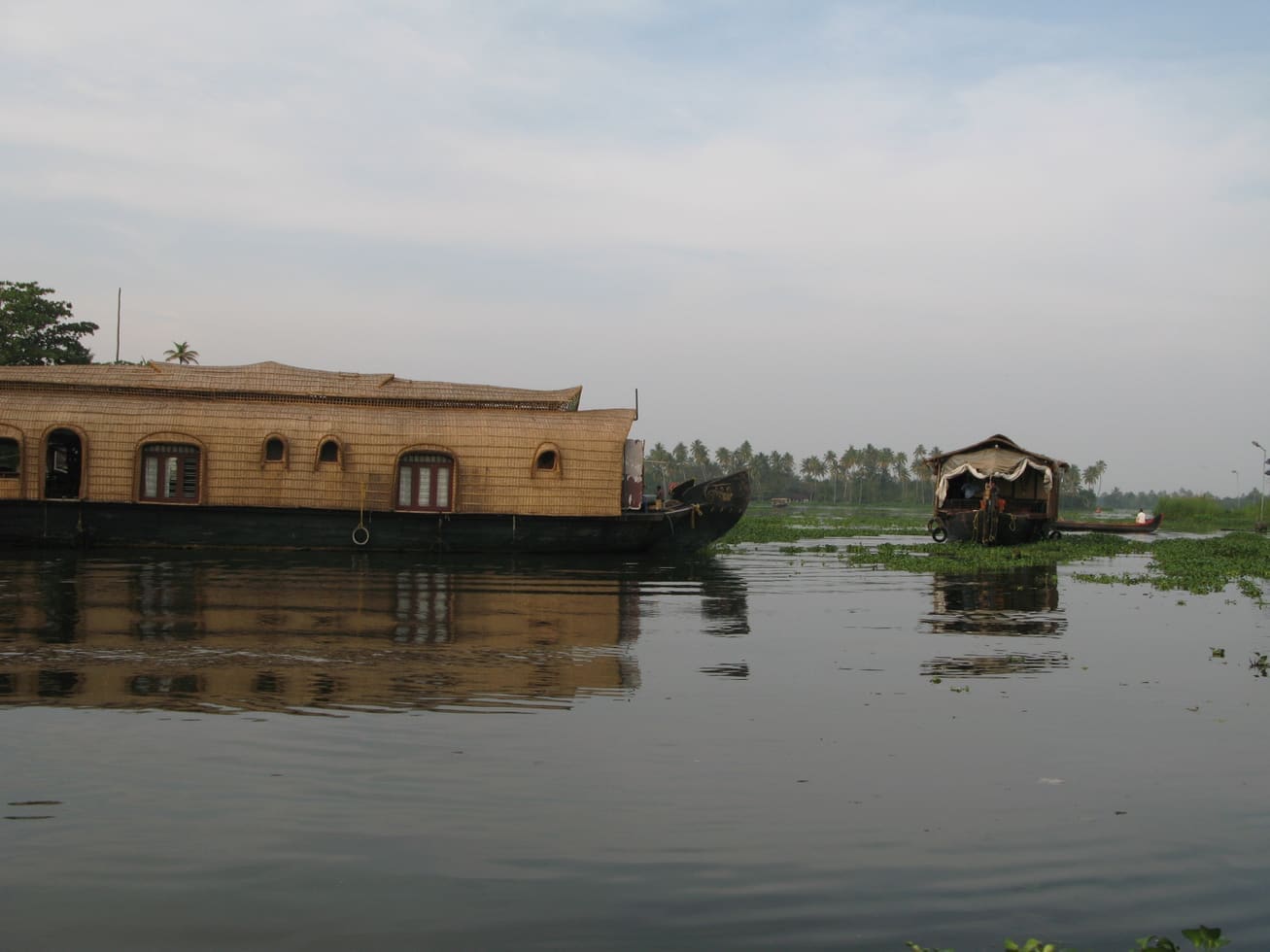
Backwater and houseboat hub with canals, beach, lighthouse and Finishing Point jetty.
2.5 km · straight line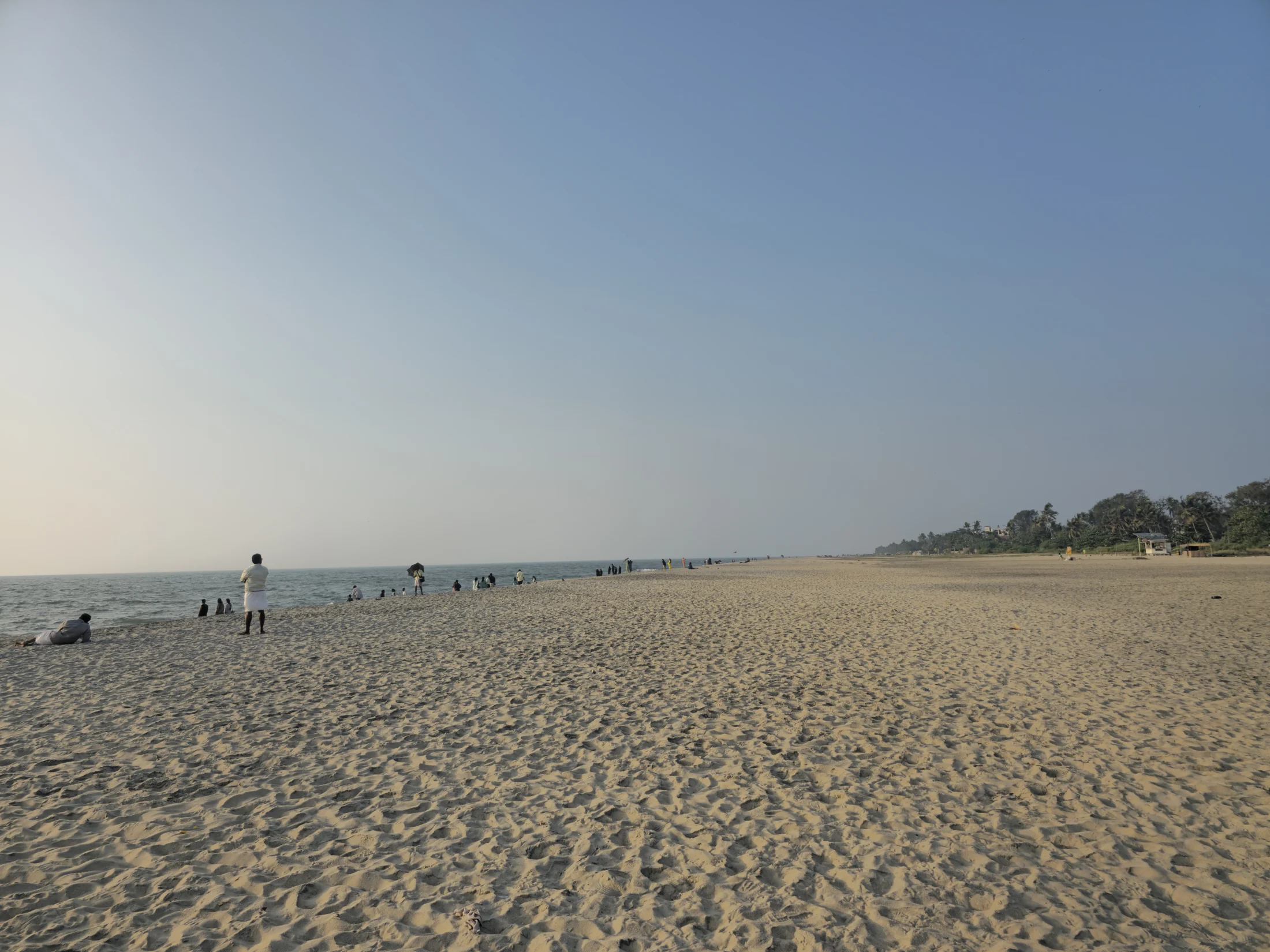
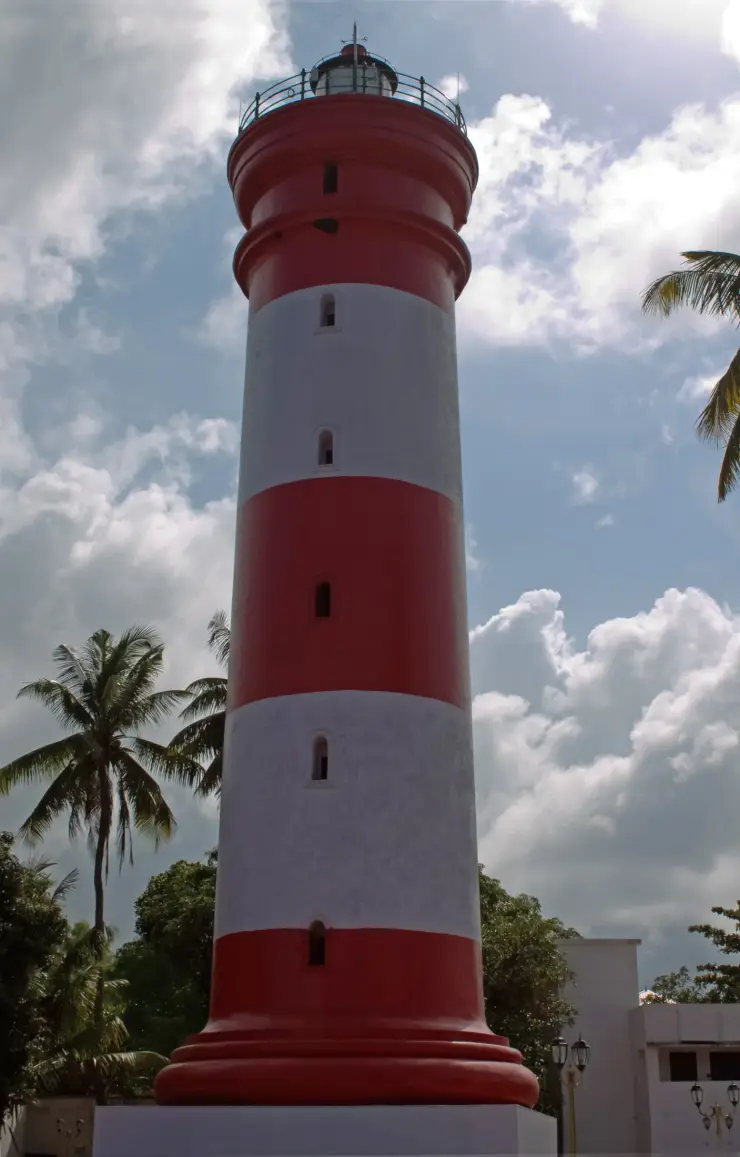
Pair Alappuzha’s broad town beach and old pier remains with the red-and-white lighthouse on C.C.S.B. Road, commissioned in 1862 and still maintained as a navigational light.
2.7 km · straight line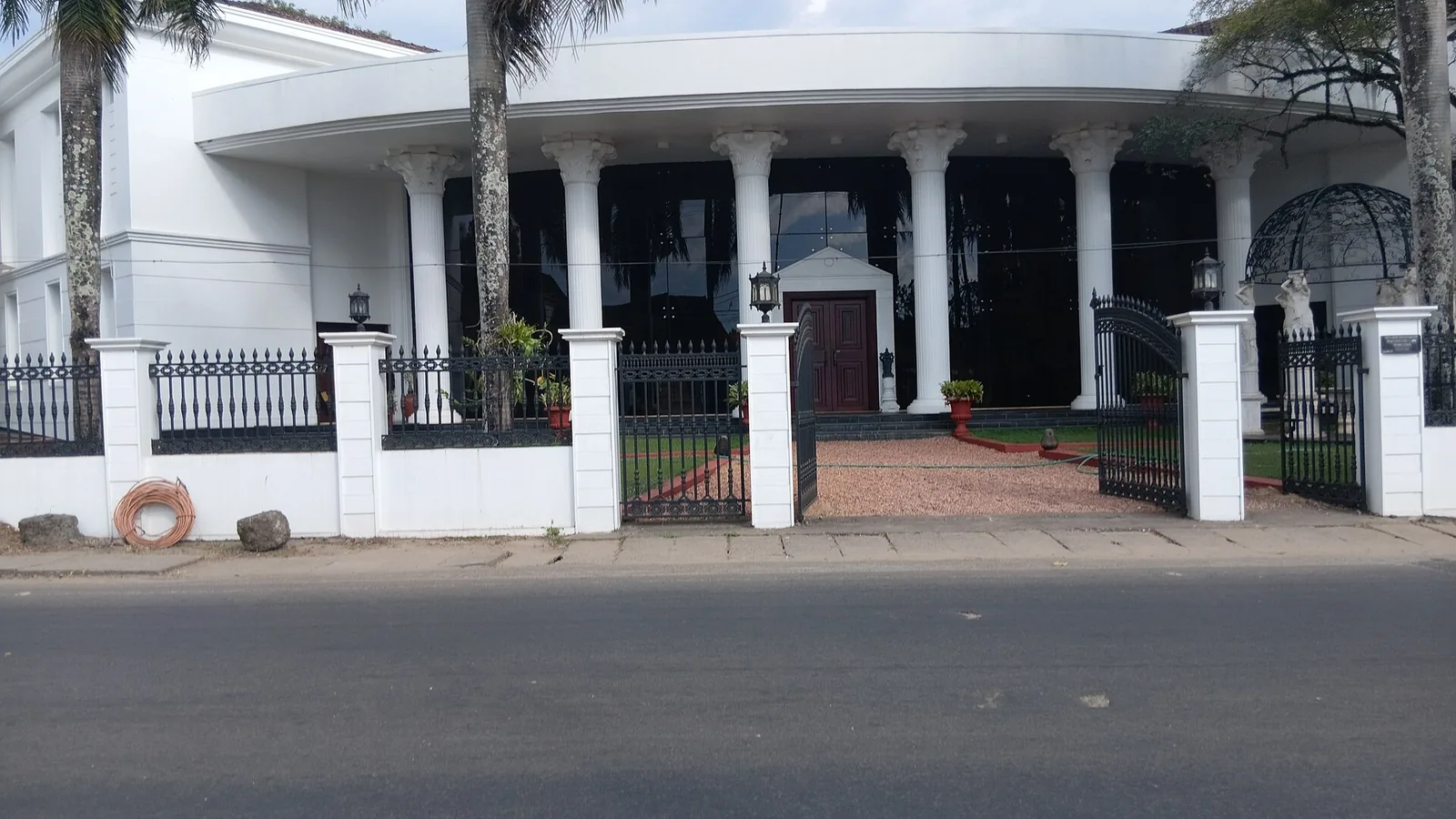
Private memorial museum in Thathampally with a large collection of paintings, ivory, crystal and antiques.
2.7 km · straight line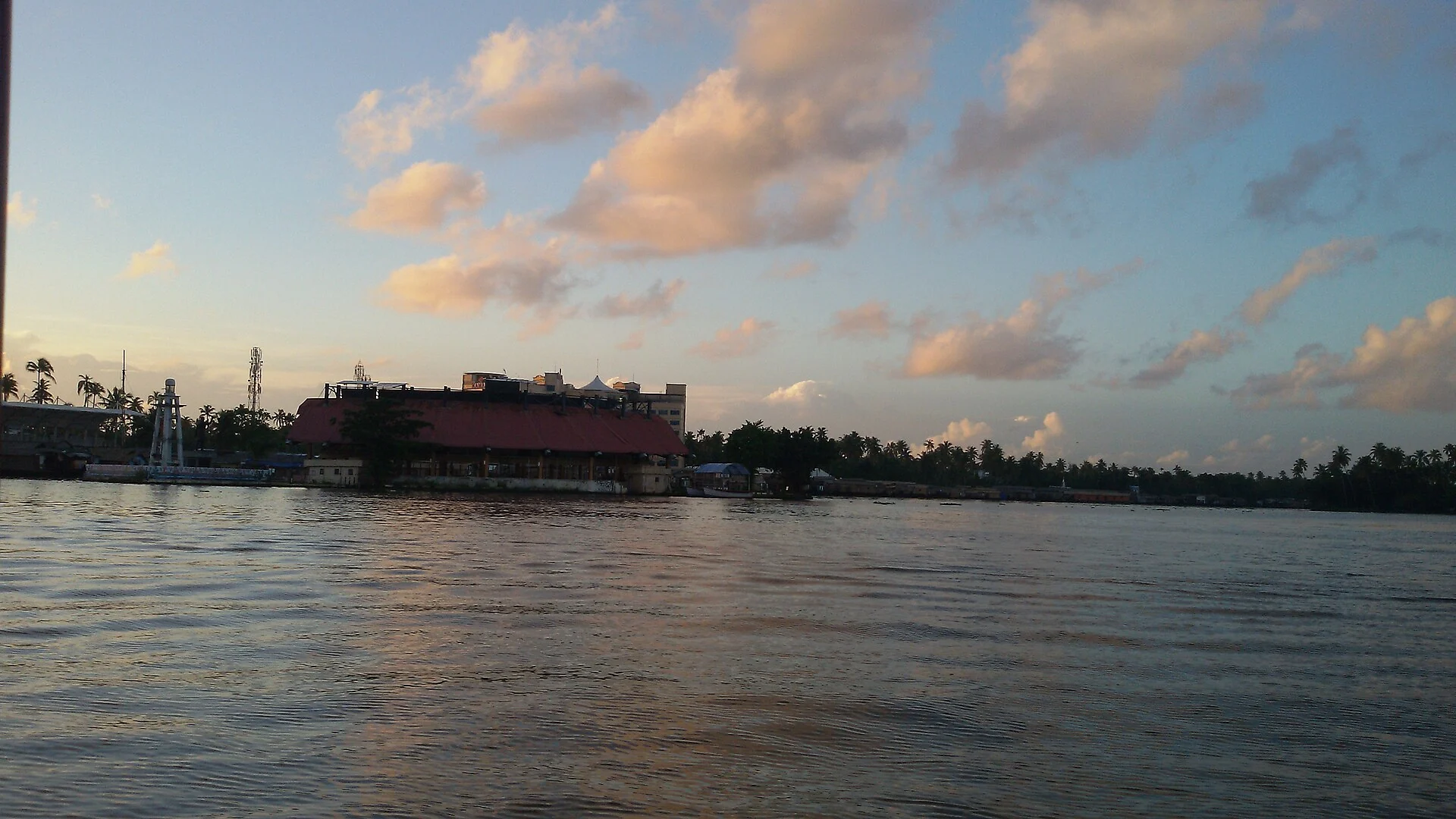
Finishing-point lake of the Nehru Trophy Boat Race and the main houseboat cruising water off Alappuzha.
3.4 km · straight line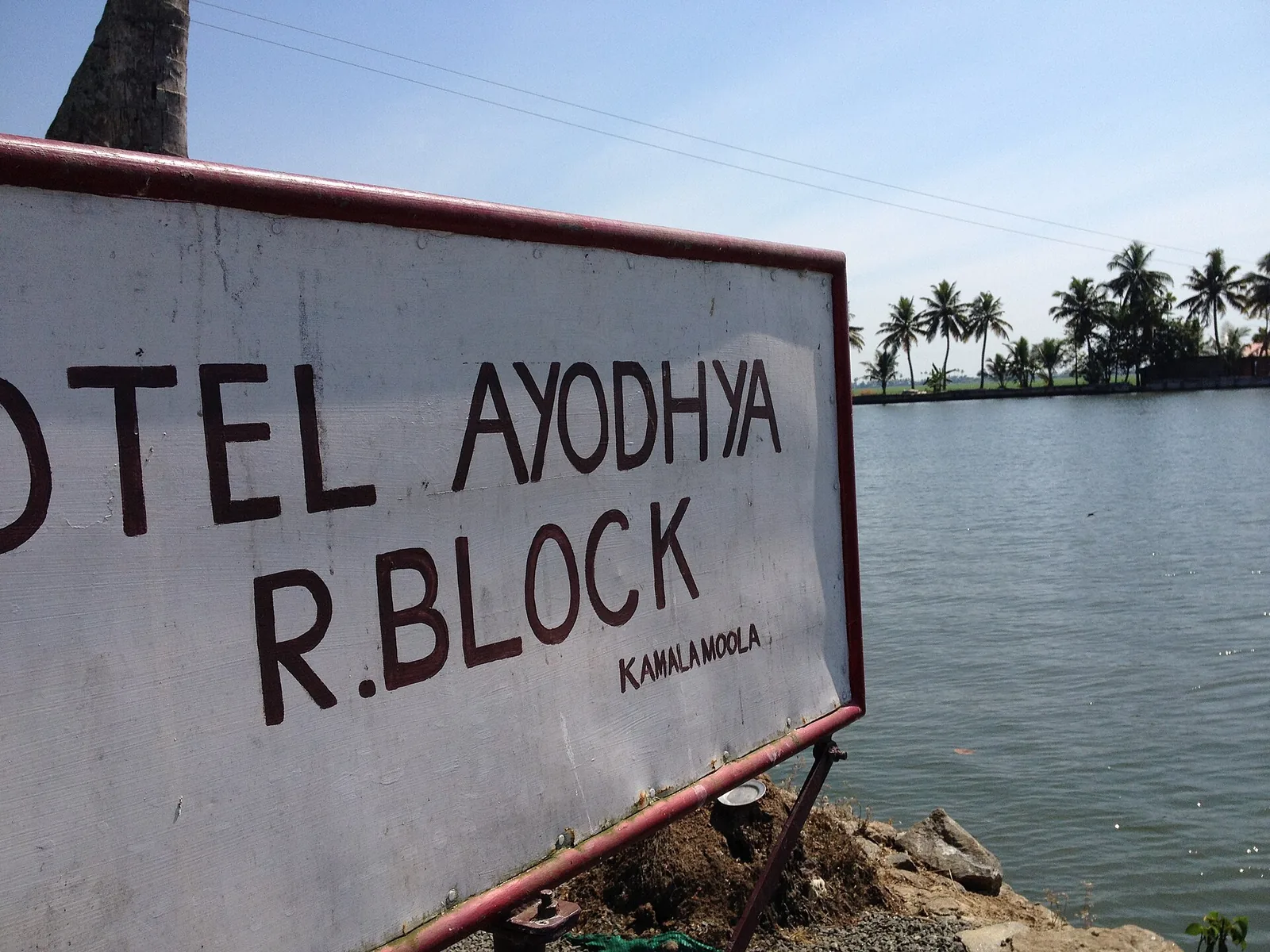
Iconic below-sea-level reclaimed farmland at Kainakary, ringed by bunds with the canal water sitting higher than the paddy fields.
5.1 km · straight line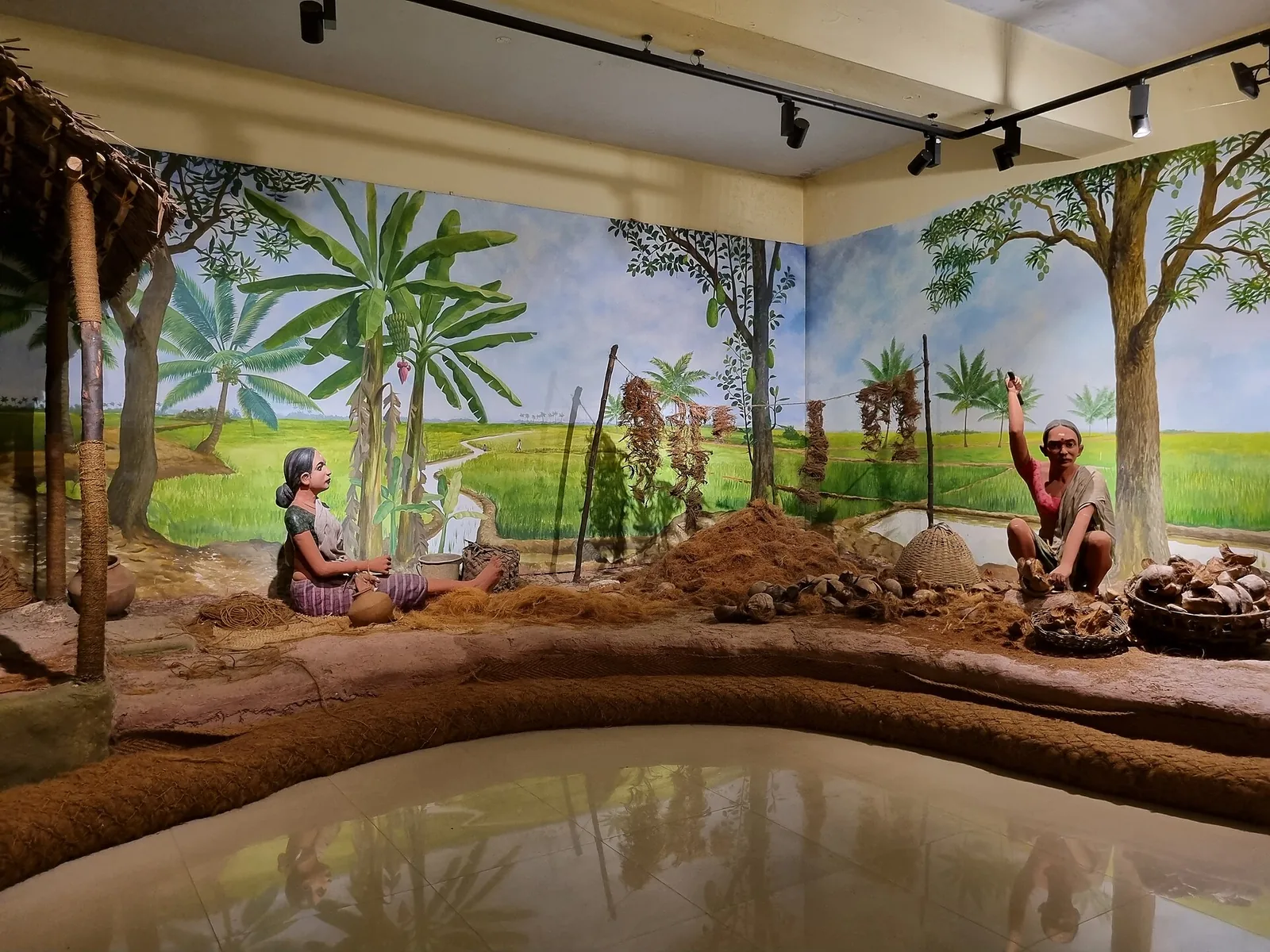
Museum on Kerala’s coir (coconut-fibre) heritage — the craft Alappuzha built its trade on.
9.7 km · straight line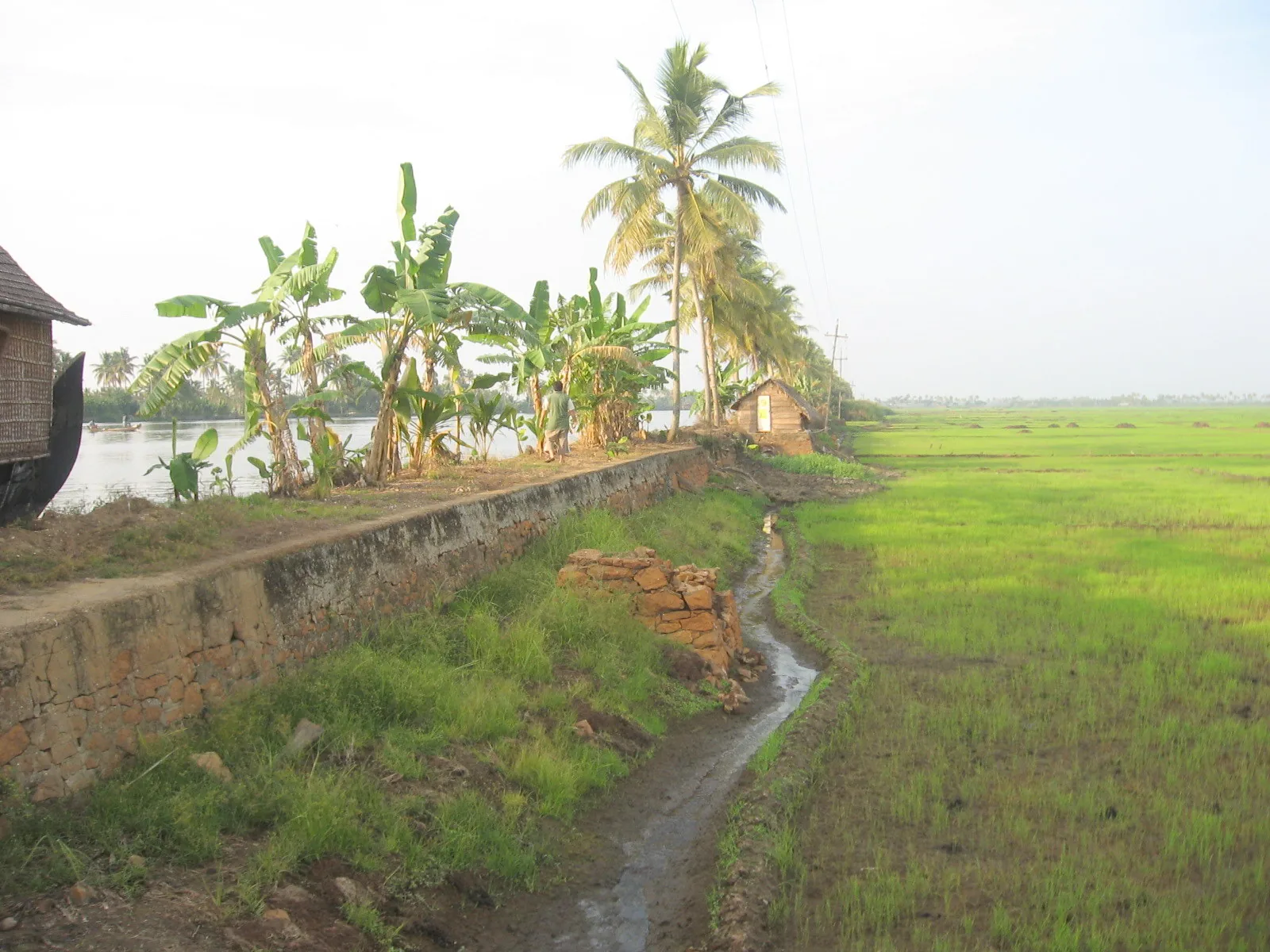
Low-lying paddy and canal region known as Kerala’s rice bowl.
10.6 km · straight lineAmbalappuzha Sree Krishna Temple is an active temple in Ambalappuzha town, south of Alappuzha, administered by the Travancore Devaswom Board. Krishna is worshipped here as Parthasarathy, Arjuna’s charioteer. The temple combines a broad tank, tiled courtyards and painted ritual spaces with two enduring cultural associations: Palpayasam offered to the deity, and Kunchan Nambiar’s creation of Thullal. A visit works best when darshan, the permitted exterior spaces and any offering collection are planned around the temple’s morning or evening opening.
10.8 km · straight line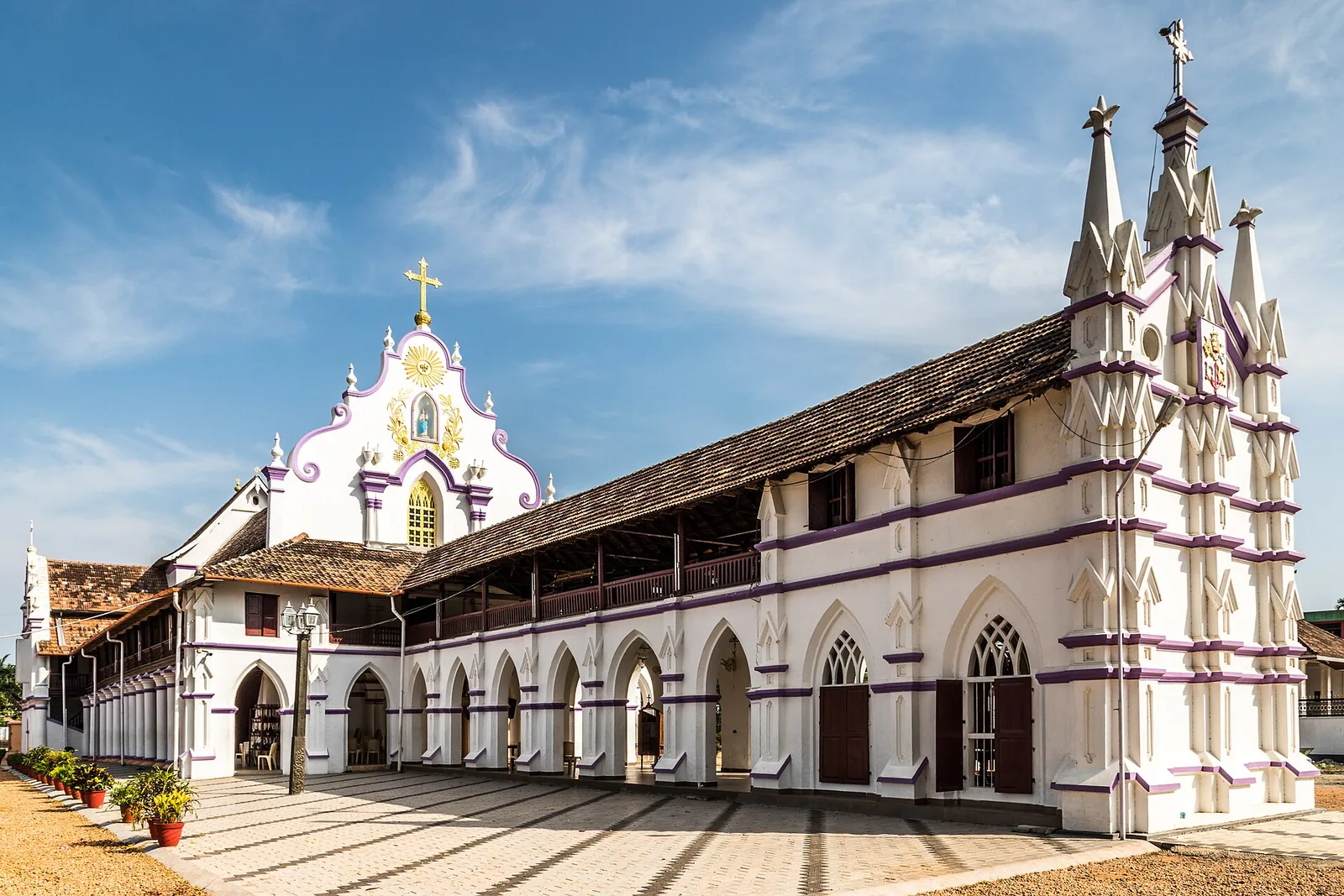
Kuttanad village on the Pamba known for the Champakulam Moolam snake-boat race and Kalloorkad St Mary’s Basilica.
11.1 km · straight lineAncient black-granite Buddha statue at Karumadi near Ambalappuzha, a relic of Kerala’s Buddhist past.
12.0 km · straight lineNearby toilets, pharmacies, ATMs, seating and vets are community-mapped and may be incomplete or out of date. Map data © OpenStreetMap contributors | Walking times © openrouteservice.org by HeiGIT
No. It is an open-air walled enclosure with a tapering red obelisk carrying a clock face, a hammer-and-sickle finial and an inscribed panel of names, a second red pylon with a plaque, a paved walk and two flagstaffs. There is no museum, no ticket office and no English interpretation board. Allow fifteen to twenty minutes unless you are there for a commemoration.
Nobody knows, and you should be suspicious of any source that gives you one number. At Punnapra on 24 October 1946 the figures are relatively firm: a sub-inspector and three policemen killed, and twenty-seven killed by police fire. For Vayalar on 27 October the published figures range from a hundred and three, counted from burial records by the former MLA D. Sugathan, through at least a hundred and thirty and over four hundred and seventy, both of which appear in the same Wikipedia article, to more than a thousand in that article's infobox and thousands in the historian A. Sreedhara Menon's account. There was no independent enumeration, and bodies were reported to have been disposed of by the army.
We do not know, and we would rather say so. The date is cast into the CPI(M) obelisk in Latin script as 1946 OCT 23, alongside a Malayalam-era date we could not read with confidence even at full resolution. The most commonly published date for the attack on the Punnapra police camp is 24 October; English Wikipedia dates the start of the revolt to 25 October, the Maharaja's birthday, which is also when martial law was declared. All three dates are in print.
No, and this trips people up regularly. This page is about the memorial at Punnapra, in Ambalappuzha taluk south of Alappuzha town. The Vayalar Rakthasakshi Mandapam is a separate memorial at Vayalar in Cherthala taluk, roughly twenty-five kilometres north, marking the second and far bloodier day. There are also at least two further CPI(M) obelisks in the Punnapra area, including one at Punnapra South. Navigate by coordinates, not by name.
The chronology does not support putting it that way. The Diwan's announcement that Travancore would become independent came on 2 June 1947, some eight months after October 1946. What was contemporaneous was his proposed American Model constitution, which English Wikipedia says was scheduled for implementation on 25 October 1946, and against which the slogan American Model Arabikkadalil was raised. Whether the rising should be counted as part of the freedom struggle at all is actively disputed in print, and we set out both positions rather than adopting one.
There is no entry fee — it is a free, open-air roadside memorial. Daytime is the practical answer for hours; note that the enclosure has gates, and at least one photograph of the site shows them closed, so access outside commemoration days may not be guaranteed and we have no source either way. The commemorative week runs 23 to 27 October, with Martyrs' Day on the twenty-seventh, when there will be gatherings, flags and speeches.
November to February and early mornings are best for walking; avoid midday heat where possible.
Entry: Free. There is no ticket office, and no charge has ever been reported. Timings: An open-air roadside memorial, so daytime is the practical answer. ⚠ The enclosure has iron gates and at least one photograph of the site shows them shut, so access outside commemoration days may not be guaranteed. We have found no source stating opening hours either way, and would rather say so than invent them.
Base yourself in Ambalappuzha or a nearby town in Alappuzha, then confirm the last-mile route locally before leaving. Walkable heritage areas are best done slowly; combine nearby streets, museums, markets and food stops. If the visit depends on forest, temple, boat, ferry, weather or seasonal access, check the official/local rule on the day before travel.
1 to 3 hours.
Nearby you can pair Our Lady of Mount Carmel Cathedral (2.4 km, approximate straight-line separation), Mullakkal Temple (2.4 km, approximate straight-line separation), Alappuzha / Alleppey town (2.5 km, approximate straight-line separation), Alappuzha Beach & Lighthouse (2.7 km, approximate straight-line separation).
Watch traffic on narrow heritage streets. Keep valuables close in crowded markets.
Written about Punnapra Vayalar Memorial itself — its history, its legends and the arguments about them.
These guides explore Ambalappuzha and the surrounding area. Choose a visit that fits your interests, allowing separately for travel between stops.


Route-level itineraries and practical guides for the rest of Kerala.
Photographs: Vijayanrajapuram (CC BY-SA 4.0), Kannanshanmugam, shanmugamstudio, Kollam (CC BY 3.0), Ajeeshkumar4u (CC BY-SA 4.0), Vis M (CC BY-SA 4.0), Fotokannan at ml.wikipedia (CC BY-SA 3.0). Wikimedia Commons.