What to expect
Highlights
- Heritage experience at Dhobi Khana
- Architecture, local stories and old trade/cultural routes
- Good fit for guided walks and nearby cafes/shops
A working colonial-era community open-air laundry in Fort Kochi, still used by traditional washermen families.
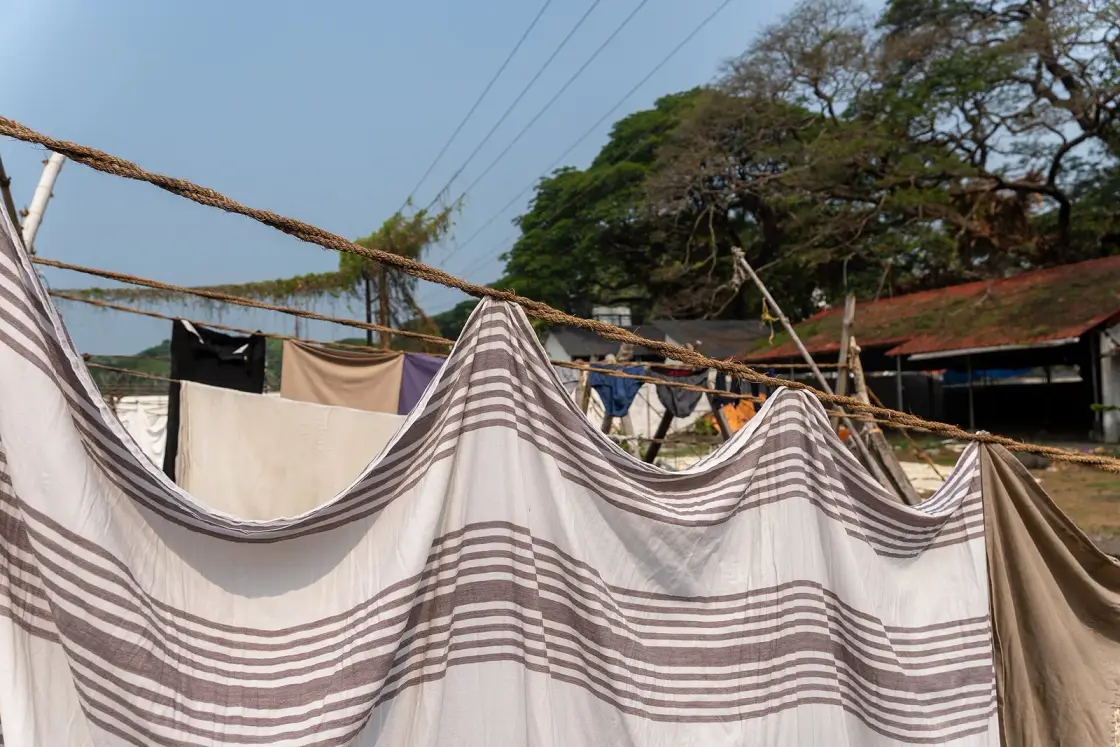
About a kilometre and a half inland from the Chinese fishing nets, in the Veli quarter of Fort Kochi, several dozen families still wash clothes by hand in an open-air laundry — beating, boiling, wringing and hanging, largely without machines. The Dhobi Khana is run by the Tamil-speaking Vannan community, who have been in Kochi for generations and have kept their language, their trade and their fierce devotion to Tamil cinema intact. It is not a monument. It is somebody's workplace, and that is exactly what makes it worth the walk.
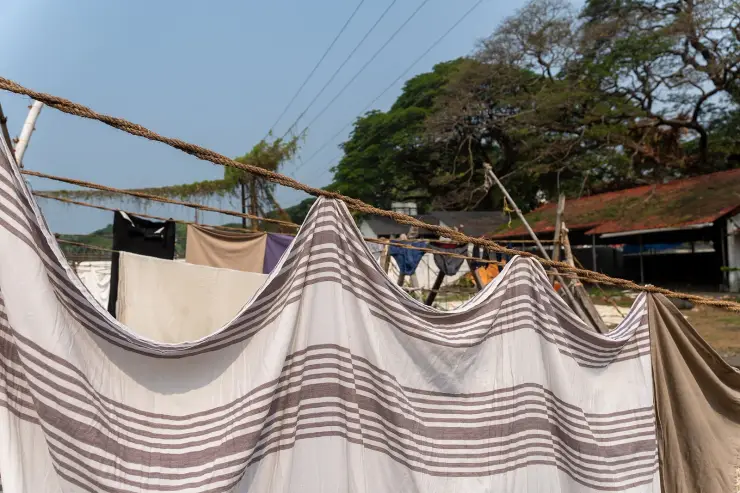
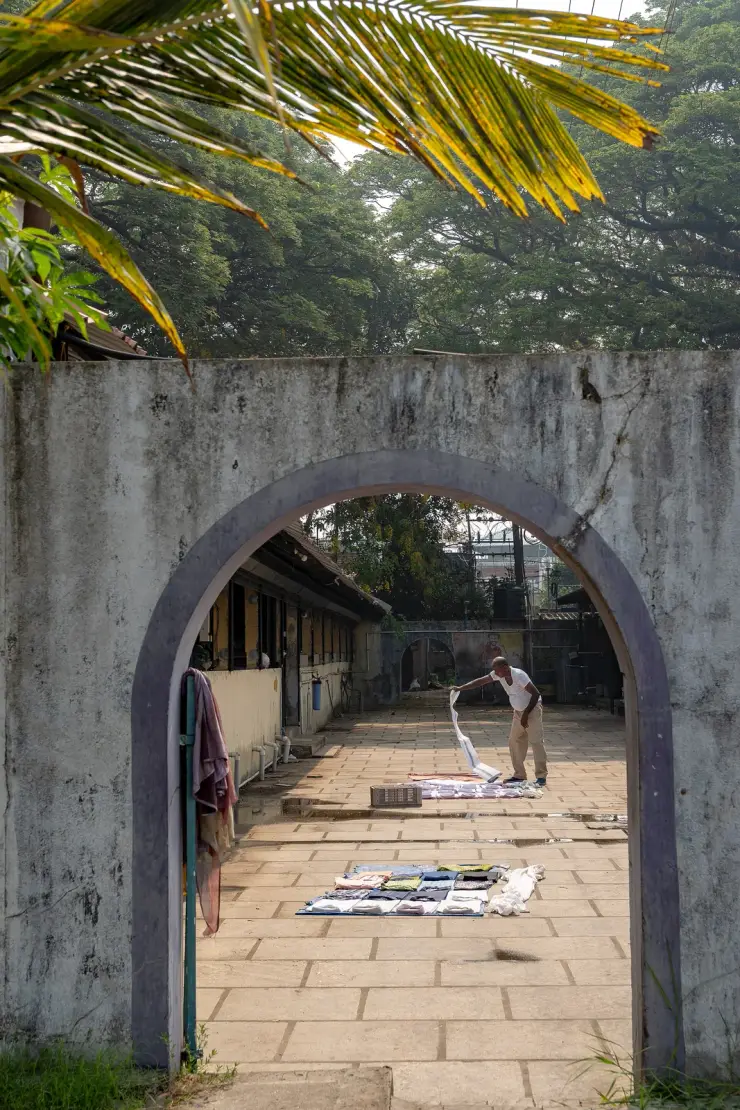
Come mid-morning and the place is working. Water, soap, stone, muscle. Clothes are soaked, beaten, boiled in coppers, wrung out and carried to lines that run in long bright ranks across the open ground. In the ironing hall the irons are heavy and coal-heated, and the smell of hot cotton and charcoal is the first thing you notice going in.
The first surprise for most visitors is the language. What you hear around you is Tamil, not Malayalam. This community came from what is now Tamil Nadu and has held its language here for generations, inside a Malayalam-speaking city, without dissolving into it. The Dhobi Khana is a Tamil island in Fort Kochi, and the community's identity is bound up in that.
The second surprise is the Rajinikanth posters. There is usually a television running Tamil films in the ironing hall, and the walls carry the star's image. It is easy to read this as a charming detail for visitors; it is better read as the thing itself. For a Tamil-speaking working community living away from home, Tamil cinema is not entertainment laid on top of the culture — it is a good part of how the culture is kept. Films including Mumbai Police, Dheena and Vikramadithyan have been shot here in part, which the community is quietly pleased about.
The work itself is genuinely hard and getting harder. Washing machines are in every apartment block in Kochi. Hotels have industrial laundries. The economics that supported dozens of families on hand-washing are thinning year by year, and coverage of the Dhobi Khana in the Indian press has for some time carried the same worried question about how long it can last. Recent reporting puts around forty families still using the khana.
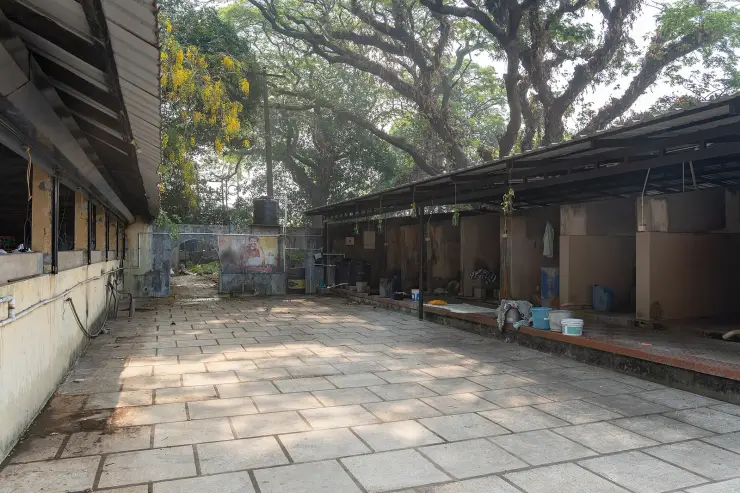
Walk out of the washing pens and you are on the edge of Veli Ground, a large open playing field. The two are directly connected, and the connection is the single most concrete fact about this place — see the history below. Most visitors look at the ground and see a park. It is really a receipt.
The ground is divided, and once you see the division the place stops looking like chaos. Families work allotted pens rather than a common pool — a washing bay, a stretch of line, a share of the boiling coppers — which is why the same person is in the same corner every day and why a bundle can be traced back to whoever handled it. Nothing is labelled in a way a visitor can read, and yet almost nothing goes astray, because the system is people rather than paperwork.
It is also worth being accurate about the 'no machines' line, which gets repeated more absolutely than it deserves. The heavy lifting here is genuinely hand work — soaking, beating on stone, boiling, wringing, line-drying in the sun — but a khana that survives on hotel and hospital contracts cannot be entirely pre-industrial, and you will see mechanical help where the volume demands it. What has not been mechanised is the part that matters commercially: the judgement about what a given fabric and a given stain will take. That is the skill being sold, and it is the reason a hotel still sends work here rather than buying another machine.
There is no ticket, no counter and no guide service. Someone will usually show you round, and the custom is to give a small tip to whoever actually did. It should be given to that person, not to whoever meets you at the entrance.
How the Vannan community first came to Kochi is genuinely unsettled, and three different accounts circulate — often in the same guidebook, and sometimes in the same paragraph.
The first says the Portuguese, and later the Dutch, brought Tamil washermen to Kochi to launder military uniforms. This is the version behind the frequently repeated line that the Dhobi Khana was established by the Dutch in the early 1700s, and it is the one most often printed.
The second attributes it to the British, with colonial officers bringing Tamil villagers to Kochi to work as washermen during the later colonial period.
The third has nothing to do with Europeans at all: that a group of Tamil-speaking Vannan families were brought to Kochi in the 1720s by the King of Kochi.
These cannot all be true, and we have not found a source that settles it. What is beyond dispute is that a Tamil-speaking laundering community has been established in Kochi for a very long time, that it was formally organised here in the 1920s under the Madras Presidency, and that it is still working. We publish the disagreement rather than picking the most attractive version, because the most attractive version — the Dutch one — is also the one that most conveniently flatters a colonial-heritage tour.
One thing that is often implied and is simply not so: the building is not old. Whatever the community's origins, the structure standing at Veli today dates from 1976.
There is a deeper question underneath the arrival stories that almost nothing written about this place asks, and it is the interesting one: Kerala already had washermen. It did not need to import any. So why is there a Tamil-speaking laundering community in Kochi at all?
The answer is that the two trades were not the same trade. In traditional Kerala society, washing was a ritual office as much as a service. Castes including the Veluthedathu Nair — the name itself carries the sense of whitening or purifying — and, in other communities, the Mannan and the Velan, existed to supply mattu: a freshly washed cloth handed to a household at the precise moment its pollution ended. Colonial-era ethnography records the schedule in detail. A woman received mattu on the fourth morning after her period began; a woman who had given birth on the fifth, ninth, eleventh and sixteenth days; an entire family under death pollution on the sixteenth day. The cloth was worn to bathe in and returned immediately afterwards. The washerman's importance was not that he got clothes clean. It was that only he could deliver the object that made a purification valid.
That is a hereditary religious function tied to specific families and specific clients, and it does not scale. What Portuguese garrisons, Dutch officials, British officers and then a port city full of hotels and offices actually wanted was something quite different: bulk commercial laundry, done to a deadline, for anyone who paid. A ritual specialist could not simply be turned into a contract laundry, and would not have wanted to be. Bringing in a Tamil-speaking washing community to do commercial work alongside the existing ritual one resolves the puzzle neatly, and it also explains the durability of the arrangement — the newcomers were not competing for anybody's inherited clients.
None of that settles which coloniser or king did the bringing, and we are not going to pretend otherwise. But it does reframe the Dhobi Khana. It is not a picturesque survival of an old Kerala custom. It is the working end of an imported commercial trade that grew up beside an older ritual one, in a city that had uses for both.
A Tamil-speaking Vannan laundering community has been established in Kochi for centuries, though the circumstances of its arrival are disputed — variously credited to the Portuguese and Dutch, to British officers, and to the King of Kochi in the 1720s.
The community was formally organised in the 1920s, under the Madras Presidency, and has retained a cohesive identity since. Its trade, its language and its social structure have held together through the reorganisation of Indian states that put a Tamil-speaking community inside Kerala.
The decisive modern event is the one visitors walk past. The community gave up around ten acres of land as part of a city improvement scheme — land that became the open playing field now known as Veli Ground. The present Dhobi Khana was built in 1976 by the Greater Cochin Development Authority as compensation for that. The laundry you visit exists because the community lost ten acres.
Since then the pressure has been economic rather than administrative. Domestic washing machines, hotel laundries and rising costs have steadily eroded the trade, and coverage in the Indian press over recent years has repeatedly framed the khana as a way of life under threat. Around forty families were reported to be using it in recent reporting.
Tamil cinema has run through all of it. The ironing hall's television, the Rajinikanth posters and the film shoots — including parts of Mumbai Police, Dheena and Vikramadithyan — are part of how a Tamil community has stayed Tamil in a Malayalam city.
Because it is one of the very few places in Fort Kochi where you watch people working rather than watch a preserved building.
Because the Tamil language, the Rajinikanth posters and the coal irons together tell a story about migration and cultural survival that no heritage plaque in the quarter tells.
Because the connection between the laundry and Veli Ground next door is a rare, legible piece of urban history: ten acres traded for a building.
Because it takes half an hour and is a short auto ride from the seafront, on a side of Fort Kochi that most visitors never reach.
And because the trade is genuinely shrinking. This is one of the places where seeing it now actually means something.
Road km to Ernakulam; ghat roads and traffic vary — allow extra.
November to February and early mornings are best for walking; avoid midday heat where possible.
Live forecast loads in your browser.
Sun and moon are calculated for this location and shown in IST. Photography windows are the hour around sunrise and sunset; the sunset bearing is degrees clockwise from true north. Moon phase is accurate to about half a day.
Browse listed stays, food, activities, sights, shops and rentals around Dhobi Khana. Check each listing’s locality and contact the business directly for current arrangements.
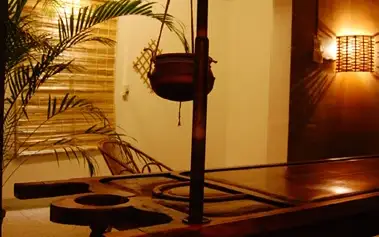
Ayurville offers Ayurveda and massage appointments in Fort Kochi. Discuss the chosen service, duration and suitability with the centre before booking; a spa session and a medical treatment programme are different arrangements.
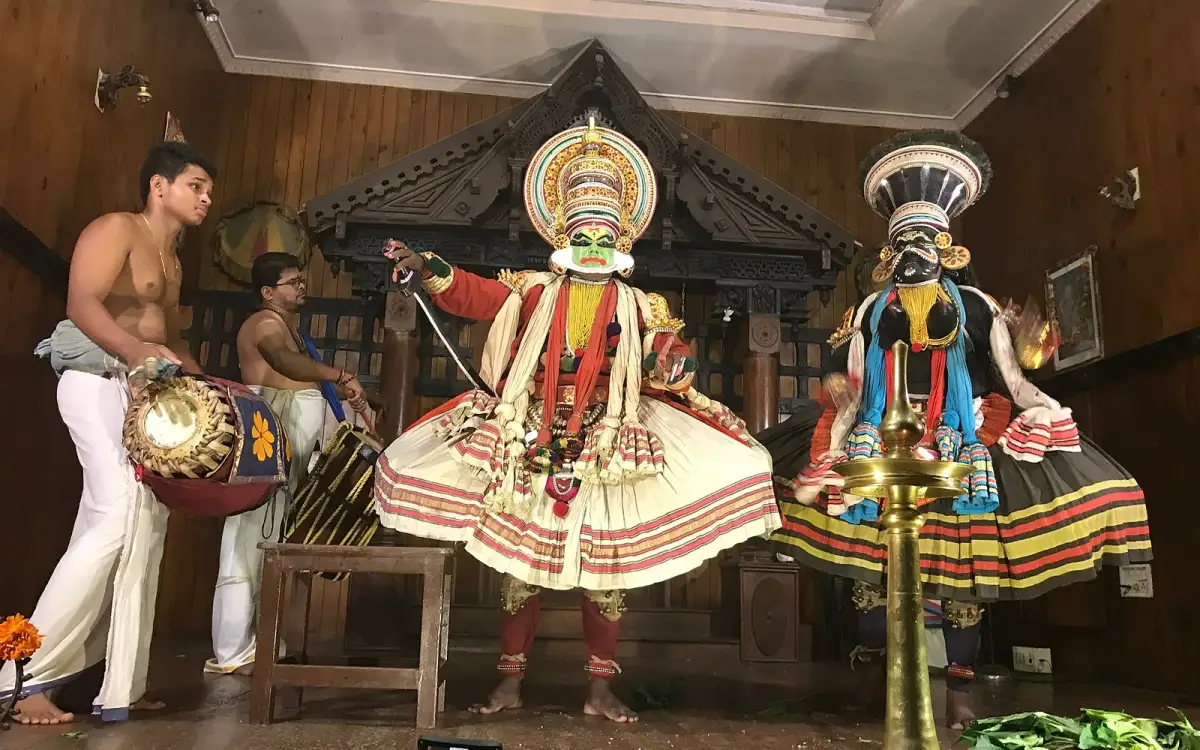
Fort Kochi cultural centre for Kathakali, Kalaripayattu, classical music and related performances. Published show prices; confirm direct · Fort Kochi, Kathakali, Kalaripayattu.
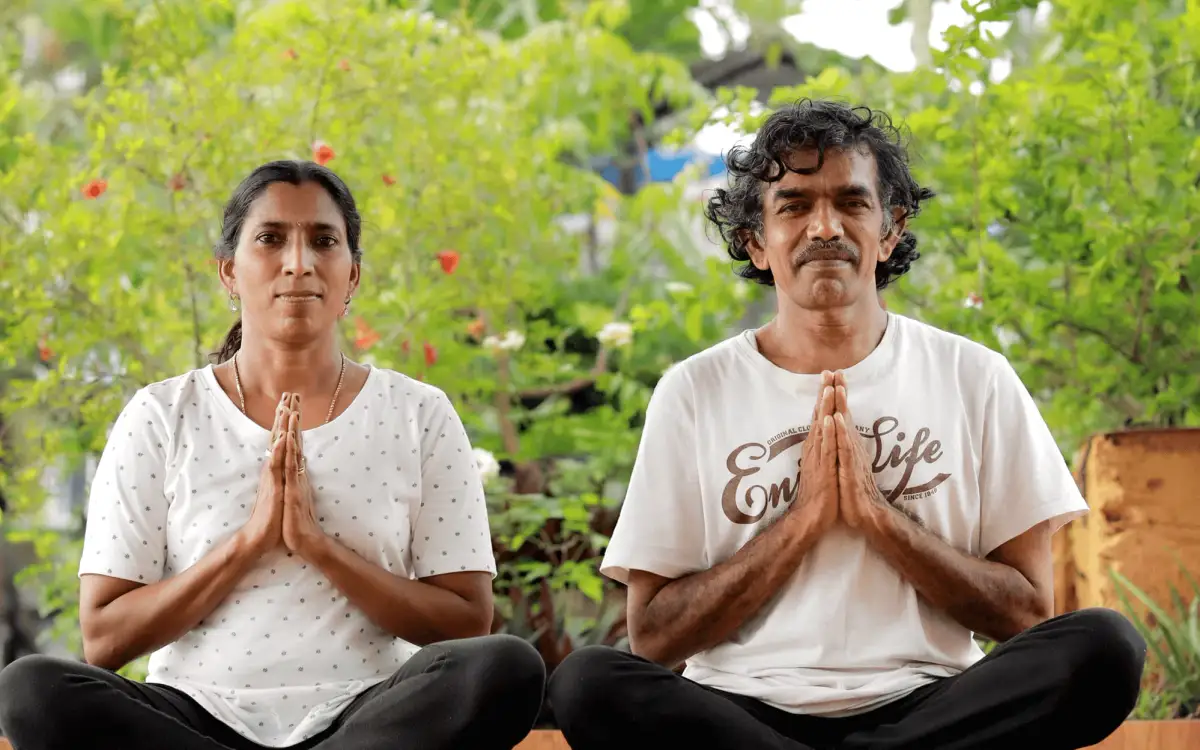
Ayurtheeram is a yoga and Ayurveda centre on K. B. Jacob Road in South Thamaraparambu, Fort Kochi. Its own site names founders Anitha and Ramesh and lists yoga classes, individual Ayurveda treatments and longer courses. Choose it if you want a class or a treatment visit near the heritage side; a training course is a separate commitment. Ask for the practitioner, exact service, duration, any consultation, complete price and cancellation terms before booking. The website shows its own founders; it does not establish availability on your travel date.
Book with the place itself. India’s cyber-crime coordination centre warned in April 2025 that convincing copies of hotel and pilgrimage booking sites are being pushed through sponsored search and social ads, taking payment for rooms the property never hears about. Use the contact and source details on each profile to confirm the exact business and booking channel. A directory entry or map pin alone does not establish an operator’s identity or current availability. Roampedia takes no commission and does not collect booking payments. If a booking page reached you through an ad, check the address bar against the property’s own site before you pay. Fraud can be reported on cybercrime.gov.in or on 1930.
Browse food, accommodation and activities across Fort Kochi. Check each address and journey before adding it to your day; these selections are not all beside Dhobi Khana.
10 more places around Fort Kochi. Open a guide to plan the visit and onward journey.
2.3 km · 27 min walk
Kerala’s most walkable heritage quarter, with Chinese fishing nets, colonial churches, art cafes and Mattancherry nearby.
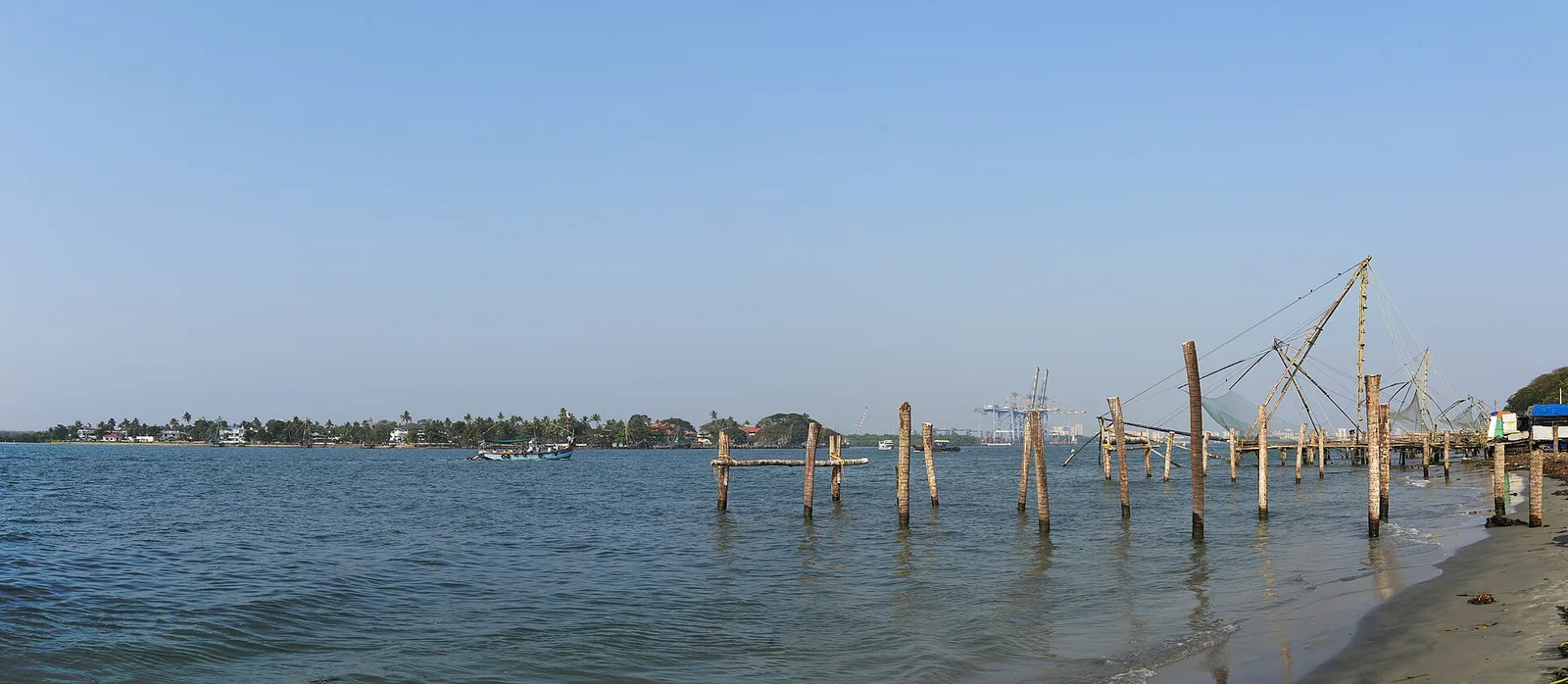
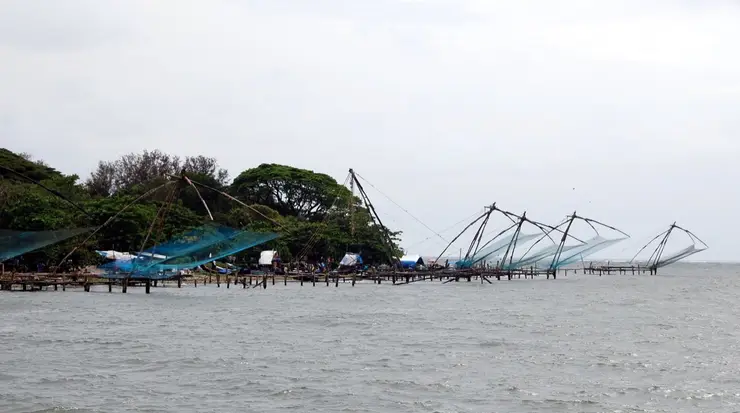
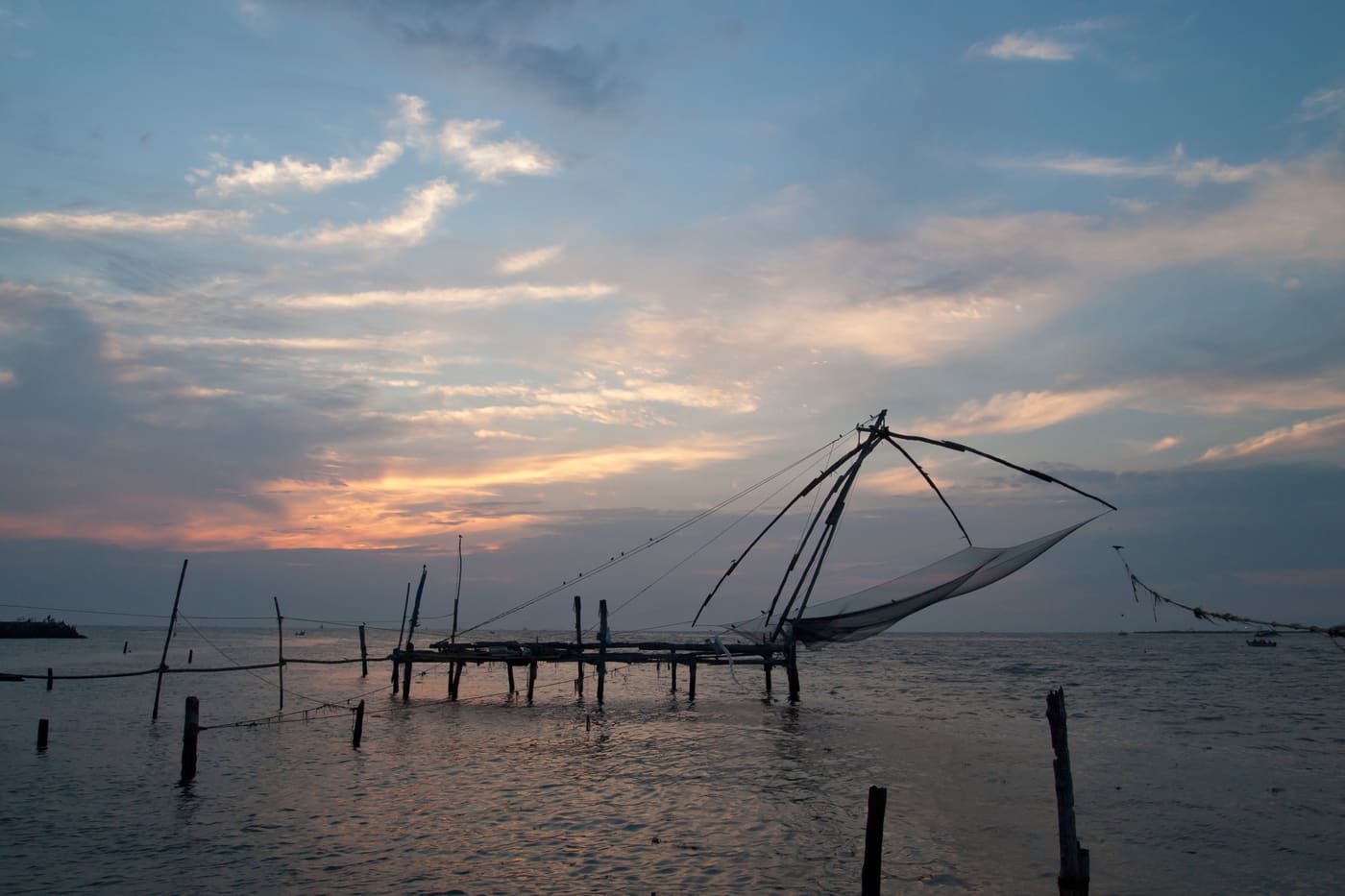
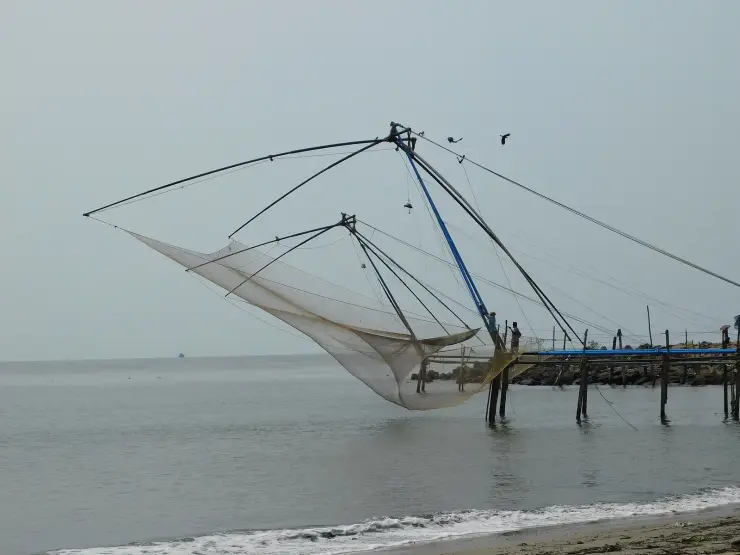
The giant cantilevered lift nets that are Fort Kochi’s emblem, strung along the shore at Vasco da Gama Square and still landing fish. Even their origin is argued — popular tradition credits Chinese traders of Zheng He’s era, some scholars later Portuguese settlers from Macau — and the argument is part of the attraction.
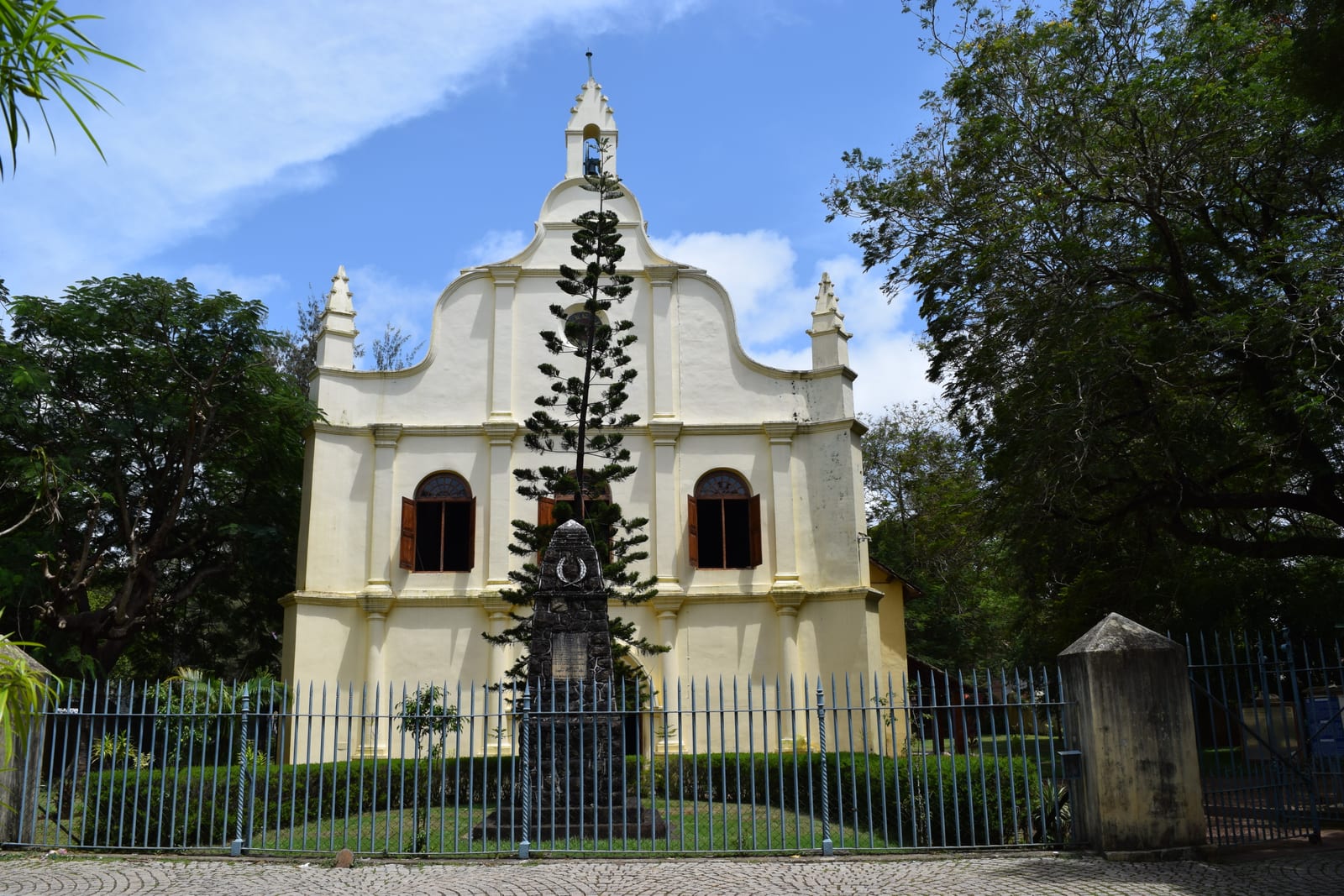
2.4 km · 28 min walk
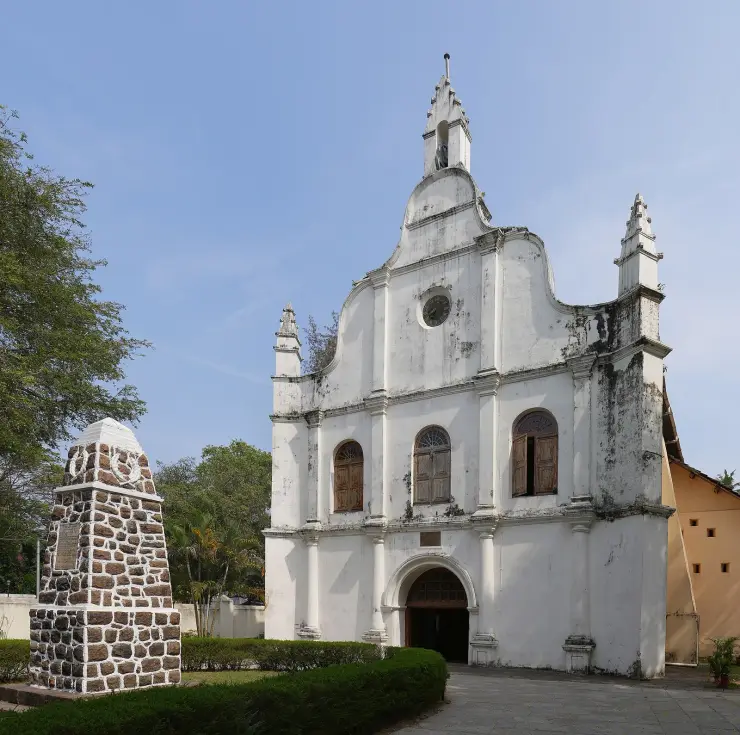
Believed to be the oldest European church in India (1503); Vasco da Gama was buried here before his remains were moved to Lisbon.
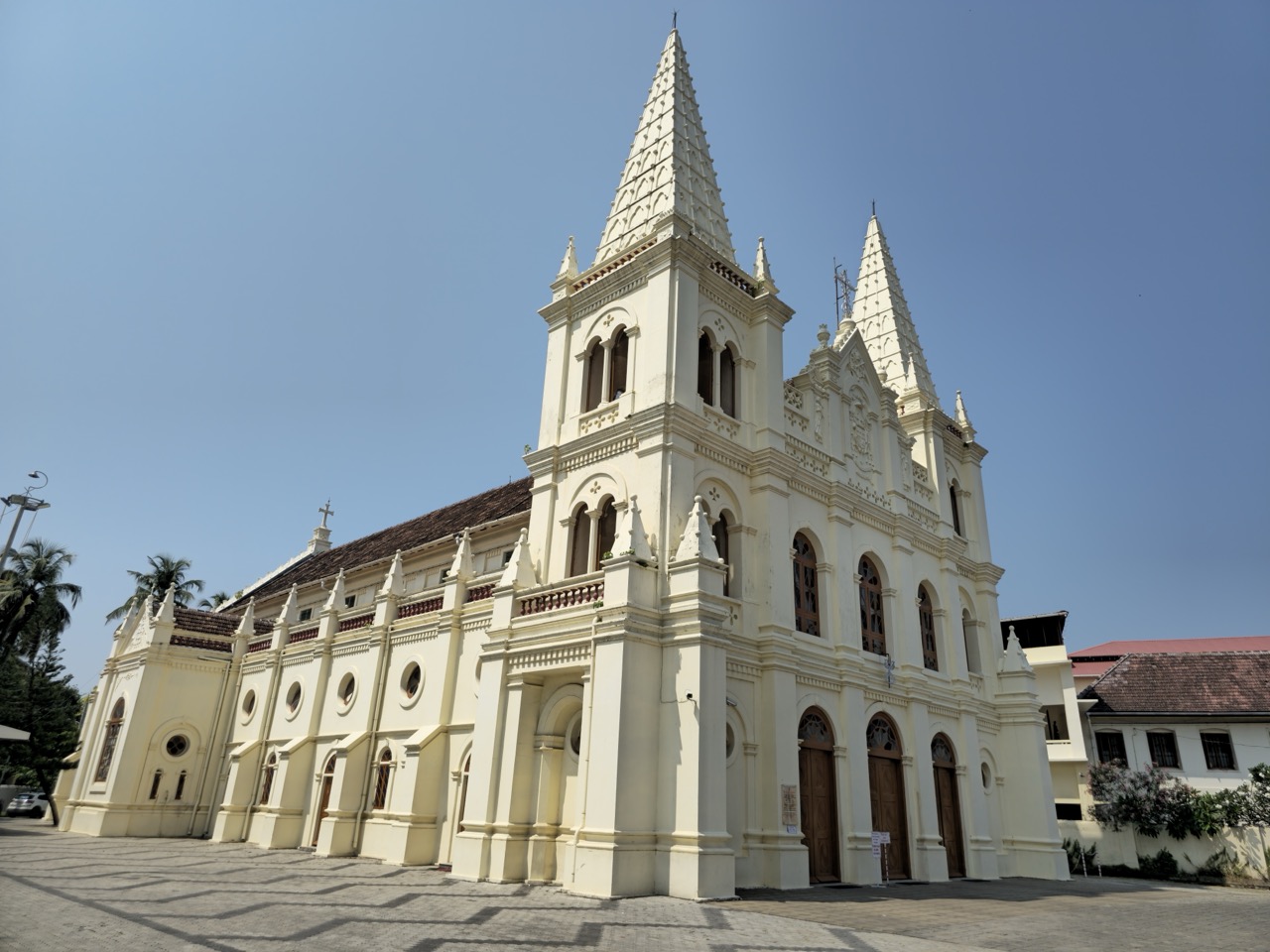
2.0 km · 25 min walk
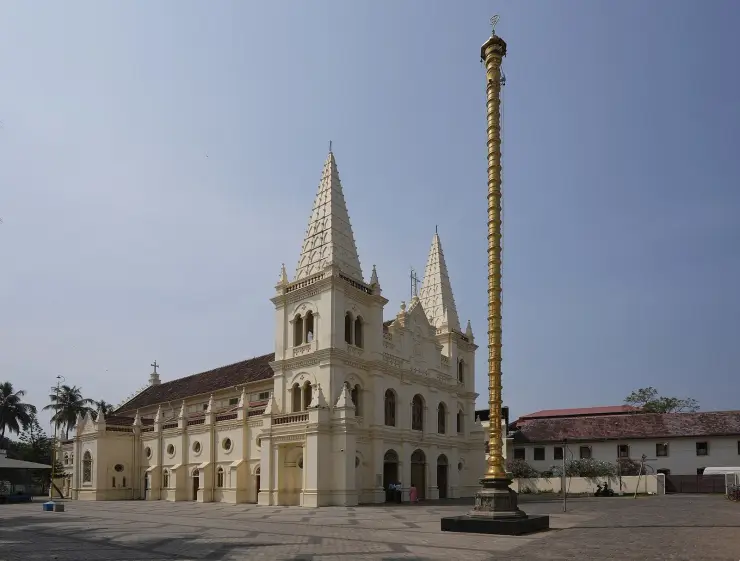
One of the finest churches in Kerala, with a richly painted interior, beside the Kerala Kathakali Centre in Fort Kochi.
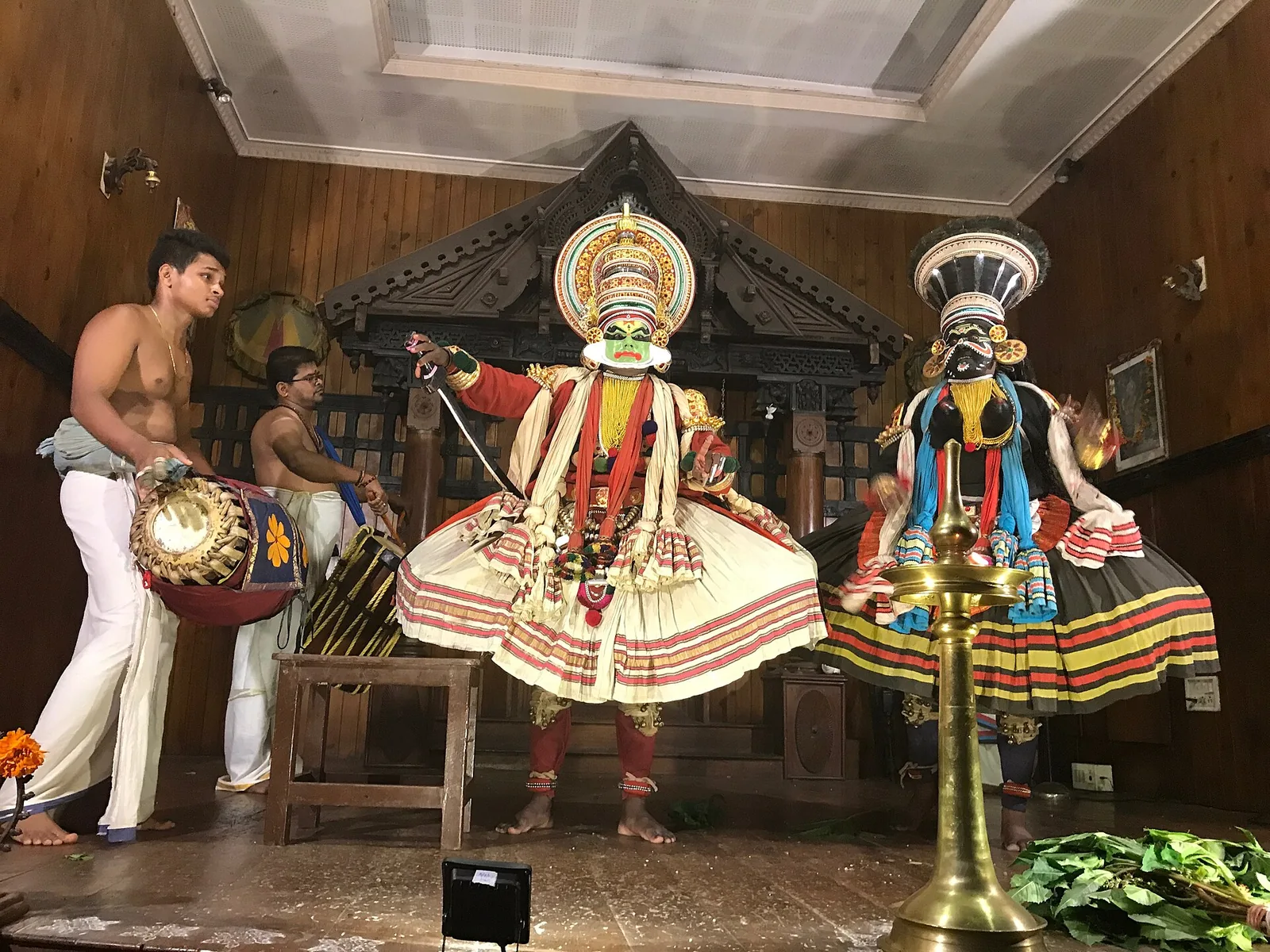
1.9 km · 23 min walk
Evening Kathakali and Kerala classical-art performances in Fort Kochi, with make-up shown before the show.
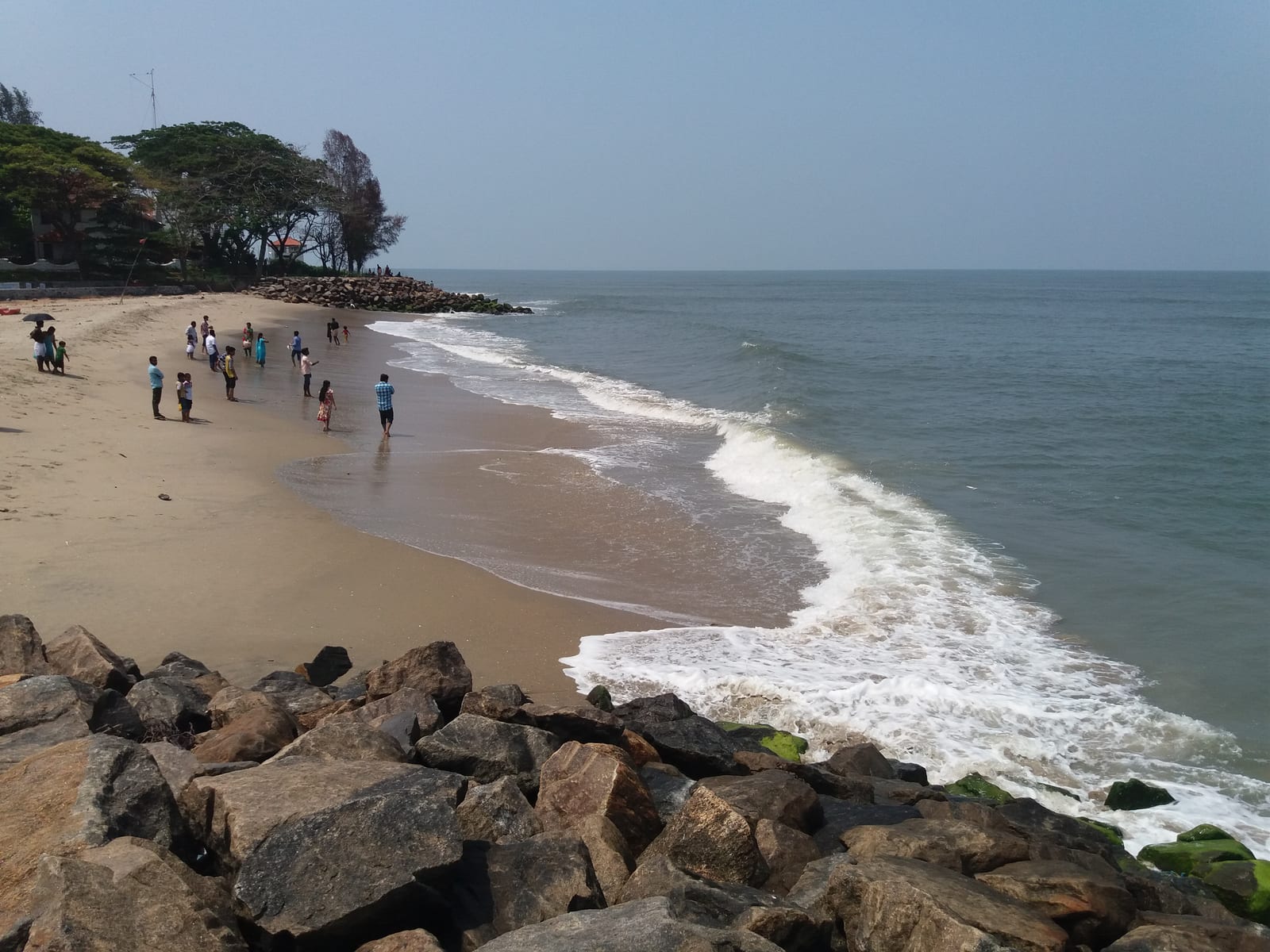
2.1 km · 3 min drive
Public seafront beside the Chinese fishing nets — a walking-and-sunset beach, not a swimming beach.
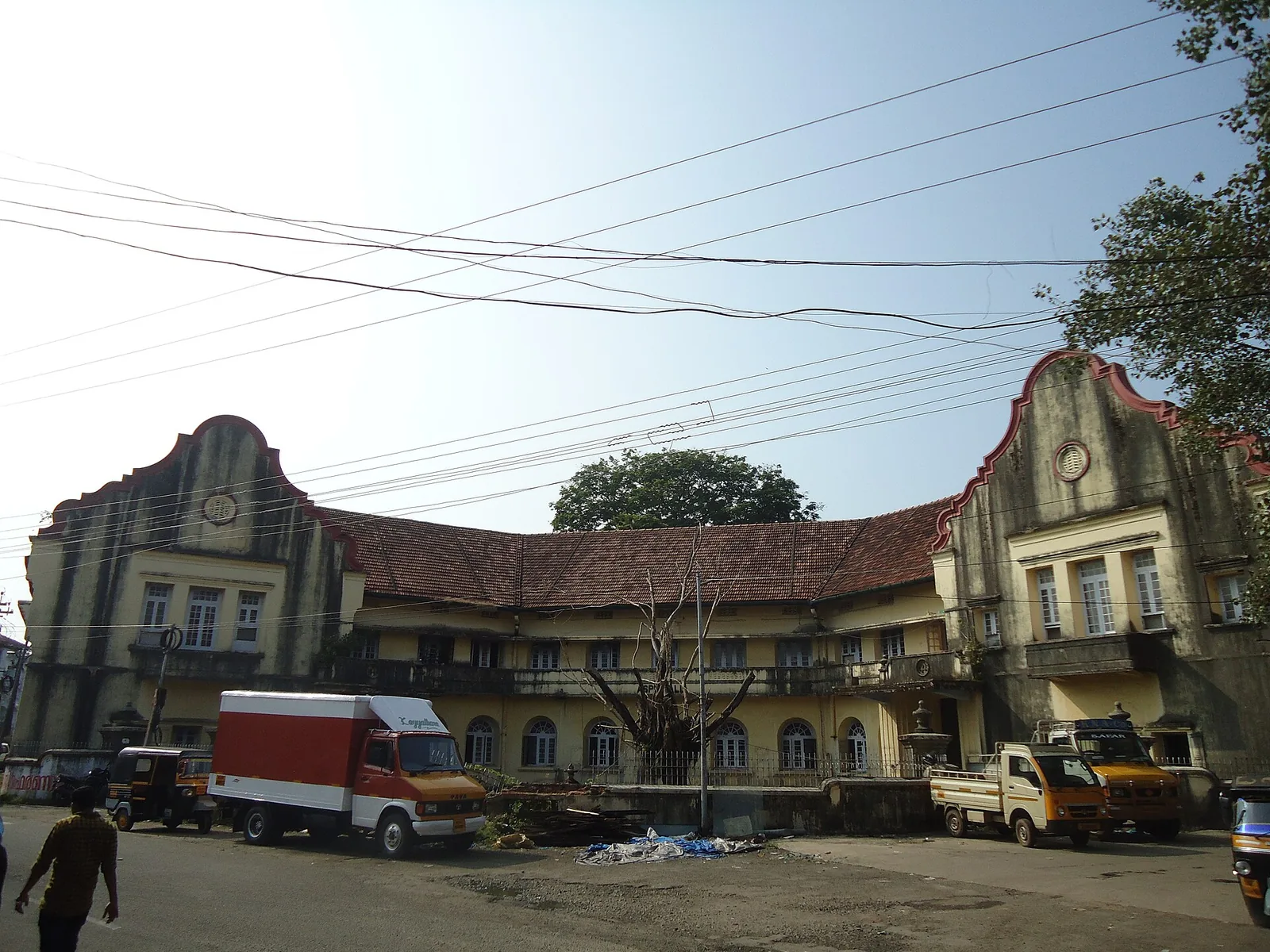
A large 19th-century waterfront trading compound in Fort Kochi, the principal venue of the Kochi-Muziris Biennale.
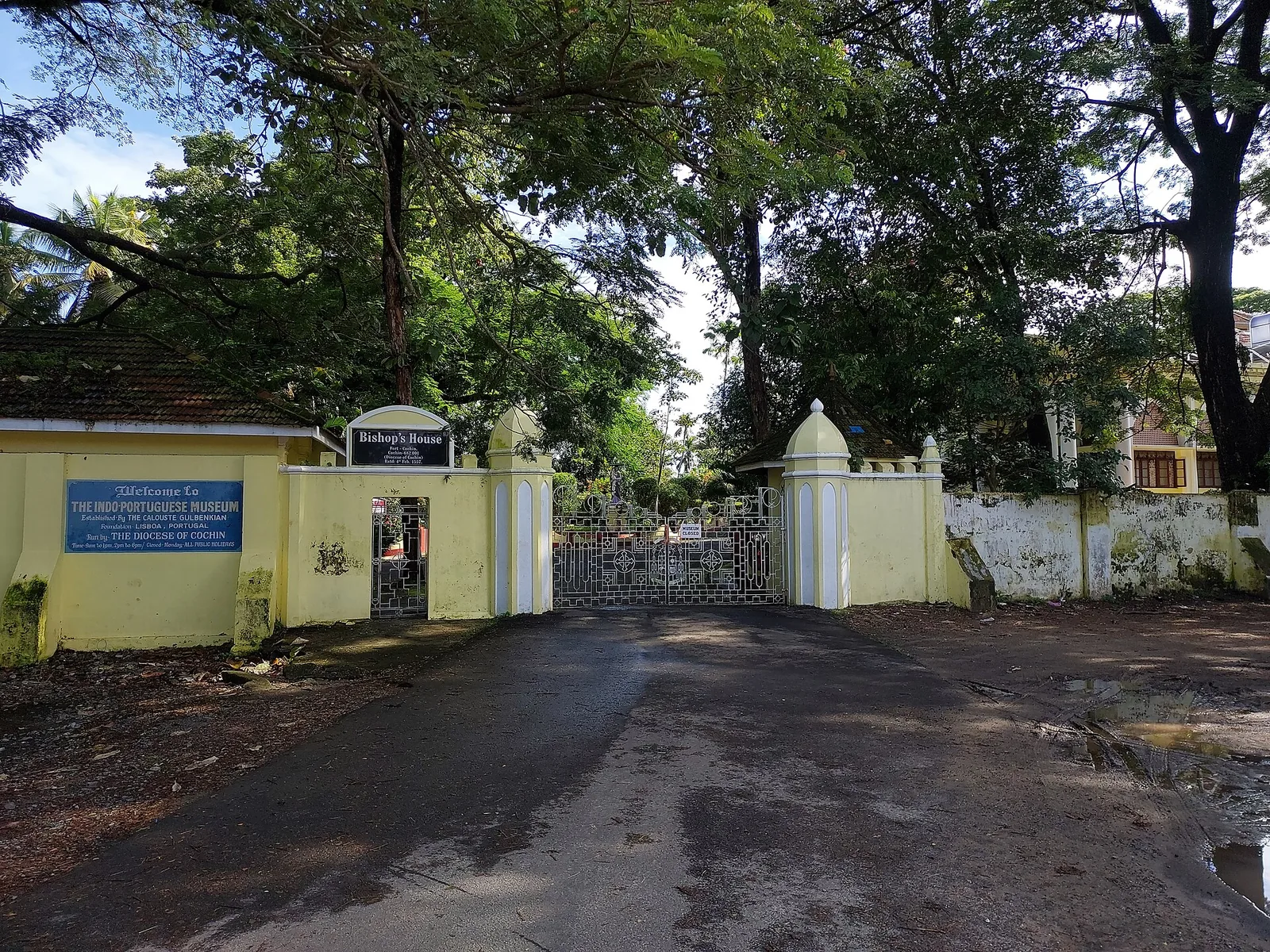
1.8 km · 22 min walk
Museum of Kerala’s Indo-Portuguese Catholic heritage in the Bishop’s House garden, Fort Kochi.
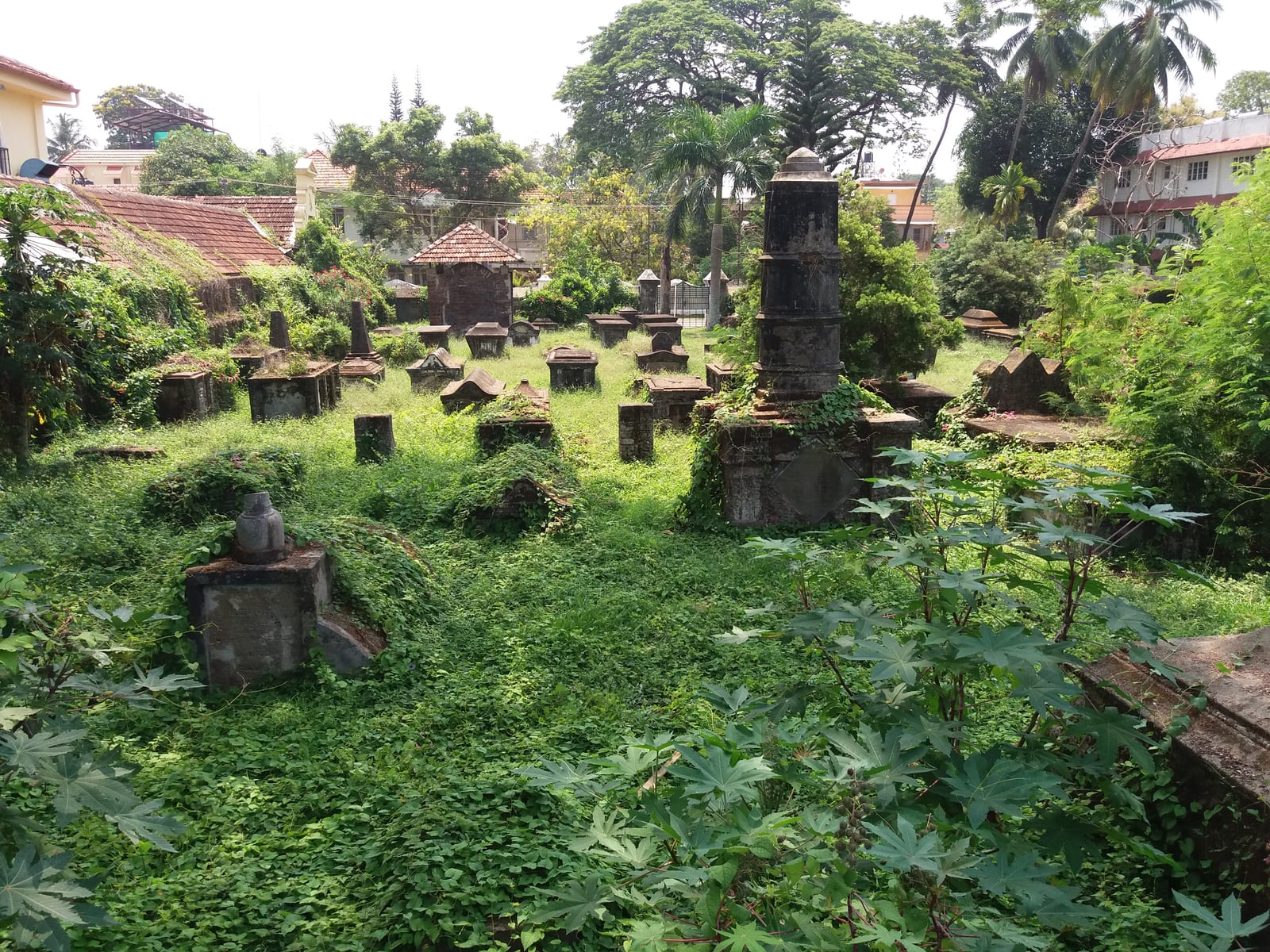
2.2 km · 27 min walk
The 1724 burial ground of Kochi’s Dutch colonial officials and merchants, beside St Francis Church — ASI-protected, and usually locked.
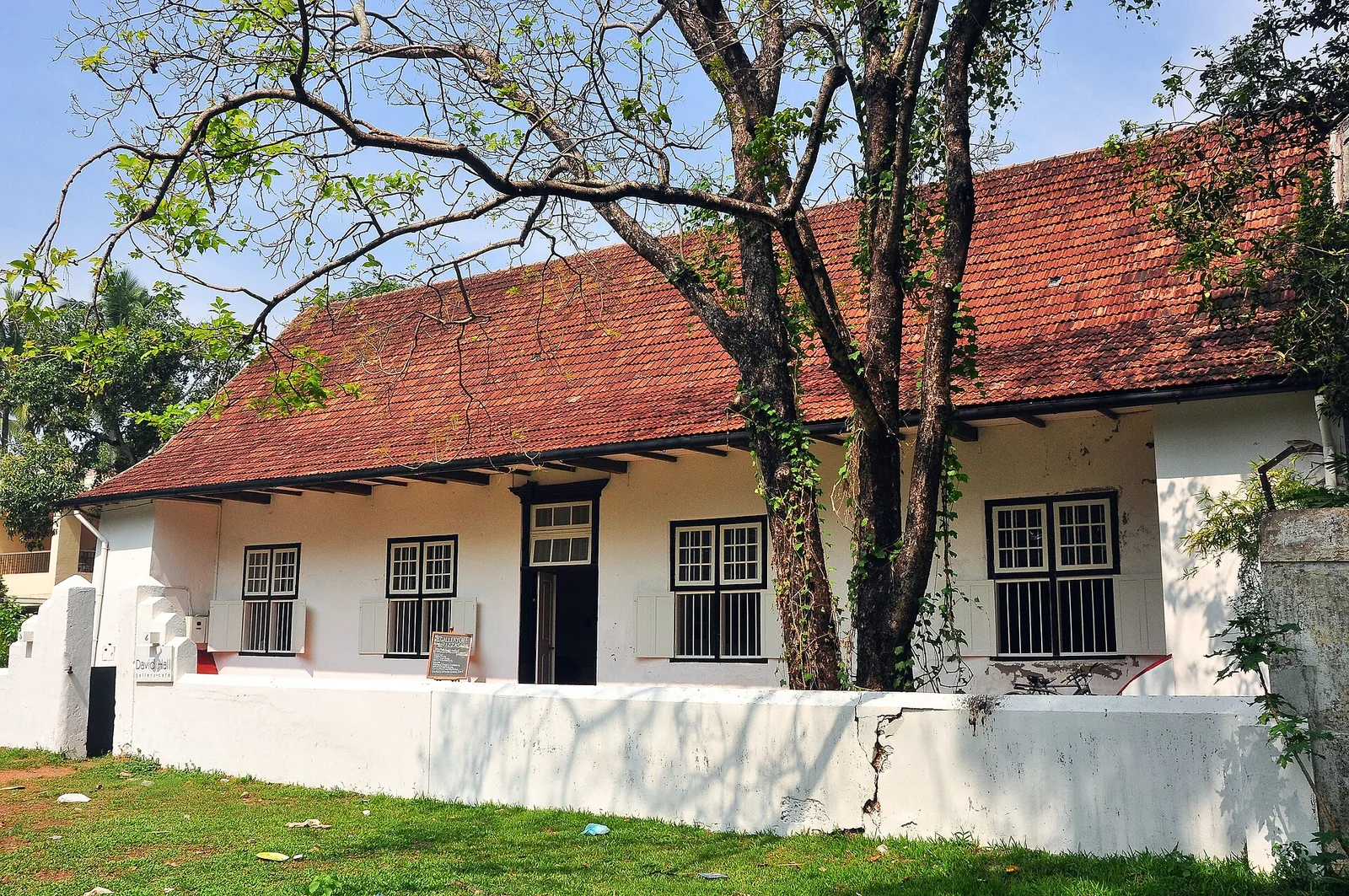
2.1 km · 26 min walk
A restored 17th-century Dutch bungalow on the Fort Kochi parade ground, now a contemporary art gallery and cafe.
Roampedia is commission-free — own or know a stay, eatery, guide or shop near Dhobi Khana? Submit public business details for review.
Add a nearby businessEntry: There is no ticket. This is a working community laundry, and the customary courtesy is a small tip to whoever shows you round — agree nothing in advance and give what the time was worth.
Photography: People are working and living here. Ask before photographing anyone, and accept a refusal — this is somebody's workplace, not a set. The washing pens, the drying lines and the coal-heated irons are the subjects worth asking for.
If you are travelling by bus or ferry, check the return service with the operator before setting out. Leave time to reach the stop or jetty after your visit.
Ask at the jetty or stand for the time of the last service back, not the next one. If you miss it, an auto or app cab is the fallback — agree the fare before you get in.
If you need step-free access, contact the site before travelling. Ask about a level entrance, steps along the route, the nearest drop-off point, seating and accessible toilets.
Charge cap and free-transaction limits: Reserve Bank of India, ATM FAQ updated 4 July 2025; checked 4 October 2026.
These services are listed within about 1.2 km of Dhobi Khana. Walking distances follow mapped routes; access and opening hours can change. Other services may be closer but are not included here.
Fort Kochi is one of Kerala’s safest and most walkable tourist quarters, comfortable by day and on the main lanes after dark. Violent crime against visitors is rare — the realistic risks are auto/guide scams, petty theft in crowds, and the sea, not personal danger.
Safety guidance last reviewed 15 June 2026. Always check your own government's current travel advice before you travel.
Published emergency and visitor-assistance contacts. For an immediate emergency, call 112. Shared Kerala contact sources checked 4 October 2026; publication does not establish a tested live response.
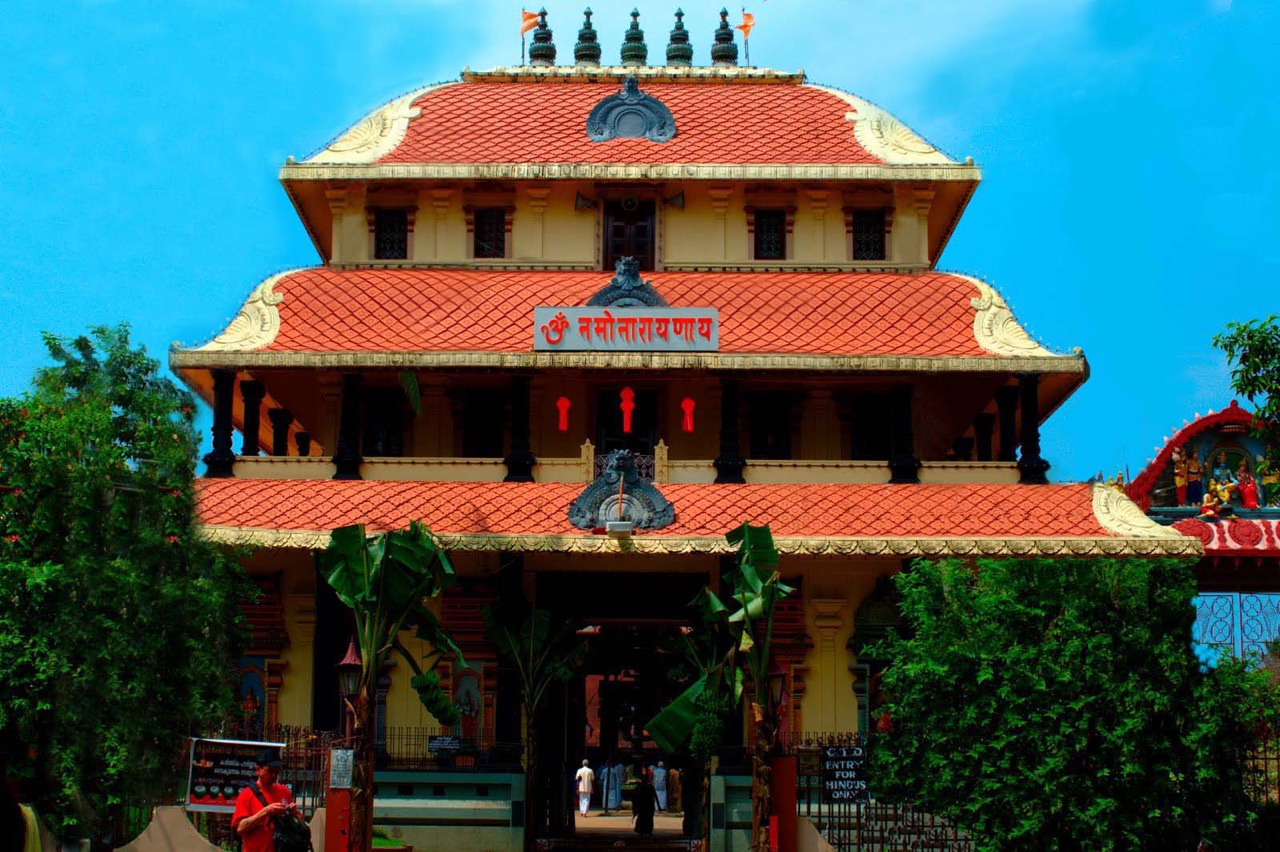
A historic Gowda Saraswat Brahmin temple in Cherlai, Mattancherry, central to Kochi’s Konkani community.
850 m · straight line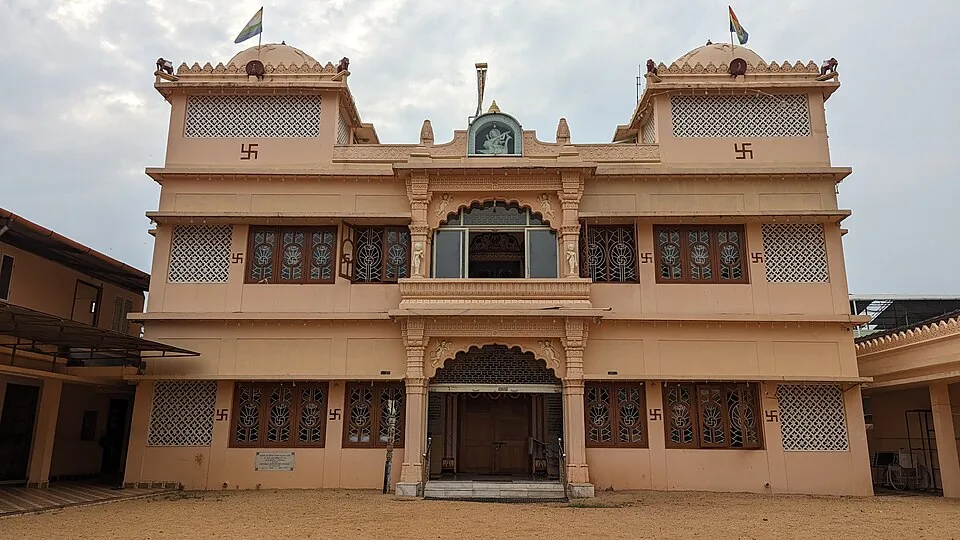
An ornate Jain temple in Mattancherry’s Gujarati quarter, raised in 1904 by Hirubai in memory of her husband Jivraj Dhanji and dedicated to Dharmanatha, the fifteenth Tirthankara — known for its white marble work and the daily midday feeding of the pigeons outside.
1.6 km · straight line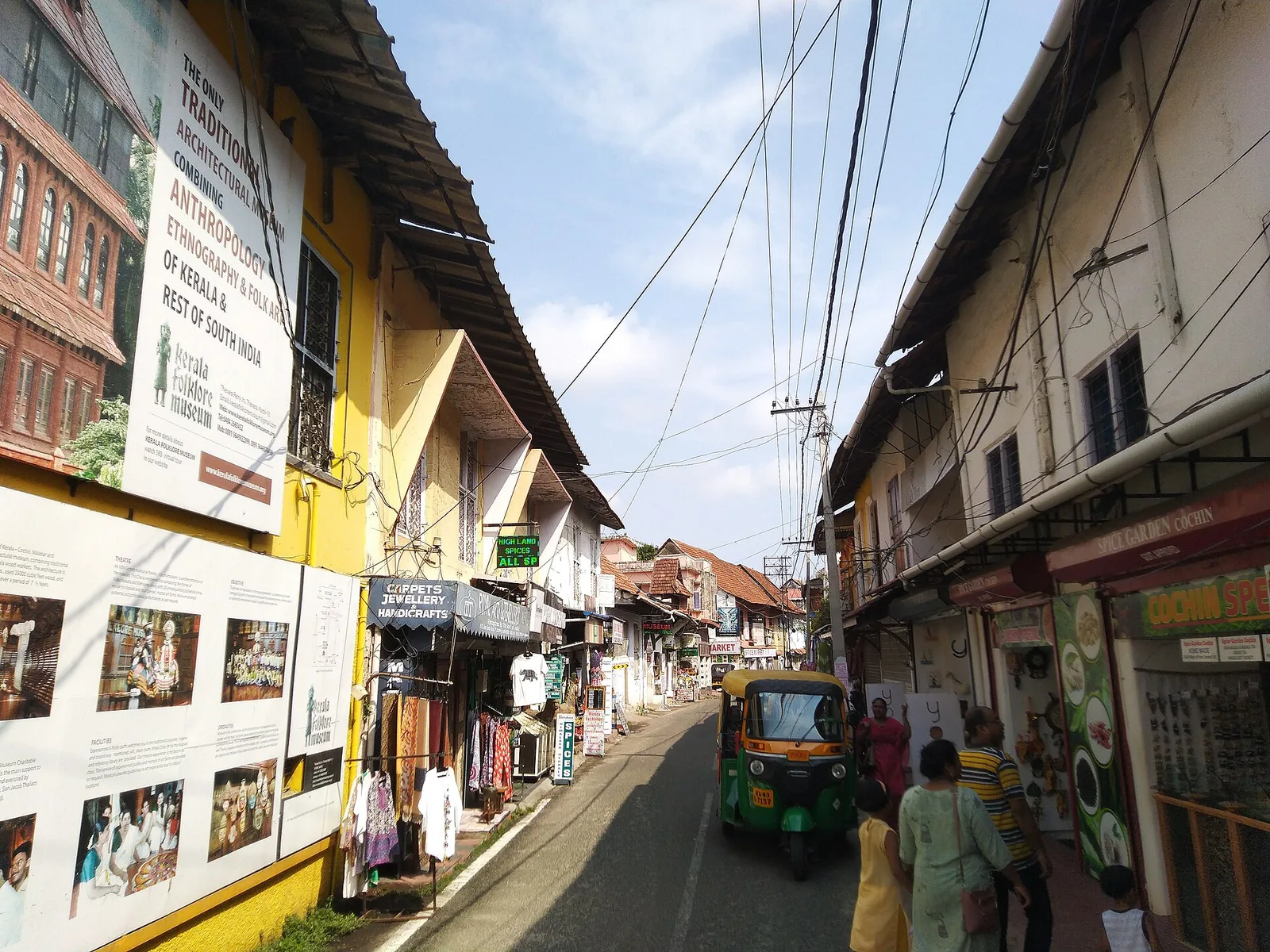
Spice warehouses, antiques, Mattancherry Palace and Paradesi Synagogue.
1.8 km · straight line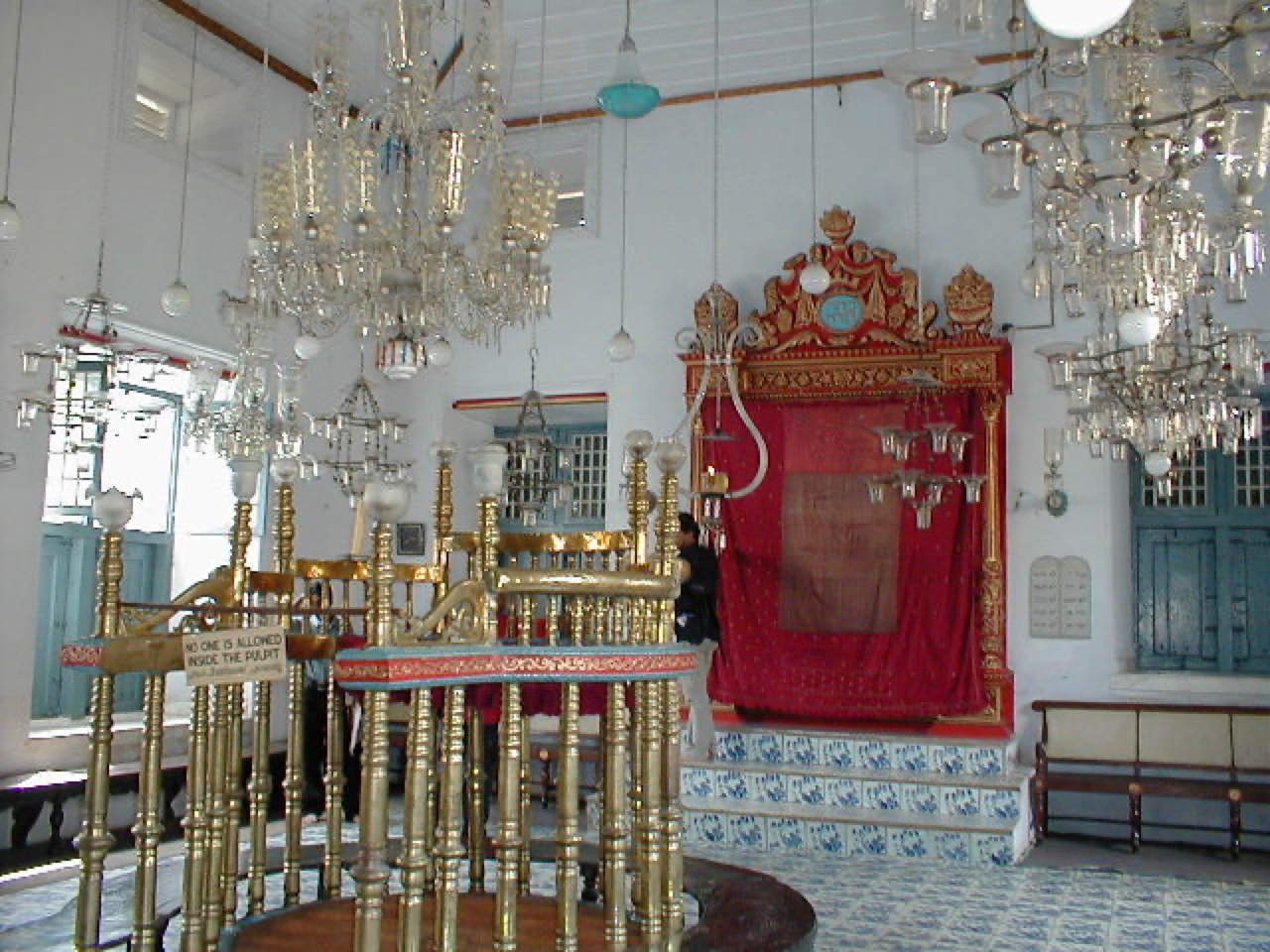
The oldest active synagogue in the Commonwealth (1568), in Jew Town, Mattancherry, with hand-painted Chinese floor tiles.
1.8 km · straight lineMuseum of Kerala’s Indo-Portuguese Catholic heritage in the Bishop’s House garden, Fort Kochi.
1.8 km · 22 min walkEvening Kathakali and Kerala classical-art performances in Fort Kochi, with make-up shown before the show.
1.9 km · 23 min walkOne of the finest churches in Kerala, with a richly painted interior, beside the Kerala Kathakali Centre in Fort Kochi.
2.0 km · 25 min walkPublic seafront beside the Chinese fishing nets — a walking-and-sunset beach, not a swimming beach.
2.1 km · 3 min driveA restored 17th-century Dutch bungalow on the Fort Kochi parade ground, now a contemporary art gallery and cafe.
2.1 km · 26 min walkThe 1724 burial ground of Kochi’s Dutch colonial officials and merchants, beside St Francis Church — ASI-protected, and usually locked.
2.2 km · 27 min walkKerala’s most walkable heritage quarter, with Chinese fishing nets, colonial churches, art cafes and Mattancherry nearby.
2.3 km · 27 min walkBelieved to be the oldest European church in India (1503); Vasco da Gama was buried here before his remains were moved to Lisbon.
2.4 km · 28 min walkRoad and walking figures are route estimates, with travel times dependent on access, traffic and conditions. Figures marked “straight line” show direct separation and do not describe a road or walking route. Fare estimates use Kerala’s 26 April 2022 auto/taxi notification and exclude waiting, night and applicable one-way surcharges. Confirm the current meter or operator quote before travelling. Routing: © openrouteservice.org by HeiGIT | Map data © OpenStreetMap contributors
Nearby toilets, pharmacies, ATMs, seating and vets are community-mapped and may be incomplete or out of date. Map data © OpenStreetMap contributors | Walking times © openrouteservice.org by HeiGIT
No ticket. This is a working community laundry, not an attraction. The custom is to give a small tip to whoever shows you round — and give it to that person, not to whoever meets you at the gate.
Mid-morning. These are working hours, not visiting hours: the washing is done early and the middle of the morning is when the place is busiest. Arrive late and you will see full lines and nobody working.
The building certainly was not — the present structure was built by the Greater Cochin Development Authority in 1976. As for the community, three different origin accounts circulate: Portuguese-Dutch military laundry, British colonial officers, and the King of Kochi in the 1720s. The sources do not agree and we have not found one that settles it.
Because the Vannan community that runs the Dhobi Khana came from what is now Tamil Nadu and has kept its language across generations inside a Malayalam-speaking city. It was formally organised here in the 1920s under the Madras Presidency.
The open playing field beside the laundry. It is about ten acres the Vannan community gave up under a city improvement scheme — and the 1976 Dhobi Khana building was put up as compensation for that land. The two are directly connected.
Ask first, every time, and accept a refusal. People are working and living here. The washing pens, the drying lines and the coal-heated irons are the subjects worth asking for, and most people are happy to be asked — the objection is to being photographed without being asked.
Around forty were reported to be using the khana in recent coverage. The number has been falling: domestic washing machines and hotel laundries have steadily taken the trade, and the Indian press has covered the khana's uncertain future repeatedly over recent years.
It did, and they were doing a different job. Castes including the Veluthedathu Nair — the name carries the sense of whitening or purifying — and, in other communities, the Mannan and the Velan, held a ritual office: supplying mattu, the freshly washed cloth a household needed at the exact moment a period of pollution ended. That is hereditary work tied to particular families, and it does not scale into bulk commercial laundry for a garrison, a port and later a city full of hotels. The Tamil-speaking Vannan trade grew up alongside the ritual one rather than replacing it.
A washed cloth handed over to mark the end of ritual pollution, worn to bathe in and returned straight afterwards. Colonial-era ethnography records the timings precisely: the fourth morning for a woman after her period began; the fifth, ninth, eleventh and sixteenth days after childbirth; the sixteenth day for a family under death pollution. The washerman's importance was not that he got cloth clean but that only he could supply the object that made the rite valid.
The core of it is — soaking, beating on stone, boiling in coppers, wringing, and drying on lines in the sun — and the ironing is done with heavy coal-heated irons. But a laundry running hotel and hospital contracts is not entirely pre-industrial, and you will see mechanical help where the volume demands it. What has not been mechanised is the judgement about what a given fabric and a given stain will take, which is the skill actually being sold.
Twenty to thirty minutes. It is a compact site and the interest is in watching the work, not in covering ground.
November to February and early mornings are best for walking; avoid midday heat where possible.
Entry: There is no ticket. This is a working community laundry, and the customary courtesy is a small tip to whoever shows you round — agree nothing in advance and give what the time was worth. Timings: Working hours, not visiting hours: the washing is done early, and the middle of the morning is when the place is busiest and most worth seeing. There is no published timetable and no closing time posted.
Base yourself in Fort Kochi or a nearby town in Ernakulam, then confirm the last-mile route locally before leaving. Walkable heritage areas are best done slowly; combine nearby streets, museums, markets and food stops. If the visit depends on forest, temple, boat, ferry, weather or seasonal access, check the official/local rule on the day before travel.
1 to 3 hours.
Nearby you can pair Cochin Thirumala Devaswom (850 m, approximate straight-line separation), Dharmanath Jain Temple (1.6 km, approximate straight-line separation), Mattancherry & Jew Town (1.8 km, approximate straight-line separation), Mattancherry Paradesi Synagogue (1.8 km, approximate straight-line separation).
Watch traffic on narrow heritage streets. Keep valuables close in crowded markets.
Written about Dhobi Khana itself — its history, its legends and the arguments about them.
These guides explore Fort Kochi and the surrounding area. Choose a visit that fits your interests, allowing separately for travel between stops.

Written about Fort Kochi as a whole rather than about Dhobi Khana — its history, its streets, and how to spend a day in it.
Route-level itineraries and practical guides for the rest of Kerala.
Photographs: Rainer Halama (CC BY-SA 4.0). Wikimedia Commons.